What Are Full Ride Scholarships? 2026 Complete Guide
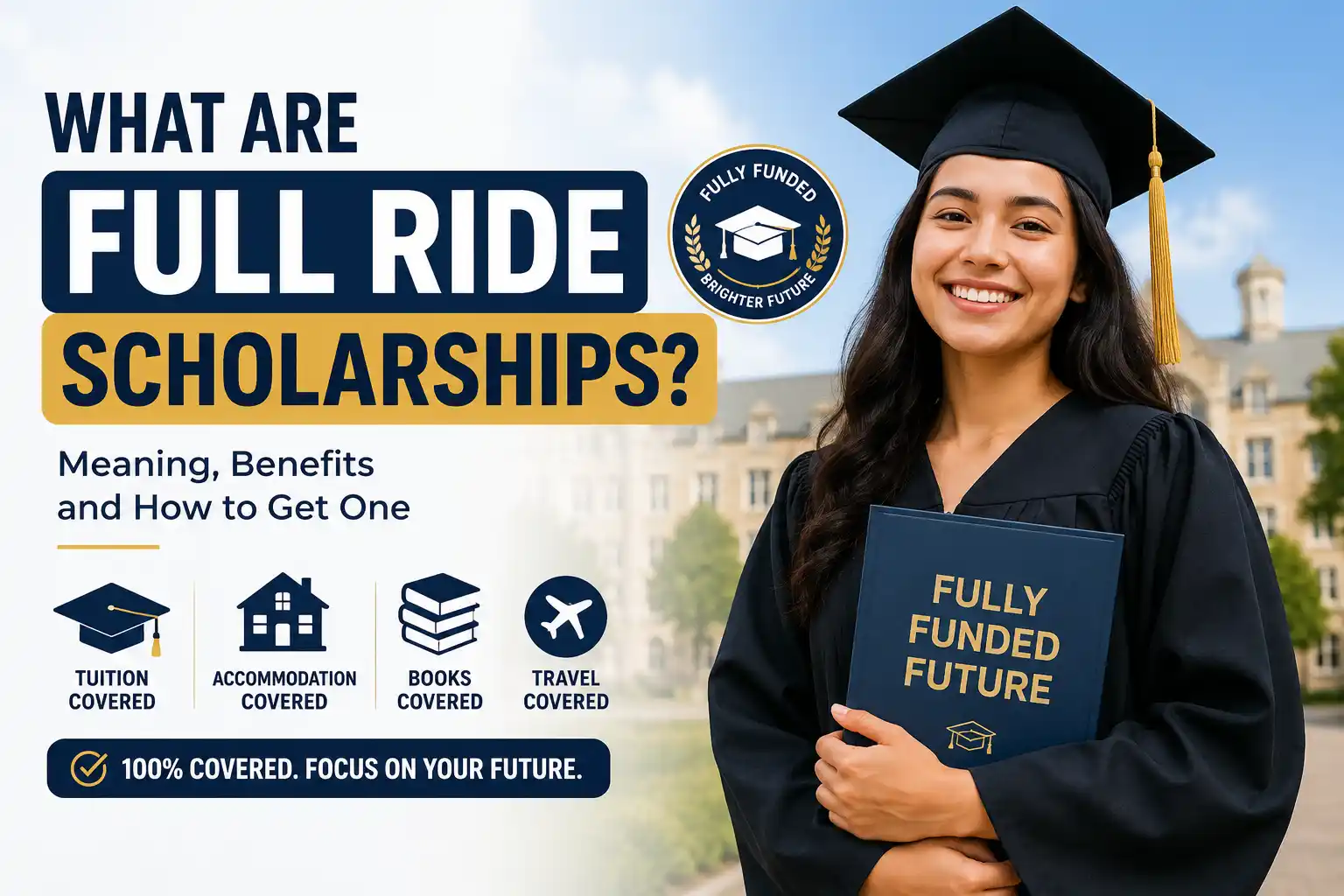
A full ride scholarship is the holy grail of financial aid , it covers every major cost of attending college, from tuition and fees to room, board, and books, often including a living stipend. But what exactly qualifies as a full ride? How do you find them, and what does it take to win one? This 2026 guide, written by an education finance expert, demystifies full ride scholarships, breaks down the different types, and gives you a proven roadmap to secure one for yourself.
Your full ride scholarship roadmap
What is a full ride scholarship?
A full ride scholarship (or full-ride) is a financial aid package that covers the entire cost of attendance for a student at a college or university. This typically includes tuition, mandatory fees, room and board (housing and meals), textbooks, supplies, and sometimes even personal expenses and travel.
Unlike a "full tuition" scholarship (which only covers academic charges), a full ride is designed to eliminate the financial burden entirely, allowing the student to focus on their studies without worrying about costs. Full rides are highly competitive and are often awarded based on exceptional merit, financial need, a combination of both, or specific talents (e.g., athletics, arts).
What does a full ride cover?
Full ride packages vary by scholarship, but they generally include the following components:
Types of full ride scholarships
Full ride scholarships come in several flavors. Understanding the different types will help you target the ones that match your profile.
| Type | Basis | Examples |
|---|---|---|
| Merit-based | Academic excellence, leadership, extracurriculars, awards | Gates Scholarship, Robertson Scholars, University merit full rides |
| Need-based | Demonstrated financial need (based on FAFSA/CSS Profile) | QuestBridge National College Match, some Ivy League need‑blind full rides |
| Athletic | Exceptional athletic ability (NCAA Division I, II) | Full athletic scholarships (football, basketball, etc.) |
| Institutional | Offered by specific universities to attract top students | Emory Scholars Program, USC Trustee Scholarship |
| External / National | National competitions or foundations | Rhodes, Fulbright, Marshall, Goldwater (for STEM) |
| Corporate / Employer | Through employers or corporate foundations | McDonald's HACER, Coca‑Cola Scholars, Google Scholarship |
Top full ride programs to know
Here are some of the most prestigious and generous full ride scholarships available:
Who is eligible?
Eligibility varies widely, but here are common requirements across most full ride programs:
- Academic excellence: High GPA, rigorous course load, strong standardized test scores (if required).
- Leadership & extracurriculars: Demonstrated initiative, community service, and impact.
- Financial need: For need‑based scholarships, you'll need to submit FAFSA/CSS Profile.
- Personal characteristics: Resilience, unique perspective, or overcoming adversity.
- Citizenship / residency: Some are open to international students (e.g., Fulbright, Rhodes), others are U.S.-only.
- Field of study: Some target specific fields (STEM, public service, arts).
The Gates Scholarship: U.S. citizens/permanent residents, African‑American, Hispanic, Asian/Pacific Islander, or Native American, Pell‑eligible, and with outstanding academic and leadership credentials.
Rhodes Scholarship: Open to citizens of Commonwealth and selected countries, under 26, completed undergraduate degree.
How to find full ride scholarships
Finding full ride scholarships requires a strategic search. Here are the best channels:
- University financial aid offices: Many universities have institutional full rides (e.g., "Stamps Scholars," "Presidential Scholars").
- Scholarship databases: Use platforms like CoursMooc, Fastweb, Scholarships.com, and College Board's BigFuture.
- National competitions: Rhodes, Fulbright, Gates, and other national awards.
- Local & community foundations: Often less competitive and can cover full costs when combined.
- Employer & corporate scholarships: Check if your parent's employer offers scholarships.
- Professional associations: For specific fields (e.g., IEEE, AMA, etc.).
The application process
Full ride scholarships are highly selective, so the application process is rigorous. Here's what to expect:
- Application form: Personal details, academic history, activities.
- Essays / personal statements: Typically 1‑3 essays, including a personal statement, a "why this scholarship" essay, and sometimes a leadership or community impact essay.
- Recommendation letters: Usually 2‑3 from teachers, counselors, or mentors.
- Transcripts: Official high school or college transcripts.
- Test scores: SAT/ACT (if required; many are now test‑optional).
- Interview: Many full ride programs require a panel interview (in‑person or virtual).
- Additional materials: Some may require portfolios, research papers, or proof of financial need.
Winning strategies
Here are the secrets that successful applicants use to stand out:
Do
- Start researching and preparing 12‑18 months before enrollment.
- Build a strong profile: take challenging courses, lead initiatives, volunteer consistently.
- Write essays that are personal, specific, and reflect deep self‑awareness.
- Request recommendation letters from people who know you well.
- Practice for interviews with mock panels.
- Show, don't tell , use concrete examples to demonstrate your impact.
- Tailor each application to the specific scholarship.
Don't
- Wait until the last minute to start.
- Send generic essays that could apply to any scholarship.
- Ignore the scholarship's mission and values.
- Forget to proofread , errors signal carelessness.
- Overlook small local scholarships , they can add up to a full ride.
- Give up after one rejection , many recipients apply multiple times.
Common myths debunked
Myth
"Only straight‑A students get full rides."
Fact
Many full rides consider holistic factors: leadership, community impact, unique backgrounds, and resilience. A 3.5 GPA with extraordinary achievements can win over a 4.0 with no engagement.
Myth
"Full rides are only for U.S. citizens."
Fact
Many prestigious scholarships (Fulbright, Rhodes, Gates Cambridge, DAAD) are open to international students. Also, many U.S. universities offer need‑based aid to internationals.
Myth
"You have to be a genius to win."
Fact
Committees look for well‑rounded individuals with passion, drive, and potential. Hard work, initiative, and a clear vision often matter more than raw IQ.
Myth
"Applying to more than 5 scholarships is a waste of time."
Fact
Many full ride winners apply to 10–20 scholarships. The more you apply, the higher your chances. Just be strategic and reuse tailored essays.
Your action plan
Ready to pursue a full ride scholarship? Follow this 6‑month action plan: