Advanced Operating Systems
Course Description
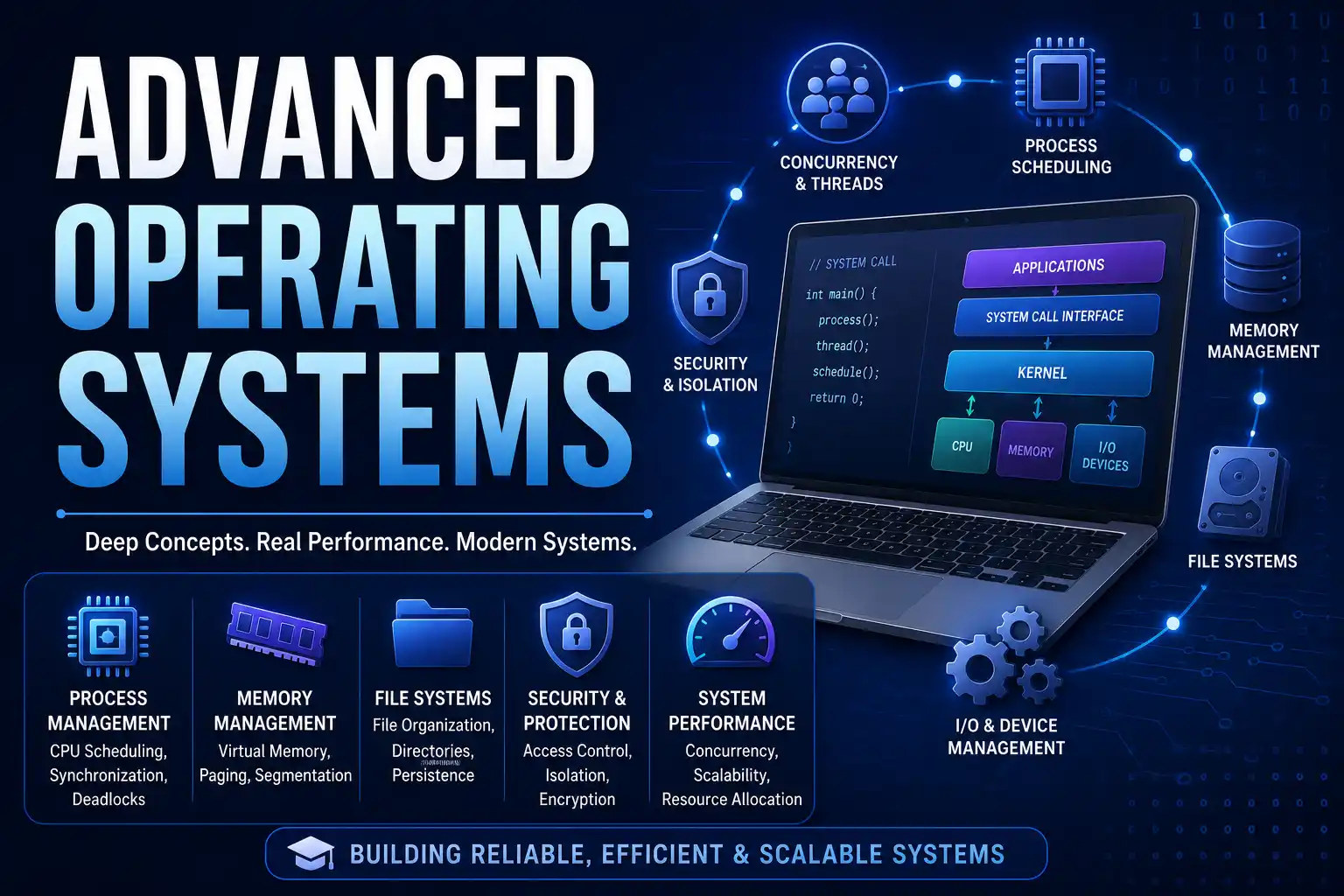
Operating systems are the hidden engine that powers every computer, server, and smartphone. Understanding how they work at an advanced level separates good systems programmers from great ones. This course, from Udacity's school of engineering, dives deep into the core principles that make modern operating systems powerful, efficient, and reliable.
You'll explore the guts of OS design: how memory is managed (from physical to virtual), how concurrency and parallelism work without crashing your system, how file systems and I/O are structured for performance, and how virtualization is changing modern computing. The course is taught by industry veterans from companies like Google, Amazon, and Microsoft, who bring real-world case studies and battle-tested insights.
This free, self-paced course is designed for experienced programmers who want to master systems-level development. You should be comfortable with C or C++ and have a basic understanding of how operating systems work at an introductory level. The course runs about 4 months with 5-10 hours of effort per week, and includes video lectures, quizzes, hands-on coding projects, and a final exam. Upon completion, you'll earn a certificate you can share on LinkedIn.
Course Provider
Provider: Udacity, a leading online education platform known for its "Nanodegree" programs and high-quality technical courses developed with industry partners like Google, AT&T, and NVIDIA.
Platform: Udacity's interactive learning platform – fully online, with video lectures, in-video quizzes, project reviews (in paid tracks), and discussion forums.
Accreditation: While not a university credit course, Udacity's certificates are widely recognized in the tech industry as proof of advanced, practical skills. Many learners use this course to prepare for systems engineering roles or to deepen their knowledge for work.
Course Syllabus (Core Topics)
Learning Objectives
- Design and implement efficient memory management strategies.
- Write correct and efficient concurrent code using synchronization primitives.
- Understand and tune file system performance for different workloads.
- Compare and contrast virtualization approaches (hypervisors vs containers).
- Analyze OS behavior using performance tools and observability techniques.
- Build reliable, efficient, and scalable systems from the ground up.
- Prepare for technical interviews in systems programming and infrastructure roles.
Course Prerequisites
Programming: Strong proficiency in C or C++ (pointers, dynamic memory allocation, structs/classes). You'll be writing code that manipulates memory and handles concurrency.
Systems knowledge: An introductory operating systems course or equivalent experience. You should know what a process, thread, system call, and virtual memory are at a basic level.
Tools: Comfort with the Unix command line (bash, basic commands, gcc/g++, make, gdb). You'll be compiling and debugging code on Linux or macOS.
English fluency: You need to read and understand advanced technical English, as all materials are in English.
User Reviews
"I have got a deep understanding of OS internals that I can directly apply in my work as a systems engineer. The unit on memory management alone was worth the time. The instructors are from the industry, so you learn practical 'why' and 'how', not just textbook theory."
"Engaging content, active instructor, and challenging projects. This is not a beginner course; you will need to work hard. But if you want to truly understand how your programs interact with the kernel, this is one of the best free resources available."
"Excellent course. The concurrency module is particularly strong. The only downside is that some of the code examples are a bit dated, but the concepts are timeless. A must-take for anyone aiming for a career in systems programming, cloud infrastructure, or database internals."
Based on 65+ ratings on Udacity.
💡 Final Thoughts
Advanced Operating Systems is a challenging but immensely rewarding course. It's not for beginners. But if you're a developer who wants to understand what really happens when your code runs, if you aim to work on databases, game engines, cloud infrastructure, or embedded systems, this knowledge is essential. Udacity's industry-led approach keeps things practical. You'll learn why your multithreaded application crashes, how to debug memory leaks, and how to think about performance at the system level. The certificate is a nice bonus, but the real value is the deep, lasting understanding you'll gain. Highly recommended for serious systems programmers.
Advanced Operating Systems (Udacity) – FAQ
Is this course really free?
Yes, Udacity offers this course for free. You can access all video lectures, quizzes, and readings without paying. A certificate is also free upon completion. Some projects may require a paid Nanodegree for mentorship, but the core content is free.
What programming language is used?
The course heavily uses C and C++. You'll be writing code that interacts directly with OS abstractions (threads, memory mapping, file I/O). You should be comfortable with pointers and manual memory management.
Is this course suitable for a beginner in OS?
No. This is an advanced course. You need to have taken an introductory operating systems course first (where you learned about processes, scheduling, basic virtual memory). This course goes much deeper into implementation and performance.
How much time does it require per week?
The estimate is 5-10 hours per week over about 4 months. However, if you're already comfortable with C and concurrency, you might move faster. The projects can be time-consuming, so plan accordingly.
Will I get a certificate?
Yes, upon completing all quizzes and the final exam (and any required projects), Udacity provides a free certificate of completion. You can share it on LinkedIn or add it to your resume.
How does this course compare to a university OS class?
It's comparable to a senior-level undergraduate or first-year graduate course in operating systems. The focus is more on practical understanding and real-world trade-offs than on proving theoretical algorithms. Many learners use it to supplement or even replace a traditional textbook-based course.