Fundamentals of Electrical Engineering and Electronic Design
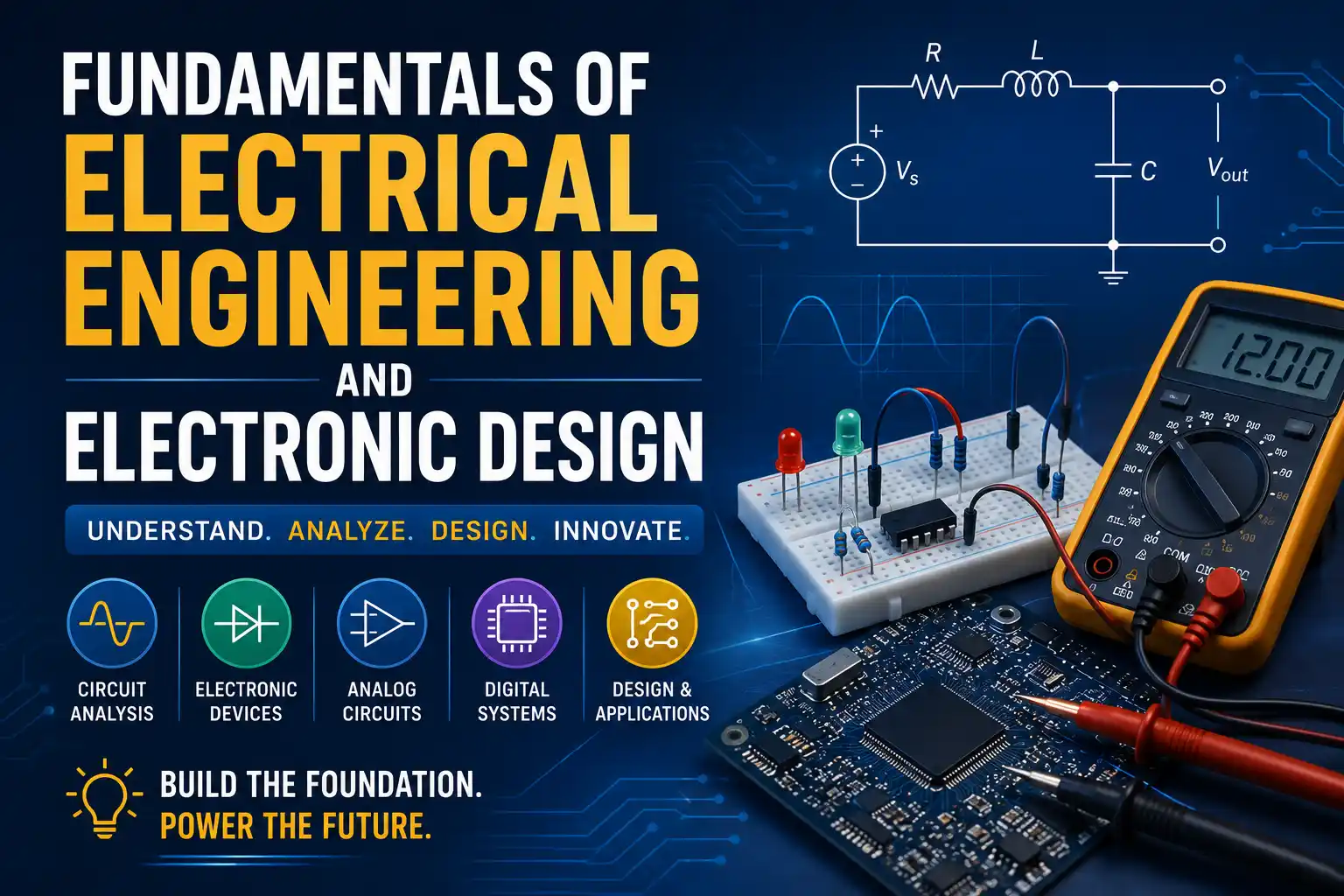
Course Description
Electricity and electronics are the invisible backbone of our modern world. From smartphones to electric cars, from medical devices to power grids, understanding electrical engineering basics opens doors to countless careers. This course from XuetangX gives you a solid, practical foundation in electrical engineering and electronic design.
You'll learn the core principles: how to analyze circuits, how electronic devices work, how to design digital systems, and how to build practical electronic projects. The course balances theory with real-world examples, helping you understand not just the math, but the "why" behind it. No prior engineering experience is required, though basic algebra is helpful.
This free, self-paced course includes video lectures, interactive circuit simulations, quizzes, and hands-on design exercises. You'll learn from experienced faculty and connect with a global community of learners. Upon completion, you'll earn a certificate that you can share on LinkedIn or add to your resume.
Course Provider
Provider: XuetangX, a leading Chinese MOOC platform founded by Tsinghua University, one of the world's top engineering schools. The course content is developed by Tsinghua faculty and industry experts.
Platform: XuetangX online learning platform – fully online, self-paced, with a user-friendly interface available in English.
Accreditation: This is a university-level course. Upon successful completion (passing the final exam), you receive a verified certificate from XuetangX, recognized by employers and academic institutions worldwide.
Course Syllabus (8 Modules)
Learning Objectives
- Understand basic electrical concepts (voltage, current, resistance, power).
- Analyze DC and AC circuits using fundamental laws and theorems.
- Explain the operation of diodes, transistors, and operational amplifiers.
- Design and analyze simple analog and digital circuits.
- Use logic gates and flip-flops to build combinational and sequential logic.
- Read electronic datasheets and prototype circuits on breadboards.
- Understand the basics of PCB design and microcontroller integration.
- Complete a practical electronic design project.
- Earn a certificate from a top engineering university.
Course Prerequisites
Math: Basic algebra (solving equations, understanding functions). No calculus required for the core material, though some AC analysis may reference basic trigonometry.
Physics: Basic understanding of electricity (from high school physics) is helpful but not strictly required.
Technical: No special software required initially. Later modules may use free circuit simulators (like Falstad or LTspice) and basic PCB design tools (like EasyEDA or KiCad). All are free and open source.
Language: The course is taught in English with optional Chinese subtitles. You should be comfortable with technical English at the university level.
User Reviews
"I'm a software developer who always wanted to understand hardware. This course was perfect. The circuit analysis modules were clear, and the op-amp section finally made sense. I especially appreciated the hands-on project at the end. Now I can read schematics and even built my own Arduino shield. Highly recommend."
"Excellent foundation. The professors explain concepts step by step, and the simulations help visualize abstract ideas. The digital electronics module is a bit rushed, but it covers the essentials. The certificate from XuetangX is well-respected in China and internationally. A great value for free."
"I took this course to prepare for a master's in robotics. It gave me exactly the foundation I needed. The weekly quizzes kept me honest, and the final project (a temperature-controlled fan) was challenging but rewarding. The discussion forums were active and helpful. A top-tier free course."
Based on 320+ ratings on XuetangX.
💡 Final Thoughts
Electrical engineering can seem intimidating, but this course breaks it down into digestible, logical pieces. You'll start with Ohm's Law and end up designing your own circuits. The mix of theory, simulation, and hands-on project is excellent. Whether you're a student considering EE as a major, a maker who wants to go beyond Arduino tutorials, or a professional in a related field (like software or mechanical engineering), this course will give you a solid grounding. And the fact that it's free, with a certificate from a top-tier institution like Tsinghua University via XuetangX, makes it an absolute no-brainer. Power up your career with this foundational EE course.
Fundamentals of Electrical Engineering and Electronic Design – FAQ
Is this course really free?
Yes, completely free. XuetangX offers this course at no cost. You just need to create a free account on the platform. No payment or credit card required.
Do I need any prior engineering experience?
No. This is an introductory course. If you've taken high school physics (basic electricity) and algebra, you'll be fine. The course starts from first principles.
How much math is involved?
Basic algebra is essential (solving equations, manipulating formulas). The AC analysis modules use simple trigonometry (sine waves) but no calculus. You'll be fine if you're comfortable with high school math.
Will I get a certificate?
Yes, upon completing all modules and passing the final exam, you'll receive a verified certificate from XuetangX. You can share it on LinkedIn or add it to your resume.
Do I need to buy any hardware or software?
No. The course uses free online circuit simulators and design tools. The optional hands-on project can be done virtually. If you want to build physical circuits, you can buy a basic kit (arduino, breadboard, components) for under $50, but it's not required.
What's the difference between this and a typical university EE course?
This course covers the core topics of a first-year EE course (circuits, devices, digital logic) but in a compressed, self-paced format. It's less math-intensive than some university courses (less calculus) but very practical and project-oriented.