CCNA 1 v7.0 Final Exam Answers – Introduction to Networks
CCNA 1 – Introduction to Networks (Version 7.00) – ITNv7 Course Final Exam. This comprehensive study guide covers the entire ITNv7 curriculum with 60+ questions, detailed explanations, and verified answers. The exam consists of 60 questions, requiring 70% to pass, with 1 hour 15 minutes per attempt.
1. Which two traffic types use the Real-Time Transport Protocol (RTP)? (Choose two.)
Explanation: Topic 14.3.4 – RTP is designed for real-time data delivery such as interactive audio and video, prioritizing rapid flow over absolute reliability.
2. Which wireless technology has low-power and data rate requirements making it popular in home automation applications?
Explanation: Topic 4.6.2 – ZigBee is an IEEE 802.15.4 standard with low power and data rate, ideal for home automation devices.
3. Which layer of the TCP/IP model provides a route to forward messages through an internetwork?
Explanation: Topic 3.5.3 – The internet layer of TCP/IP corresponds to the OSI network layer and handles addressing and routing messages through an internetwork.
4. Which type of server relies on record types such as A, NS, AAAA, and MX in order to provide services?
Explanation: Topic 15.4.2 – A DNS server stores records: A (IPv4 address), NS (name server), AAAA (IPv6 address), MX (mail exchange).
5. What are proprietary protocols?
Explanation: Topic 3.3.4 – Proprietary protocols have their definition and operation controlled by one company or vendor. Some of them can be used by different organizations with permission from the owner. The TCP/IP protocol suite is an open standard, not a proprietary protocol.
6. What service is provided by DNS?
Explanation: Topic 15.4.1 – DNS translates human-readable domain names into numeric IP addresses for network communication.
7. A client packet is received by a server. The packet has a destination port number of 110. What service is the client requesting?
Explanation: Topic 14.4.3 – Port 110 is reserved for POP3, used for retrieving email messages.
8. What command can be used on a Windows PC to see the IP configuration of that computer?
Explanation: Topic 17.5.1 – ipconfig displays the IP configuration on Windows PCs.
9. A wired laser printer is attached to a home computer. That printer has been shared so that other computers on the home network can also use the printer. What networking model is in use?
Explanation: Topic 1.2.2 – Peer-to-peer (P2P) networks have two or more network devices that can share resources such as printers or files without having a dedicated server.
10. What characteristic describes a virus?
Explanation: Topic 16.2.1 – A virus is malware that runs on an end device and propagates by inserting copies into other programs.
11. Three bank employees are using the corporate network. The first employee uses a web browser to view a company web page. The second accesses the corporate database for financial transactions. The third participates in an important live audio conference. If QoS is implemented, what will be the priorities from highest to lowest of the different data types?
Explanation: Topic 1.6.4 – QoS mechanisms enable the establishment of queue management strategies that enforce priorities for different categories of application data. Thus, this queuing enables voice data to have priority over transaction data, which has priority over web data.
12. Match the description to the IPv6 addressing component. (Not all options are used.)
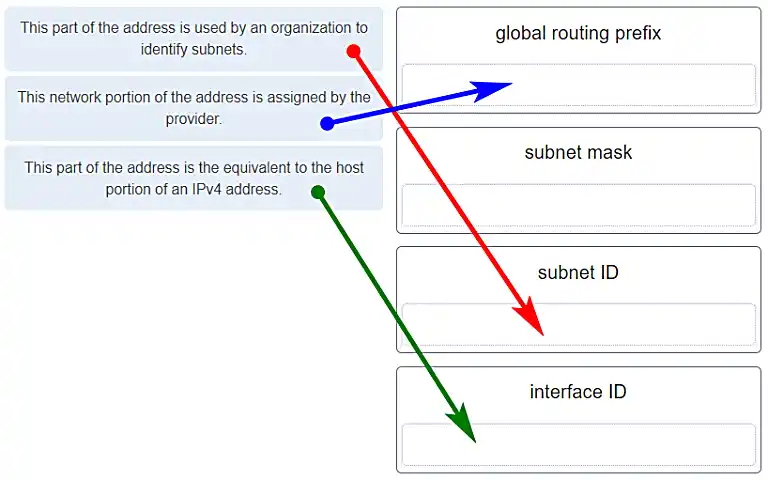
Explanation: Topic 12.3.6 - Place the options in the following order:
| Description | Component |
|---|---|
| This network portion of the address is assigned by the provider. | global routing |
| This part of the address is used by an organization to identify subnets. | subnet ID |
| This part of the address is the equivalent to the host portion of an IPv4 address. | interface ID |
13. Refer to the exhibit. If Host1 were to transfer a file to the server, what layers of the TCP/IP model would be used?
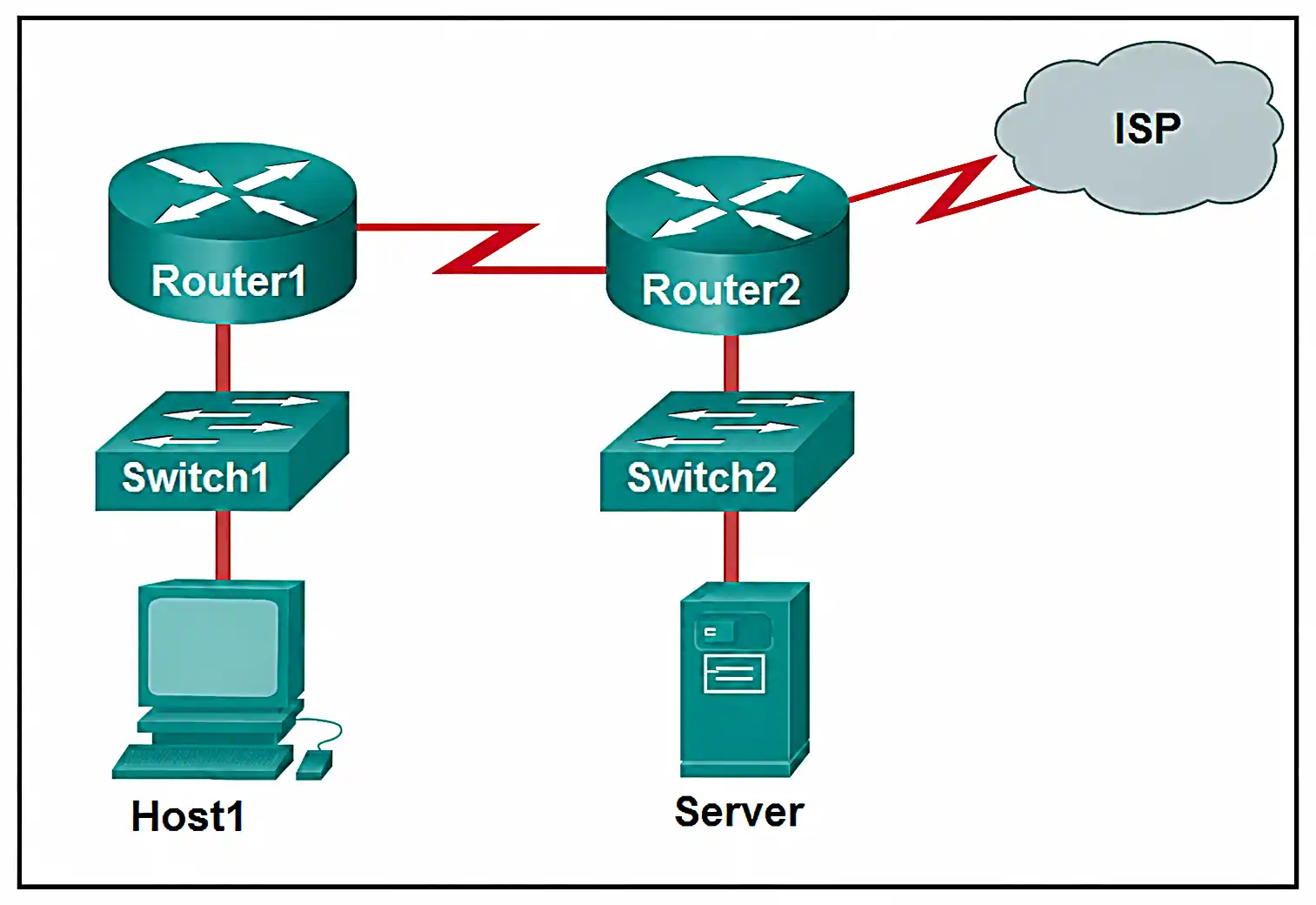
Explanation: Topic 3.5.3 – The TCP/IP model contains the application, transport, internet, and network access layers. A file transfer uses the FTP application layer protocol. The data would move from the application layer through all of the layers of the model and across the network to the file server.
14. Match the characteristic to the forwarding method. (Not all options are used.)
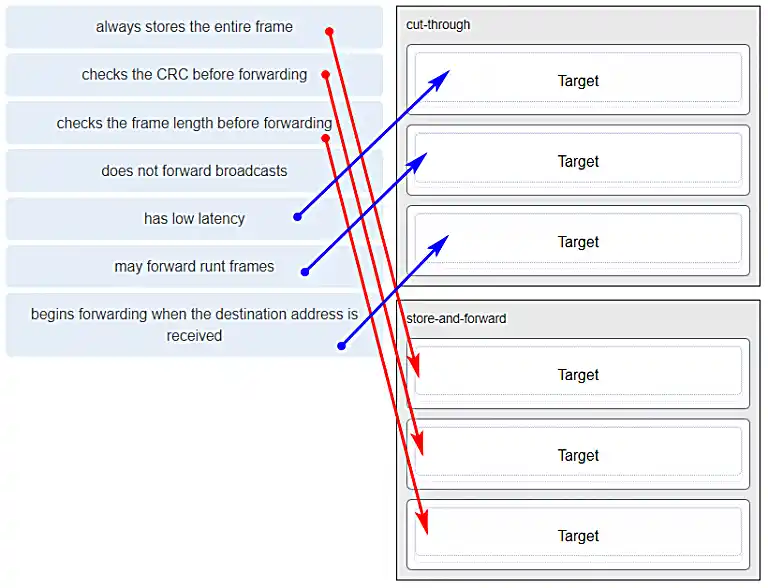
Explanation: Topic 7.4.1 - A store-and-forward switch always stores the entire frame before forwarding, and checks its CRC and frame length. A cut-through switch can forward frames before receiving the destination address field, thus presenting less latency than a store-and-forward switch. Because the frame can begin to be forwarded before it is completely received, the switch may transmit a corrupt or runt frame. All forwarding methods require a Layer 2 switch to forward broadcast frames.
| Cut-through | Store-and-forward |
|---|---|
| low latency | always stores the entire frame |
| may forward runt frames | checks the CRC before forwarding |
| begins forwarding when the destination address is received | checks the frame length before forwarding |
15. Refer to the exhibit. The IP address of which device interface should be used as the default gateway setting of host H1?
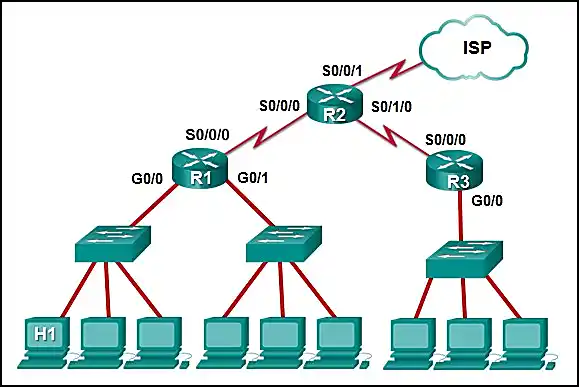
Explanation: Topic 10.3.1 – The default gateway for host H1 is the router interface that is attached to the LAN that H1 is a member of. In this case, that is the G0/0 interface of R1. H1 should be configured with the IP address of that interface in its addressing settings. R1 will provide routing services to packets from H1 that need to be forwarded to remote networks.
16. What service is provided by Internet Messenger?
Explanation: Topic 1.2.1 – Internet Messenger facilitates real-time communication between remote users.
17. Refer to the exhibit. Match the network with the correct IP address and prefix that will satisfy the usable host addressing requirements for each network.
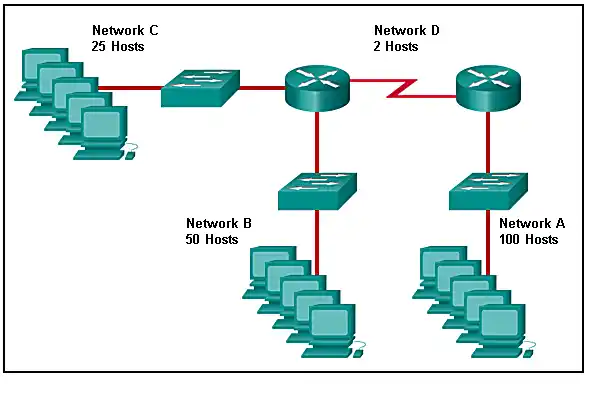
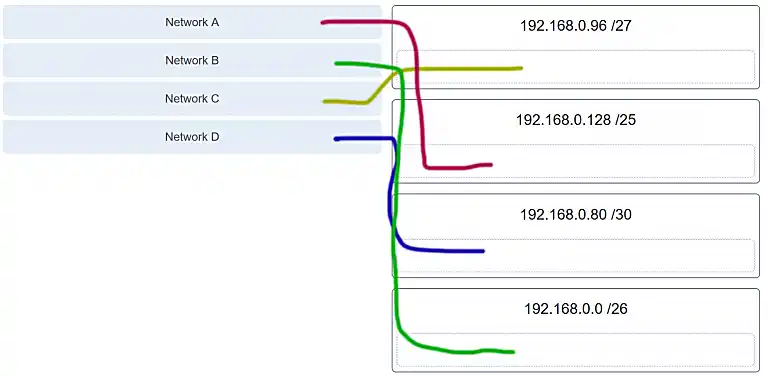
Explanation: Topic 11.7.2 - Network A needs to use 192.168.0.128 /25, which yields 128 host addresses. Network B needs to use 192.168.0.0 /26, which yields 64 host addresses. Network C needs to use 192.168.0.96 /27, which yields 32 host addresses. Network D needs to use 192.168.0.80/30, which yields 4 host addresses.
| Network | Address/Prefix |
|---|---|
| Network A | 192.168.0.128 /25 (128 hosts) |
| Network B | 192.168.0.0 /26 (64 hosts) |
| Network C | 192.168.0.96 /27 (32 hosts) |
| Network D | 192.168.0.80 /30 (4 hosts) |
18. Refer to the exhibit. Which protocol was responsible for building the table that is shown?
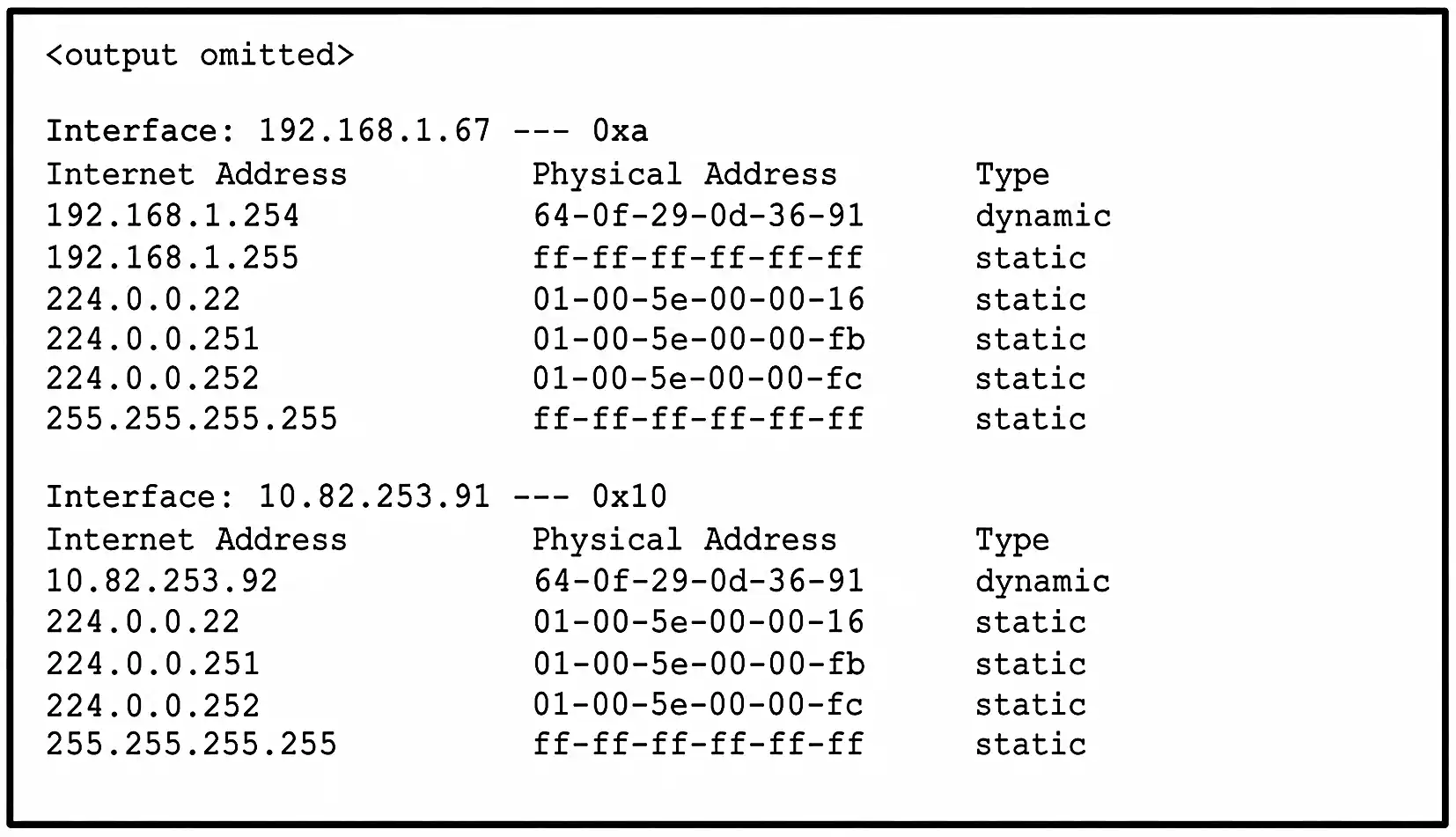
Explanation: Topic 9.2.7 – The output corresponds to arp -a, which displays the ARP table.
19. A network administrator notices that some newly installed Ethernet cabling is carrying corrupt and distorted data signals. The new cabling was installed close to fluorescent lights and electrical equipment. Which two factors may interfere with the copper cabling and result in signal distortion? (Choose two.)
Explanation: Topic 4.3.1 – EMI and RFI are external electromagnetic disruptions that corrupt data signals in copper cabling.
20. A host is trying to send a packet to a device on a remote LAN segment, but there are currently no mappings in its ARP cache. How will the device obtain a destination MAC address?
Explanation: Topic 9.2.5 – For a remote destination, the host sends an ARP request for the default gateway's MAC address.
22. A client packet is received by a server. The packet has a destination port number of 53. What service is the client requesting?
Explanation: Topic 14.4.3 – Port 53 is the well-known port for DNS name resolution services.
23. A network administrator is adding a new LAN to a branch office. The new LAN must support 25 connected devices. What is the smallest network mask that the network administrator can use for the new network?
Explanation: Topic 11.7.2 – A /27 mask (255.255.255.224) provides 30 usable host addresses (25–2), enough for 25 devices.
24. What characteristic describes a Trojan horse?
Explanation: Topic 16.2.1 – A Trojan horse is malware disguised as legitimate software, relying on user interaction to activate.
25. What service is provided by HTTPS?
Explanation: Topic 15.3.2 – HTTPS encrypts web content using SSL/TLS to ensure confidentiality and integrity.
26. A technician with a PC is using multiple applications while connected to the Internet. How is the PC able to keep track of the data flow between multiple application sessions and have each application receive the correct packet flows?
Explanation: Topic 14.4.1 – The source port number of an application is randomly generated and used to individually keep track of each session connecting out to the Internet. Each application will use a unique source port number to provide simultaneous communication from multiple applications through the Internet.
27. A network administrator is adding a new LAN to a branch office. The new LAN must support 61 connected devices. What is the smallest network mask that the network administrator can use for the new network?
Explanation: Topic 11.7.2 – A /26 mask (255.255.255.192) provides 62 usable host addresses (26–2), enough for 61 devices.
28. Refer to the exhibit. Match the network with the correct IP address and prefix that will satisfy the usable host addressing requirements for each network. (Not all options are used.)
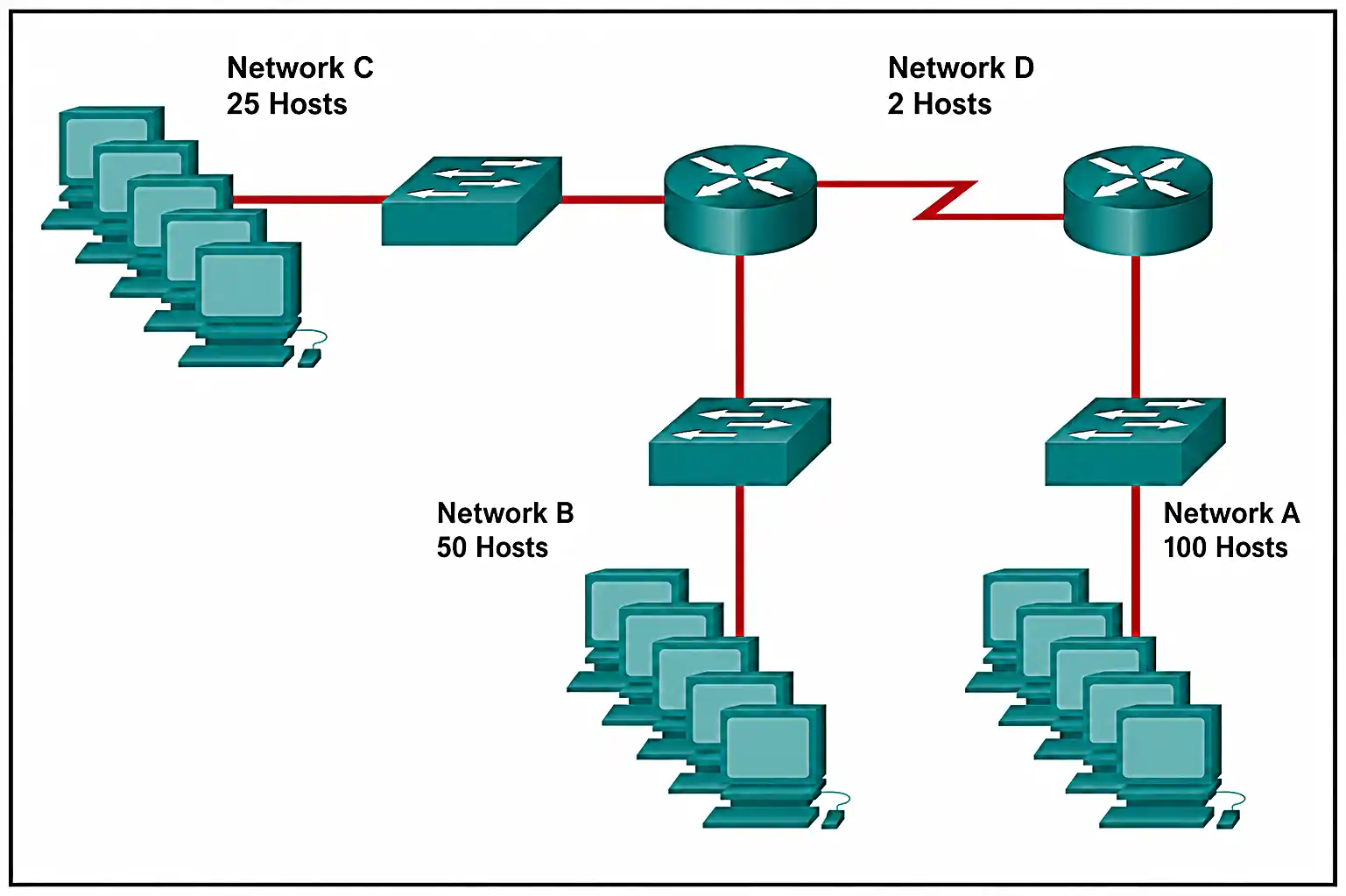
Explanation: Topic 11.7.2 - Network A needs to use 192.168.0.0 /25 which yields 128 host addresses. Network B needs to use 192.168.0.128 /26 which yields 64 host addresses. Network C needs to use 192.168.0.192 /27 which yields 32 host addresses. Network D needs to use 192.168.0.224 /30 which yields 4 host addresses.
| Network | Address/Prefix |
|---|---|
| Network A | 192.168.0.0 /25 |
| Network B | 192.168.0.128 /26 |
| Network C | 192.168.0.192 /27 |
| Network D | 192.168.0.224 /30 |
29. What characteristic describes a DoS attack?
Explanation: Topic 16.2.4 – A DoS attack is designed to slow or crash network services, disrupting availability.
30. Match the application protocols to the correct transport protocols.
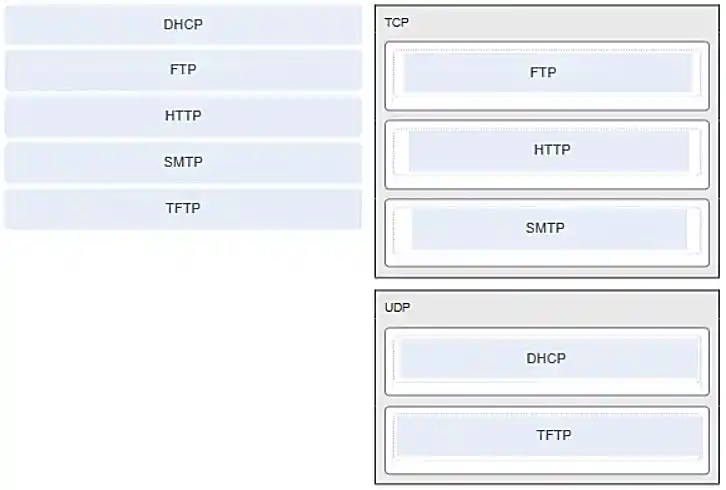
Explanation: Topic 14.4.3 – Match each application protocol to its corresponding transport protocol (TCP or UDP).
31. What service is provided by SMTP?
Explanation: Topic 15.3.4 – SMTP handles the outgoing delivery of email messages.
32. Which scenario describes a function provided by the transport layer?
Explanation: Topic 14.1.2 – The transport layer uses source and destination port numbers to identify the correct application and window.
33. Refer to the exhibit. Host B on subnet Teachers transmits a packet to host D on subnet Students. Which Layer 2 and Layer 3 addresses are contained in the PDUs that are transmitted from host B to the router?
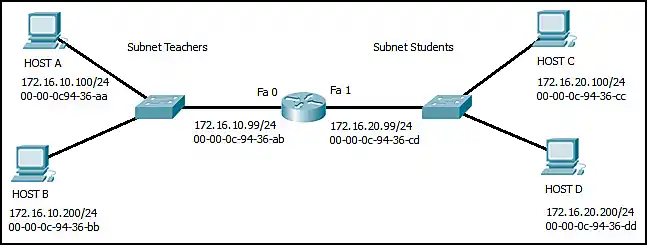
Explanation: Topic 9.1.2 – The source and destination MAC and IP addresses identify the correct application and window.
34. What does the term "attenuation" mean in data communication?
Explanation: Topic 4.3.1 – Data is transmitted on copper cables as electrical pulses. A detector in the network interface of a destination device must receive a signal that can be successfully decoded to match the signal sent. However, the farther the signal travels, the more it deteriorates. This is referred to as signal attenuation.
35. Refer to the exhibit. An administrator is trying to configure the switch but receives the error message that is displayed in the exhibit. What is the problem?

Explanation: Topic 2.2.4 – The administrator is in user EXEC mode (indicated by >), and must use enable to enter privileged EXEC mode before using configure terminal.
36. Which two protocols operate at the top layer of the TCP/IP protocol suite? (Choose two.)
Explanation: Topic 3.3.4 – DNS and POP operate at the application layer, the top layer of the TCP/IP model.
37. A company has a file server that shares a folder named Public. The network security policy specifies that the Public folder is assigned Read-Only rights to anyone who can log into the server while the Edit rights are assigned only to the network admin group. Which component is addressed in the AAA network service framework?
Explanation: Topic 16.3.4 – After a user is successfully authenticated (logged into the server), the authorization is the process of determining what network resources the user can access and what operations (such as read or edit) the user can perform.
38. What three requirements are defined by the protocols used in network communications to allow message transmission across a network? (Choose three.)
Explanation: Topic 3.1.5 – Protocols define message encoding, message size, and delivery options for successful transmission.
39. What are two characteristics of IP? (Choose two.)
Explanation: Topic 8.1.3 – The Internet Protocol (IP) is a connectionless, best effort protocol. This means that IP requires no end-to-end connection nor does it guarantee delivery of packets. IP is also media independent, which means it operates independently of the network media carrying the packets.
40. An employee of a large corporation remotely logs into the company using the appropriate username and password. The employee is attending an important video conference with a customer concerning a large sale. It is important for the video quality to be excellent during the meeting. The employee is unaware that after a successful login, the connection to the company ISP failed. The secondary connection, however, activated within seconds. The disruption was not noticed by the employee or other employees. What three network characteristics are described in this scenario? (Choose three.)
Explanation: Topic 1.6.1 – Usernames and passwords relate to network security. Good quality video, to support video conferencing, relates to prioritizing the video traffic with quality of service (QoS). The fact that a connection to an ISP failed and was then restored but went unnoticed by employees relates to the fault tolerant design of the network.
41. What are two common causes of signal degradation when using UTP cabling? (Choose two.)
Explanation: Topic 4.4.2 – Improper termination and low-quality cable/connectors cause physical layer degradation.
42. Which subnet would include the address 192.168.1.96 as a usable host address?
Explanation: Topic 11.5.2 – For the subnet of 192.168.1.64/26, there are 6 bits for host addresses, yielding 64 possible addresses. However, the first and last subnets are the network and broadcast addresses for this subnet. Therefore, the range of host addresses for this subnet is 192.168.1.65 to 192.168.1.126. The other subnets do not contain the address 192.168.1.96 as a valid host address.
43. Refer to the exhibit. On the basis of the output, which two statements about network connectivity are correct? (Choose two.)
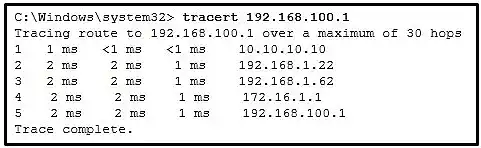
Explanation: Topic 17.4.3 – The output displays a successful Layer 3 connection between a host computer and a host at 19.168.100.1. It can be determined that 4 hops exist between them and the average transmission time is 1 milliseconds. Layer 3 connectivity does not necessarily mean that an application can run between the hosts.
44. Which two statements describe how to assess traffic flow patterns and network traffic types using a protocol analyzer? (Choose two.)
Explanation: Topic 17.3.2 – Traffic flow patterns should be gathered during peak utilization times to get a good representation of the different traffic types. The capture should also be performed on different network segments because some traffic will be local to a particular segment.
45. What is the consequence of configuring a router with the ipv6 unicast-routing global configuration command?
Explanation: Topic 12.5.1 – Enabling IPv6 unicast routing causes routers to send ICMPv6 Router Advertisement messages.
46. Which three layers of the OSI model map to the application layer of the TCP/IP model? (Choose three.)
Explanation: Topic 15.1.1 – The TCP/IP model consists of four layers: application, transport, internet, and network access. The OSI model consists of seven layers: application, presentation, session, transport, network, data link, and physical. The top three layers of the OSI model: application, presentation, and session map to the application layer of the TCP/IP model.
47. Refer to the exhibit. If PC1 is sending a packet to PC2 and routing has been configured between the two routers, what will R1 do with the Ethernet frame header attached by PC1?
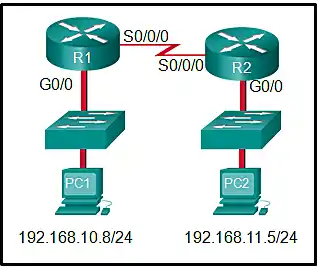
Explanation: Topic 6.1.3 – When PC1 forms the various headers attached to the data one of those headers is the Layer 2 header. Because PC1 connects to an Ethernet network, an Ethernet header is used. The source MAC address will be the MAC address of PC1 and the destination MAC address will be that of G0/0 on R1. When R1 gets that information, the router removes the Layer 2 header and creates a new one for the type of network the data will be placed onto (the serial link).
48. What will happen if the default gateway address is incorrectly configured on a host?
Explanation: Topic 17.7.4 – An incorrect default gateway prevents communication with hosts on other networks.
49. What are two features of ARP? (Choose two.)
Explanation: Topic 9.2.2 – ARP broadcasts requests and hosts with the matching IP address reply with their MAC address.
50. A network administrator is adding a new LAN to a branch office. The new LAN must support 90 connected devices. What is the smallest network mask that the network administrator can use for the new network?
Explanation: Topic 11.7.2 – A /25 mask (255.255.255.128) provides 126 usable host addresses, enough for 90 devices.
51. What are two ICMPv6 messages that are not present in ICMP for IPv4? (Choose two.)
Explanation: Topic 13.1.5 – Neighbor Solicitation and Router Advertisement are ICMPv6 messages not present in ICMP for IPv4.
52. A client packet is received by a server. The packet has a destination port number of 80. What service is the client requesting?
Explanation: Topic 14.4.1 – Port 80 is the well-known port for HTTP web services.
53. What is an advantage for small organizations of adopting IMAP instead of POP?
Explanation: Topic 15.3.4 – IMAP and POP are protocols that are used to retrieve email messages. The advantage of using IMAP instead of POP is that when the user connects to an IMAP-capable server, copies of the messages are downloaded to the client application. IMAP then stores the email messages on the server until the user manually deletes those messages.
54. A technician can ping the IP address of the web server of a remote company but cannot successfully ping the URL address of the same web server. Which software utility can the technician use to diagnose the problem?
Explanation: Topic 15.4.4 – Traceroute (tracert) is a utility that generates a list of hops that were successfully reached along the path from source to destination.This list can provide important verification and troubleshooting information. The ipconfig utility is used to display the IP configuration settings on a Windows PC. The Netstat utility is used to identify which active TCP connections are open and running on a networked host. Nslookup is a utility that allows the user to manually query the name servers to resolve a given host name. This utility can also be used to troubleshoot name resolution issues and to verify the current status of the name servers.
55. Which two functions are performed at the LLC sublayer of the OSI Data Link Layer to facilitate Ethernet communication? (Choose two.)
Explanation: Topic 6.1.2 – The LLC sublayer enables multiple Layer 3 protocols and identifies the protocol in the frame.
56. The global configuration command ip default-gateway 172.16.100.1 is applied to a switch. What is the effect of this command?
Explanation: Topic 10.3.2 – The default gateway allows the switch to be managed from a different network.
57. What happens when the transport input ssh command is entered on the switch vty lines?
Explanation: Topic 16.4.4 – The transport input ssh command when entered on the switch vty (virtual terminal lines) will encrypt all inbound controlled telnet connections.
58. Match the type of threat with the cause. (Not all options are used.)
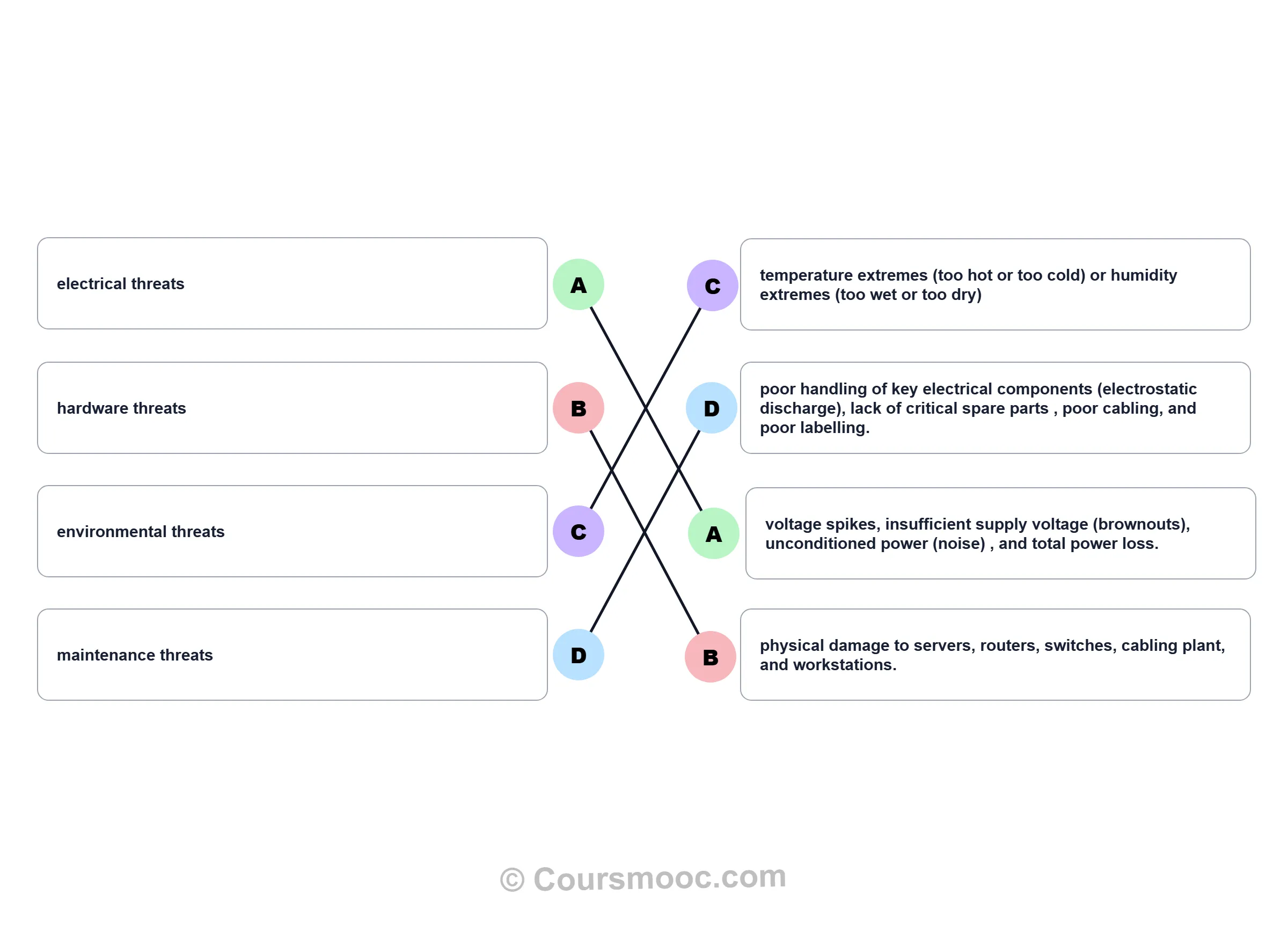
Explanation: Topic 16.1.3
| Threat Type | Cause |
|---|---|
| electrical threats | voltage spikes, brownouts, unconditioned power, total power loss |
| hardware threats | physical damage to servers, routers, switches, cabling, workstations |
| environmental threats | temperature extremes (too hot or too cold) or humidity extremes |
| maintenance threats | poor handling of components, lack of spare parts, poor cabling, poor labeling |
59. A disgruntled employee is using some free wireless networking tools to determine information about the enterprise wireless networks. This person is planning on using this information to hack the wireless network. What type of attack is this?
Explanation: Topic 16.2.2 – A reconnaissance attack involves unauthorized discovery and documentation of network systems and vulnerabilities.
60. What service is provided by HTTP?
Explanation: Topic 15.3.1 – HTTP is the foundation for exchanging multimedia files on the web.
61. A client packet is received by a server. The packet has a destination port number of 67. What service is the client requesting?
Explanation: Topic 14.4.3 – Port 67 is used by DHCP servers for client requests.
62. What are two problems that can be caused by a large number of ARP request and reply messages? (Choose two.)
Explanation: Topic 9.2.8 – ARP requests are broadcasts that flood the subnet and must be processed by all nodes.
63. A group of Windows PCs in a new subnet has been added to an Ethernet network. When testing the connectivity, a technician finds that these PCs can access local network resources but not the Internet resources. To troubleshoot the problem, the technician wants to initially confirm the IP address and DNS configurations on the PCs, and also verify connectivity to the local router. Which three Windows CLI commands and utilities will provide the necessary information? (Choose three.)
Explanation: Topic 17.5.1 – ipconfig displays IP configuration, ping tests connectivity, and nslookup verifies DNS resolution.
64. During the process of forwarding traffic, what will the router do immediately after matching the destination IP address to a network on a directly connected routing table entry?
Explanation: Topic 8.5.1 – A router receives a packet on an interface and looks at the destination IP address. It consults its routing table and matches the destination IP address to a routing table entry. The router then discovers that it has to send the packet to the next-hop address or out to a directly connected interface. When the destination address is on a directly connected interface, the packet is switched over to that interface.
65. What characteristic describes antispyware?
Explanation: Topic 1.8.2 – Antispyware protects end devices from malware infections.
66. A network administrator needs to keep the user ID, password, and session contents private when establishing remote CLI connectivity with a switch to manage it. Which access method should be chosen?
Explanation: Topic 2.1.4 – SSH encrypts all communication, providing secure remote CLI access.
67. What are the two most effective ways to defend against malware? (Choose two.)
Explanation: Topic 16.3.3 – A cybersecurity specialist must be aware of the technologies and measures that are used as countermeasures to protect the organization from threats and vulnerabilities.
68. Which type of security threat would be responsible if a spreadsheet add-on disables the local software firewall?
Explanation: Topic 16.2.1 – A Trojan horse is software that does something harmful, but is hidden in legitimate software code. A denial of service (DoS) attack results in interruption of network services to users, network devices, or applications. A brute-force attack commonly involves trying to access a network device. A buffer overflow occurs when a program attempts to store more data in a memory location than it can hold.
69. Which frame field is created by a source node and used by a destination node to ensure that a transmitted data signal has not been altered by interference, distortion, or signal loss?
Explanation: Topic 6.3.2 – The FCS field is used for error detection to verify frame integrity.
70. A network administrator is adding a new LAN to a branch office. The new LAN must support 4 connected devices. What is the smallest network mask that the network administrator can use for the new network?
Explanation: Topic 11.5.2 – A /29 mask (255.255.255.248) provides 6 usable host addresses, enough for 4 devices.
71. What service is provided by POP3?
Explanation: Topic 15.3.4 – POP3 downloads email from the server to the local client application.
72. What two security solutions are most likely to be used only in a corporate environment? (Choose two.)
Explanation: Topic 1.8.2 – VPNs and intrusion prevention systems are typically deployed in corporate environments.
73. What characteristic describes antivirus software?
Explanation: Topic 1.8.2 – Antivirus software protects end devices from malicious software.
74. What mechanism is used by a router to prevent a received IPv4 packet from traveling endlessly on a network?
Explanation: Topic 8.2.2 – The router decrements the TTL; if it reaches 0, the packet is discarded and a Time Exceeded message is sent.
75. A client packet is received by a server. The packet has a destination port number of 69. What service is the client requesting?
Explanation: Topic 14.4.3 – Port 69 is the well-known port for TFTP (Trivial File Transfer Protocol).
76. An administrator defined a local user account with a secret password on router R1 for use with SSH. Which three additional steps are required to configure R1 to accept only encrypted SSH connections? (Choose three.)
Explanation: Topic 16.4.4 – SSH requires an IP domain name, generated SSH keys, and enabling SSH on the VTY lines.
77. Which two functions are performed at the MAC sublayer of the OSI Data Link Layer to facilitate Ethernet communication? (Choose two.)
Explanation: Topic 6.1.2 – The MAC sublayer handles framing, error detection (FCS), and delimiting fields within the Ethernet frame.
78. An IPv6 enabled device sends a data packet with the destination address of FF02::2. What is the target of this packet?
Explanation: Topic 12.7.2 – FF02::2 is the multicast address for all IPv6 routers on the local link.
79. What are the three parts of an IPv6 global unicast address? (Choose three.)
Explanation: Topic 12.3.5 – The general format for IPv6 global unicast addresses includes a global routing prefix, a subnet ID, and an interface ID. The global routing prefix is the network portion of the address. A typical global routing prefix is /48 assigned by the Internet provider. The subnet ID portion can be used by an organization to create multiple subnetwork numbers. The interface ID is similar to the host portion of an IPv4 address.
80. A network administrator is designing the layout of a new wireless network. Which three areas of concern should be accounted for when building a wireless network? (Choose three.)
Explanation: Topic 4.6.1 – The three areas of concern for wireless networks focus on the size of the coverage area, any nearby interference, and providing network security. Extensive cabling is not a concern for wireless networks, as a wireless network will require minimal cabling for providing wireless access to hosts. Mobility options are not a component of the areas of concern for wireless networks.
81. A new network administrator has been asked to enter a banner message on a Cisco device. What is the fastest way a network administrator could test whether the banner is properly configured?
Explanation: Topic 2.4.5 – Exiting privileged EXEC mode displays the banner immediately.
82. What method is used to manage contention-based access on a wireless network?
Explanation: Topic 6.2.8 – Wireless networks use CSMA/CA (Carrier Sense Multiple Access with Collision Avoidance).
83. What is a function of the data link layer?
Explanation: Topic 6.1.1 – The data link layer facilitates frame exchange over the local media.
84. What is the purpose of the TCP sliding window?
Explanation: Topic 14.6.5 – The TCP sliding window allows a destination device to inform a source to slow down the rate of transmission. To do this, the destination device reduces the value contained in the window field of the segment. It is acknowledgment numbers that are used to specify retransmission from a specific point forward. It is sequence numbers that are used to ensure segments arrive in order. Finally, it is a FIN control bit that is used to end a communication session.
85. What characteristic describes spyware?
Explanation: Topic 1.8.1 – Spyware collects user information without consent.
86. Which switching method drops frames that fail the FCS check?
Explanation: Topic 7.4.1 – Store-and-forward switching drops frames that fail the FCS check.
87. Which range of link-local addresses can be assigned to an IPv6-enabled interface?
Explanation: Topic 12.3.7 – Link-local addresses are in the range of FE80::/10 to FEBF::/10. The original IPv6 specification defined site-local addresses and used the prefix range FEC0::/10, but these addresses were deprecated by the IETF in favor of unique local addresses. FDEE::/7 is a unique local address because it is in the range of FC00::/7 to FDFF::/7. IPv6 multicast addresses have the prefix FF00::/8.
88. What service is provided by FTP?
Explanation: Topic 15.5.1 – FTP enables file transfers between a client and a file server.
89. A user is attempting to access http://www.cisco.com/ without success. Which two configuration values must be set on the host to allow this access? (Choose two.)
Explanation: Topic 11.1.2 – A DNS server and a default gateway are required for web access.
90. Which two statements accurately describe an advantage or a disadvantage when deploying NAT for IPv4 in a network? (Choose two.)
Explanation: Topic 12.1.1 – Network Address Translation (NAT) is a technology that is implemented within IPv4 networks. One application of NAT is to use private IP addresses inside a network and use NAT to share a few public IP addresses for many internal hosts. In this way it provides a solution to slow down the IPv4 address depletion. However, since NAT hides the actual IP addresses that are used by end devices, it may cause problems for some applications that require end-to-end connectivity.
91. What would be the interface ID of an IPv6 enabled interface with a MAC address of 1C-6F-65-C2-BD-F8 when the interface ID is generated by using the EUI-64 process?
Explanation: Topic 12.5.6 – The EUI-64 process changes the 7th bit (C to E) and inserts FFFE.
92. Refer to the exhibit. PC1 issues an ARP request because it needs to send a packet to PC2. In this scenario, what will happen next?
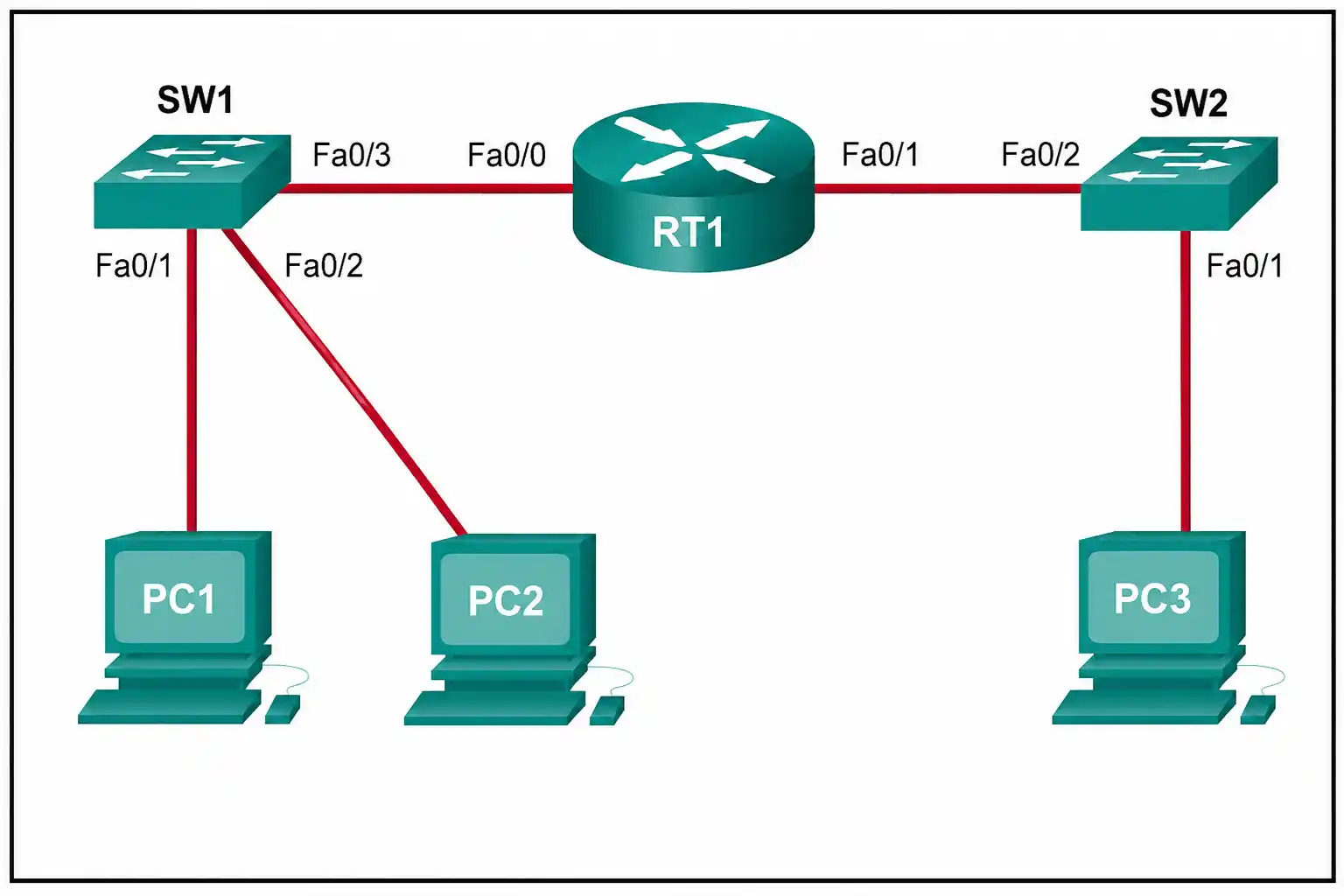
Explanation: Topic 9.2.4 – When a network device wants to communicate with another device on the same network, it sends a broadcast ARP request. In this case, the request will contain the IP address of PC2. The destination device (PC2) sends an ARP reply with its MAC address.
93. What service is provided by BOOTP?
Explanation: Topic 3.3.4 – BOOTP is a legacy protocol for diskless workstations to obtain IP addresses.
94. What characteristic describes adware?
Explanation: Topic 1.8.1 – Adware collects user information and displays unwanted advertisements.
95. When a switch configuration includes a user-defined error threshold on a per-port basis, to which switching method will the switch revert when the error threshold is reached?
Explanation: Topic 7.4.2 – When an error threshold is exceeded, the switch reverts to store-and-forward.
96. Match a statement to the related network model. (Not all options are used.)
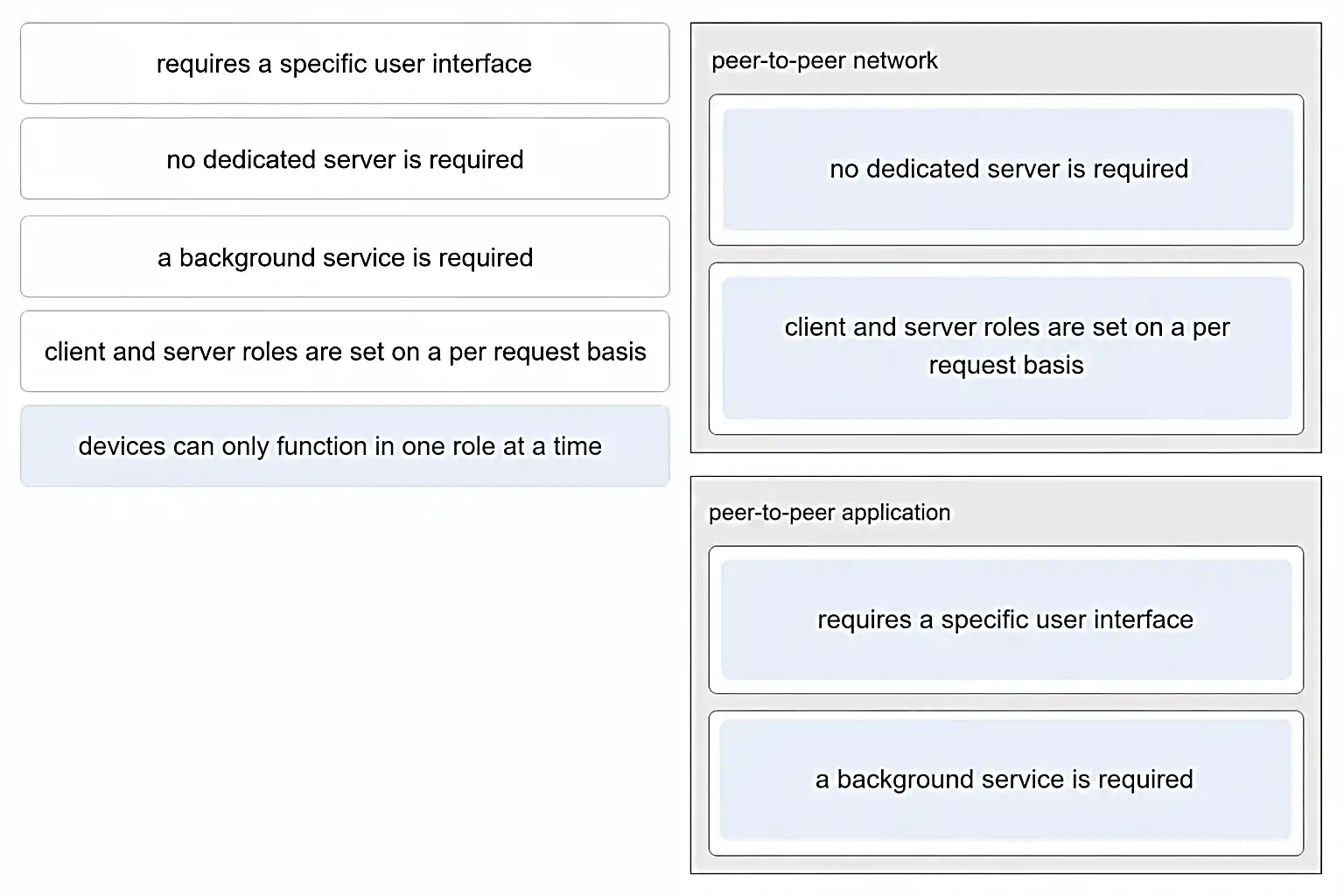
Explanation: Topic 15.2.2 - Peer-to-peer networks do not require the use of a dedicated server, and devices can assume both client and server roles simultaneously on a per request basis. Because they do not require formalized accounts or permissions, they are best used in limited situations. Peer-to-peer applications require a user interface and background service to be running, and can be used in more diverse situations.
| Model | Characteristic |
|---|---|
| peer-to-peer network | no dedicated server is required |
| peer-to-peer network | client and server roles are set on a per request basis |
| peer-to-peer application | requires a specific user interface |
| peer-to-peer application | a background service is required |
97. What are two primary responsibilities of the Ethernet MAC sublayer? (Choose two.)
Explanation: Topic 7.1.3 – The MAC sublayer is responsible for media access and data encapsulation.
98. Refer to the exhibit. What three facts can be determined from the viewable output of the show ip interface brief command? (Choose three.)
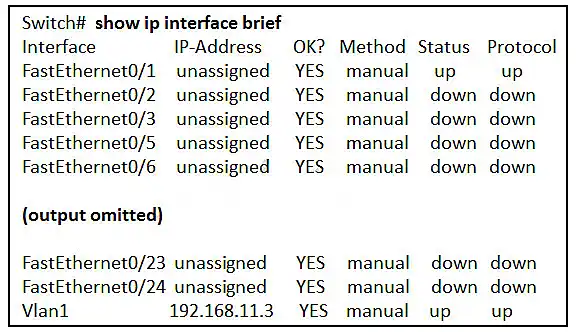
Explanation: Topic 17.5.7 – Vlan1 is the default SVI. Because an SVI has been configured, the switch can be configured and managed remotely. FastEthernet0/0 is showing up and up, so a device is connected.
99. Match each type of frame field to its function. (Not all options are used.)
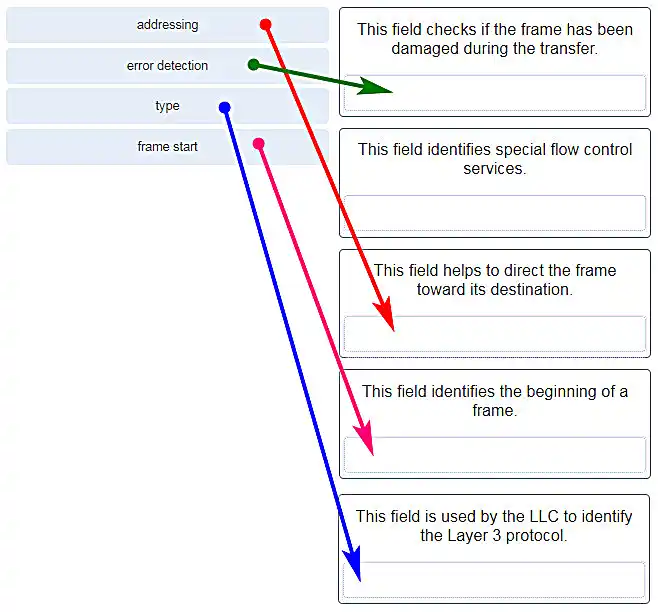
Explanation: Topic 6.3.2
| Field | Function |
|---|---|
| addressing | This field helps to direct the frame toward its destination. |
| error detection | This field checks if the frame has been damaged during the transfer. |
| type | This field is used by the LLC to identify the Layer 3 protocol. |
| frame start | This field identifies the beginning of a frame. |
100. What is the subnet ID associated with the IPv6 address 2001:DA48:FC5:A4:3D1B::1/64?
Explanation: Topic 12.3.6 – The subnet ID for a /64 prefix includes the first 64 bits of the address.
101. Match the firewall function to the type of threat protection it provides to the network. (Not all options are used.)
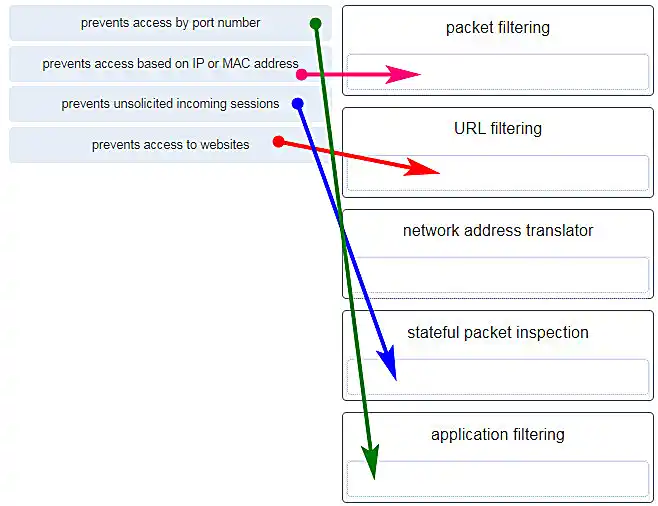
Explanation: Topic 16.3.6 - Firewall products come packaged in various forms. These products use different techniques for determining what will be permitted or denied access to a network. They include the following:
+ Packet filtering – Prevents or allows access based on IP or MAC addresses
+ Application filtering – Prevents or allows access by specific application types based on port numbers
+ URL filtering – Prevents or allows access to websites based on specific URLs or keywords
+ Stateful packet inspection (SPI) – Incoming packets must be legitimate responses to requests from internal hosts. Unsolicited packets are blocked unless permitted specifically. SPI can also include the capability to recognize and filter out specific types of attacks, such as denial of service (DoS)
| Function | Protection Type |
|---|---|
| prevents access by port number | application filtering |
| prevents access based on IP or MAC address | packet filtering |
| prevents unsolicited incoming sessions | stateful packet inspection |
| prevents access to websites | URL filtering |
102. Users are reporting longer delays in authentication and in accessing network resources during certain time periods of the week. What kind of information should network engineers check to find out if this situation is part of a normal network behavior?
Explanation: Topic 17.4.5 – A network performance baseline helps determine if delays are normal or abnormal.
103. How does the service password-encryption command enhance password security on Cisco routers and switches?
Explanation: Topic 2.4.4 – The service password-encryption command encrypts plaintext passwords in the configuration file so that they cannot be viewed by unauthorized users.
104. Which two statements are correct in a comparison of IPv4 and IPv6 packet headers? (Choose two.)
Explanation: Topic 8.3.3 – The IPv6 packet header fields are as follows: Version, Traffic Class, Flow Label, Payload Length, Next Header, Hop Limit, Source Address, and Destination Address. The IPv4 packet header fields include the following: Version, Differentiated Services, Time-to-Live, Protocol, Source IP Address, and Destination IP Address. Both versions have a 4-bit Version field. Both versions have a Source (IP) Address field. IPv4 addresses are 32 bits; IPv6 addresses are 128 bits. The Time-to-Live or TTL field in IPv4 is now called Hop Limit in IPv6, but this field serves the same purpose in both versions. The value in this 8-bit field decrements each time a packet passes through any router. When this value is 0, the packet is discarded and is not forwarded to any other router.
105. A network administrator wants to have the same network mask for all networks at a particular small site. The site has the following networks and number of devices: IP phones – 22 addresses, PCs – 20 addresses needed, Printers – 2 addresses needed, Scanners – 2 addresses needed. The network administrator has deemed that 192.168.10.0/24 is to be the network used at this site. Which single subnet mask would make the most efficient use of the available addresses to use for the four subnetworks?
Explanation: Topic 11.7.2 – A /27 mask (255.255.255.224) provides 30 usable addresses per subnet, enough for the largest requirement (22 IP phones).
106. What characteristic describes identity theft?
Explanation: Topic 1.8.1 – Identity theft involves using stolen credentials to access private data.
107. A network administrator is adding a new LAN to a branch office. The new LAN must support 200 connected devices. What is the smallest network mask that the network administrator can use for the new network?
Explanation: Topic 11.7.2 – A /24 mask (255.255.255.0) provides 254 usable host addresses, enough for 200 devices.
108. What are three commonly followed standards for constructing and installing cabling? (Choose three.)
Explanation: Topic 4.4.2 – Standards cover cable lengths, pinouts, and connector types.
109. Refer to the exhibit. What is wrong with the displayed termination?
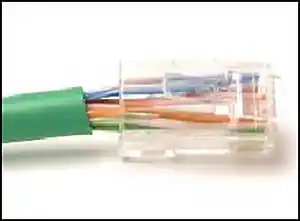
Explanation: Topic 4.4.2 – The untwisted length must be kept short to avoid crosstalk.
110. Match the characteristic to the category. (Not all options are used.)
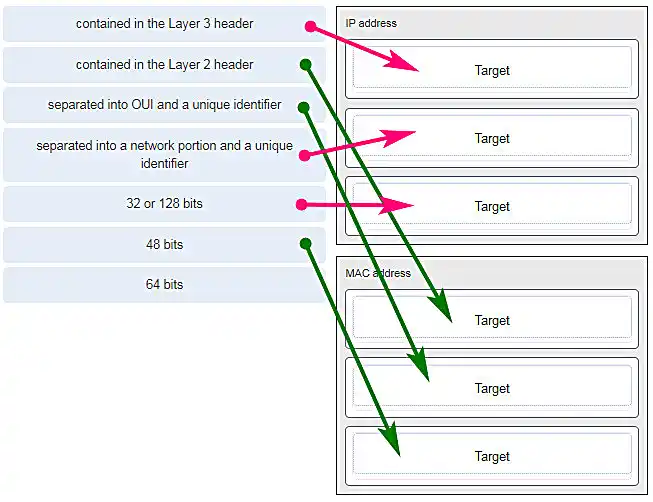
Explanation: Topic 9.1.1
| IP address | MAC address |
|---|---|
| contained in the Layer 3 header | contained in the Layer 2 header |
| separated into a network portion and a unique identifier | separated into OUI and a unique identifier |
| 32 or 128 bits | 48 bits |
111. A client packet is received by a server. The packet has a destination port number of 143. What service is the client requesting?
Explanation: Topic 14.4.3 – Port 143 is the well-known port for IMAP email retrieval.
112. What are two characteristics shared by TCP and UDP? (Choose two.)
Explanation: Topic 14.1.2 – Both TCP and UDP use source and destination port numbers to distinguish different data streams and to forward the right data segments to the right applications. Error checking the header and data is done by both protocols by using a checksum calculation to determine the integrity of the data that is received. TCP is connection-oriented and uses a 3-way handshake to establish an initial connection. TCP also uses window to regulate the amount of traffic sent before receiving an acknowledgment. UDP is connectionless and is the best protocol for carry digitized VoIP signals.
113. Refer to the exhibit. Which two network addresses can be assigned to the network containing 10 hosts? Your answers should waste the fewest addresses, not reuse addresses that are already assigned, and stay within the 10.18.10.0/24 range of addresses. (Choose two.)
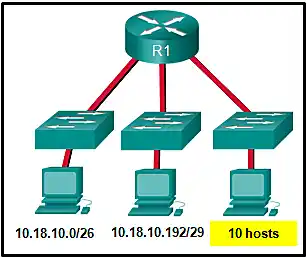
Explanation: Topic 11.7.2 – Addresses 10.18.10.0 through 10.18.10.63 are taken for the leftmost network. Addresses 192 through 199 are used by the center network. Because 4 host bits are needed to accommodate 10 hosts, a /28 mask is needed. 10.18.10.200/28 is not a valid network number. Two subnets that can be used are 10.18.10.208/28 and 10.18.10.224/28.
114. A client packet is received by a server. The packet has a destination port number of 21. What service is the client requesting?
Explanation: Topic 14.4.3 – Port 21 is the well-known port for FTP control.
115. What attribute of a NIC would place it at the data link layer of the OSI model?
Explanation: Topic 7.2.2 – The MAC address is a data link layer attribute.
116. A network administrator is adding a new LAN to a branch office. The new LAN must support 10 connected devices. What is the smallest network mask that the network administrator can use for the new network?
Explanation: Topic 11.5.2 – A /28 mask (255.255.255.240) provides 14 usable host addresses, enough for 10 devices.
117. What technique is used with UTP cable to help protect against signal interference from crosstalk?
Explanation: Topic 4.4.1 – To help prevent the effects of crosstalk, UTP cable wires are twisted together into pairs. Twisting the wires together causes the magnetic fields of each wire to cancel each other out.
118. Refer to the exhibit. The network administrator has assigned the LAN of LBMISS an address range of 192.168.10.0. This address range has been subnetted using a /29 prefix. In order to accommodate a new building, the technician has decided to use the fifth subnet for configuring the new network (subnet zero is the first subnet). By company policies, the router interface is always assigned the first usable host address and the workgroup server is given the last usable host address. Which configuration should be entered into the properties of the workgroup server to allow connectivity to the Internet?
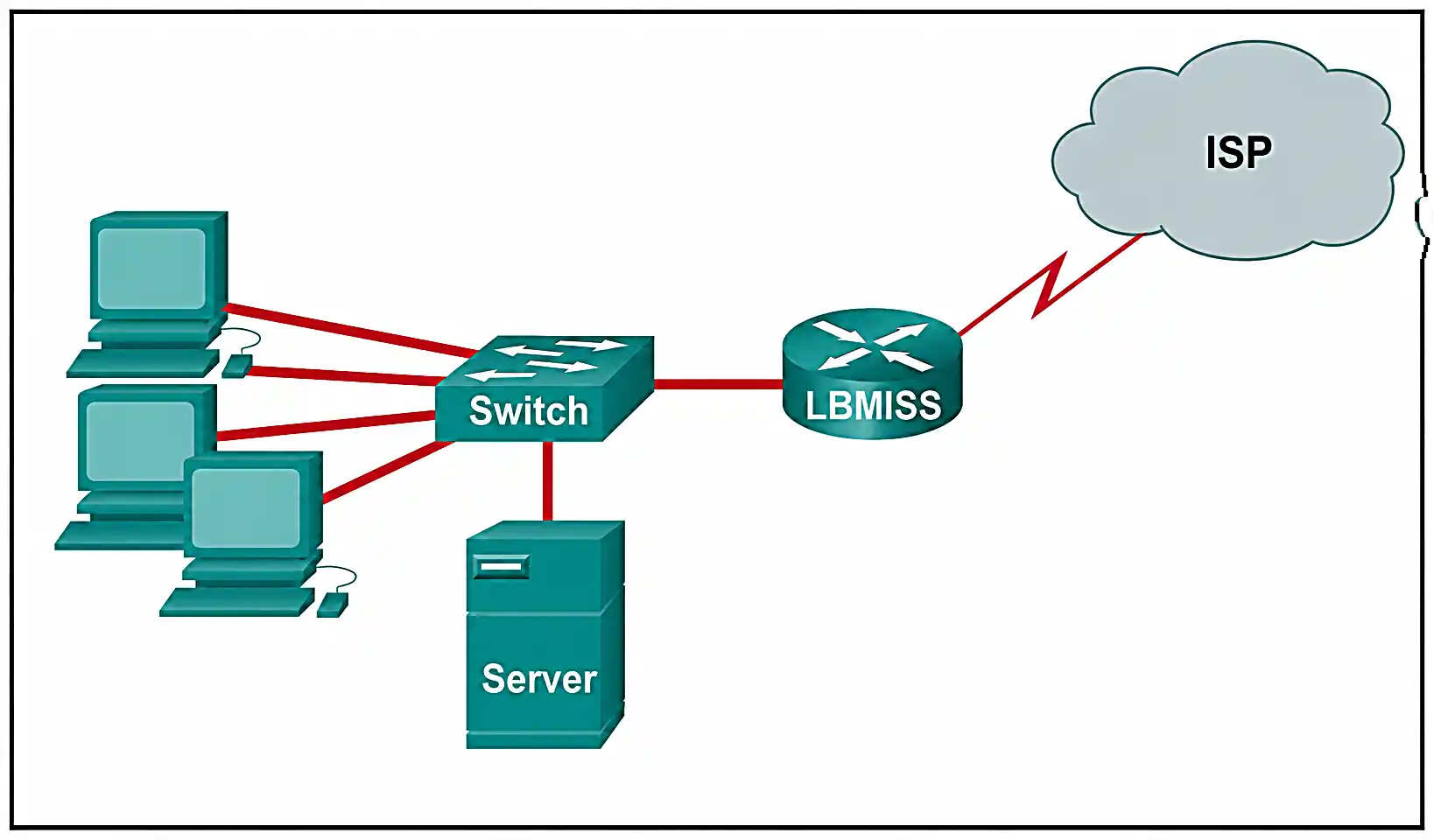
Explanation: Topic 11.5.2 – The fifth subnet (192.168.10.32/29) has a range of 33–38; the router gets 33 and the server gets 38.
119. Refer to the exhibit. The switches are in their default configuration. Host A needs to communicate with host D, but host A does not have the MAC address for its default gateway. Which network hosts will receive the ARP request sent by host A?
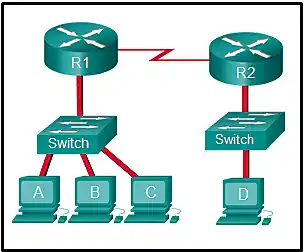
Explanation: Topic 11.4.1 – Since host A does not have the MAC address of the default gateway in its ARP table, host A sends an ARP broadcast. The ARP broadcast would be sent to every device on the local network. Hosts B, C, and router R1 would receive the broadcast. Router R1 would not forward the message.
120. Match a statement to the related network model. (Not all options are used.)
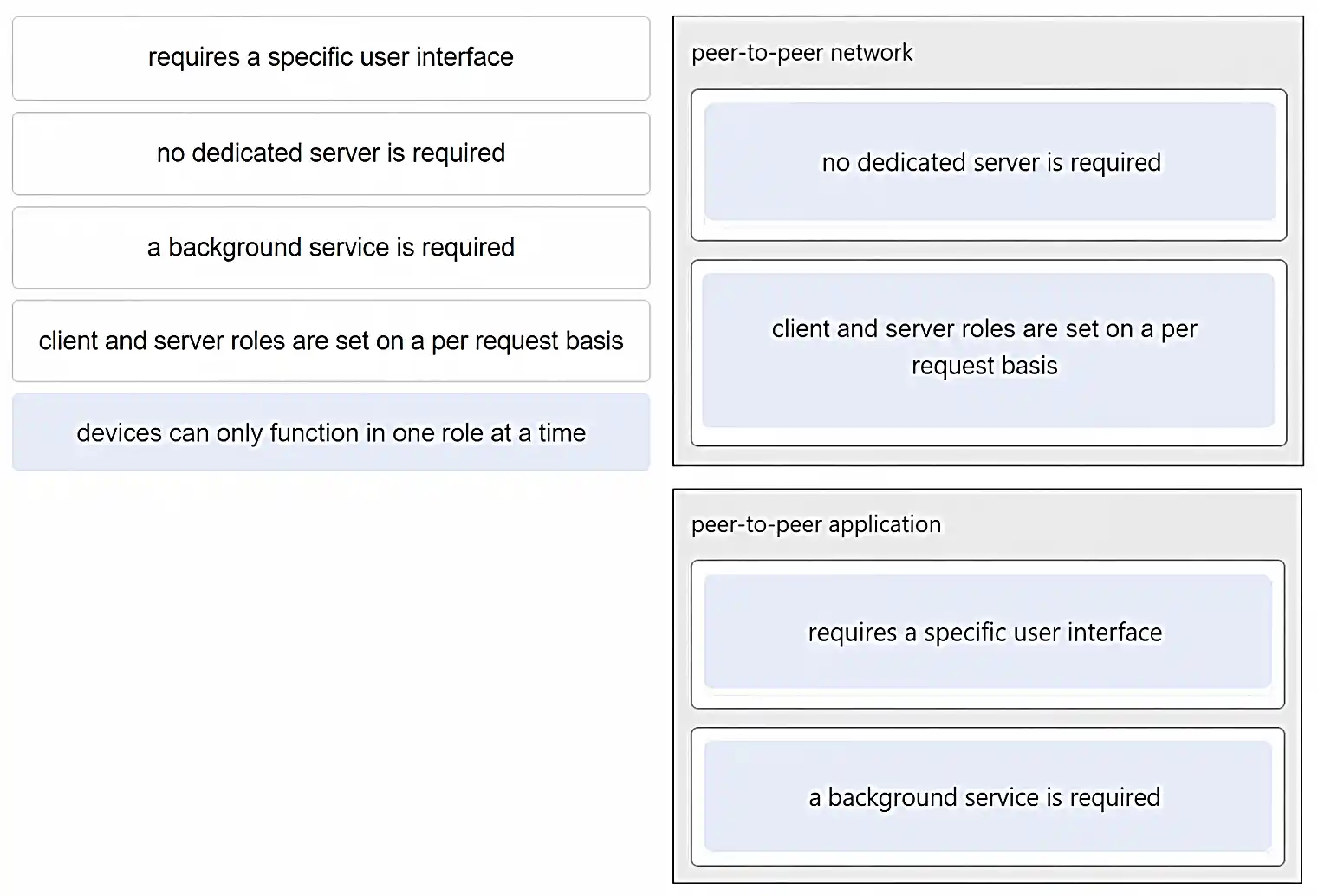
Explanation: Topic 5.2 - Peer-to-peer networks do not require the use of a dedicated server, and devices can assume both client and server roles simultaneously on a per request basis. Because they do not require formalized accounts or permissions, they are best used in limited situations. Peer-to-peer applications require a user interface and background service to be running, and can be used in more diverse situations.
121. Refer to the exhibit. A network engineer has been given the network address of 192.168.99.0 and a subnet mask of 255.255.255.192 to subnet across the four networks shown. How many total host addresses are unused across all four subnets?
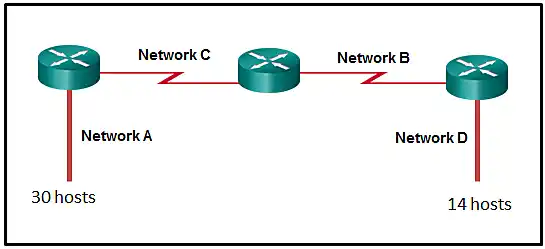
Explanation: Topic 11.5.2 – Each /26 subnet provides 62 usable addresses; total unused across four subnets is 200.
122. Which connector is used with twisted-pair cabling in an Ethernet LAN?
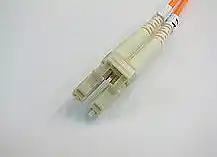
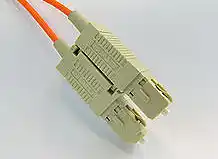
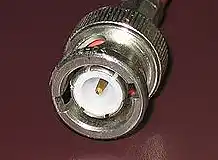
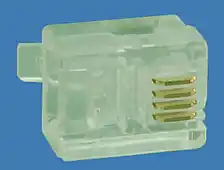
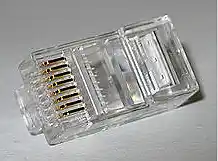
Explanation: Topic 4.4.2 – RJ-45 connectors are used with twisted-pair cabling in Ethernet LANs.
Answer: RJ-45
123. A client packet is received by a server. The packet has a destination port number of 22. What service is the client requesting?
Explanation: Topic 14.4.3 – Port 22 is the well-known port for SSH.
124. What characteristic describes an IPS?
Explanation: Topic 1.8.2 – IPS – An intrusion prevention system (IPS) monitors incoming and outgoing traffic looking for malware, network attack signatures, and more. If it recognizes a threat, it can immediately stop it.
125. What service is provided by DHCP?
Explanation: Topic 15.4.6 – DHCP dynamically assigns IP addresses to devices.
126. Match the header field with the appropriate layer of the OSI model. (Not all options are used.)
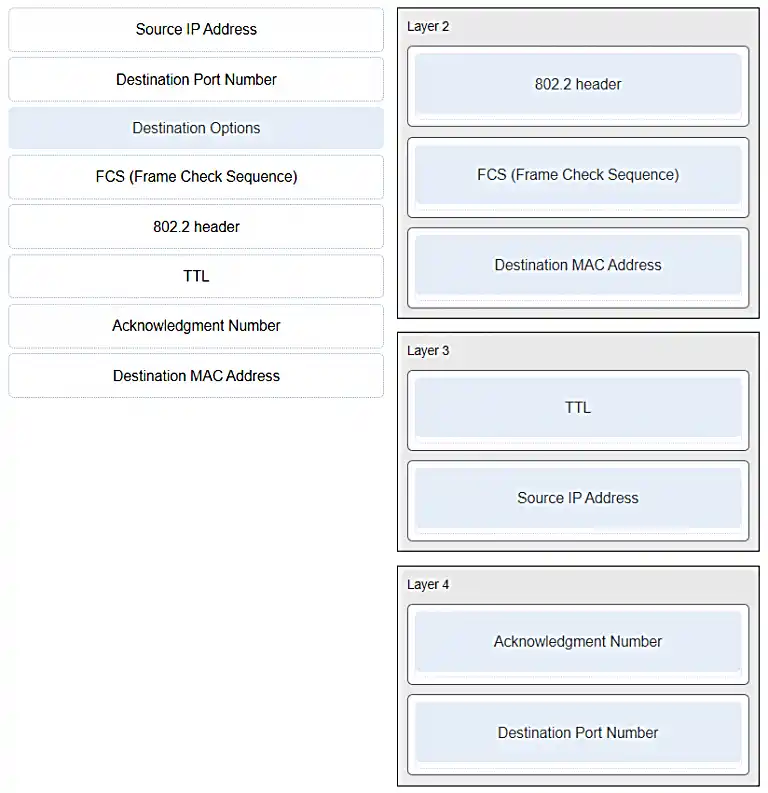
Explanation: Topic 3.6.3
| Layer 2 | Layer 3 | Layer 4 |
|---|---|---|
| 802.2 header | source IP address | destination port number |
| FCS (frame check sequence) | TTL | Acknowledgement number |
| destination MAC address |
127. Refer to the exhibit. The switches have a default configuration. Host A needs to communicate with host D, but host A does not have the MAC address for the default gateway. Which network devices will receive the ARP request sent by host A?
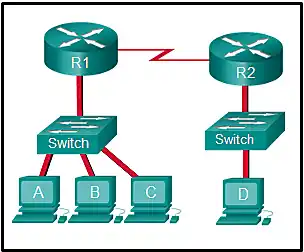
Explanation: Topic 11.4.1 – Because host A does not have the MAC address of the default gateway in the ARP table, host A sends an ARP broadcast. The ARP broadcast would be sent to every device on the local network. Hosts B, C, and router R1 would receive the broadcast. Router R1 would not forward the message.
128. Which wireless technology has low-power and low-data rate requirements making it popular in IoT environments?
Explanation: Topic 4.6.2 – Zigbee is a specification used for low-data rate, low-power communications. It is intended for applications that require short-range, low data-rates and long battery life. Zigbee is typically used for industrial and Internet of Things (IoT) environments such as wireless light switches and medical device data collection.
129. What two ICMPv6 message types must be permitted through IPv6 access control lists to allow resolution of Layer 3 addresses to Layer 2 MAC addresses? (Choose two.)
Explanation: Topic 9.3.3 – Neighbor Solicitation and Neighbor Advertisement messages are used for IPv6 address resolution.
130. A client is using SLAAC to obtain an IPv6 address for its interface. After an address has been generated and applied to the interface, what must the client do before it can begin to use this IPv6 address?
Explanation: Topic 12.5.7 – The client performs Duplicate Address Detection (DAD) using Neighbor Solicitation.
131. Two pings were issued from a host on a local network. The first ping was issued to the IP address of the default gateway of the host and it failed. The second ping was issued to the IP address of a host outside the local network and it was successful. What is a possible cause for the failed ping?
Explanation: Topic 13.2.3 – Security rules may block ICMP ping requests to the gateway.
132. An organization is assigned an IPv6 address block of 2001:db8:0:ca00::/56. How many subnets can be created without using bits in the interface ID space?
Explanation: Topic 12.8.1 – A /56 prefix provides 8 subnet bits (64-56=8), allowing 28=256 subnets.
133. What subnet mask is needed if an IPv4 network has 40 devices that need IP addresses and address space is not to be wasted?
Explanation: Topic 11.5.2 – In order to accommodate 40 devices, 6 host bits are needed. With 6 bits, 64 addresses are possible, but one address is for the subnet number and one address is for a broadcast. This leaves 62 addresses that can be assigned to network devices. The mask associated with leaving 6 host bits for addressing is 255.255.255.192.
134. Refer to the exhibit. If host A sends an IP packet to host B, what will the destination address be in the frame when it leaves host A?
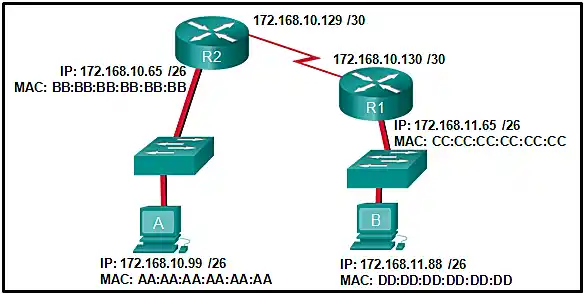
Explanation: Topic 9.1.2 – When a host sends information to a distant network, the Layer 2 frame header will contain a source and destination MAC address. The source address will be the originating host device. The destination address will be the router interface that connects to the same network. In the case of host A sending information to host B, the source address is AA:AA:AA:AA:AA:AA and the destination address is the MAC address assigned to the R2 Ethernet interface, BB:BB:BB:BB:BB:BB.
135. What is a benefit of using cloud computing in networking?
Explanation: Topic 1.7.6 – Cloud computing extends IT’s capabilities without requiring investment in new infrastructure, training new personnel, or licensing new software. These services are available on-demand and delivered economically to any device anywhere in the world without compromising security or function. BYOD is about end users having the freedom to use personal tools to access information and communicate across a business or campus network. Smart home technology is integrated into every-day appliances allowing them to interconnect with other devices, making them more ‘smart’ or automated. Powerline networking is a trend for home networking that uses existing electrical wiring to connect devices to the network wherever there is an electrical outlet, saving the cost of installing data cables.
136. Which two statements are correct about MAC and IP addresses during data transmission if NAT is not involved? (Choose two.)
Explanation: Topic 9.1.2 – IP addresses remain constant end-to-end; MAC addresses change at each hop.
137. What is one main characteristic of the data link layer?
Explanation: Topic 6.1.1 – The data link layer abstracts the physical medium from upper layers.
138. What are three characteristics of the CSMA/CD process? (Choose three.)
Explanation: Topic 6.2.7 – The Carrier Sense Multiple Access/Collision Detection (CSMA/CD) process is a contention-based media access control mechanism used on shared media access networks, such as Ethernet. When a device needs to transmit data, it listens and waits until the media is available (quiet), then it will send data. If two devices transmit at the same time, a collision will occur. Both devices will detect the collision on the network. When a device detects a collision, it will stop the data transmission process, wait for a random amount of time, then try again.
139. Which information does the show startup-config command display?
Explanation: Topic 2.5.1 – The show startup-config command displays the saved configuration located in NVRAM. The show running-config command displays the contents of the currently running configuration file located in RAM.
140. Which two commands can be used on a Windows host to display the routing table? (Choose two.)
Explanation: Topic 8.4.4 – On a Windows host, the route print or netstat -r commands can be used to display the host routing table. Both commands generate the same output. On a router, the show ip route command is used to display the routing table. The netstat –s command is used to display per-protocol statistics. The tracert command is used to display the path that a packet travels to its destination.
141. What are two functions that are provided by the network layer? (Choose two.)
Explanation: Topic 8.1.1 – The network layer is primarily concerned with passing data from a source to a destination on another network. IP addresses supply unique identifiers for the source and destination. The network layer provides connectionless, best-effort delivery. Devices rely on higher layers to supply services to processes.
142. Which two statements describe features of an IPv4 routing table on a router? (Choose two.)
Explanation: Topic 8.5.6 – The routing table stores route information and includes static routes with source code S.
143. What characteristic describes a VPN?
Explanation: Topic 1.8.2 – A VPN provides secure remote access to an organization's network.
144. Why would a Layer 2 switch need an IP address?
Explanation: Topic 10.3.2 – A switch, as a Layer 2 device, does not need an IP address to transmit frames to attached devices. However, when a switch is accessed remotely through the network, it must have a Layer 3 address. The IP address must be applied to a virtual interface rather than to a physical interface. Routers, not switches, function as default gateways.
145. Match each description to its corresponding term. (Not all options are used.)
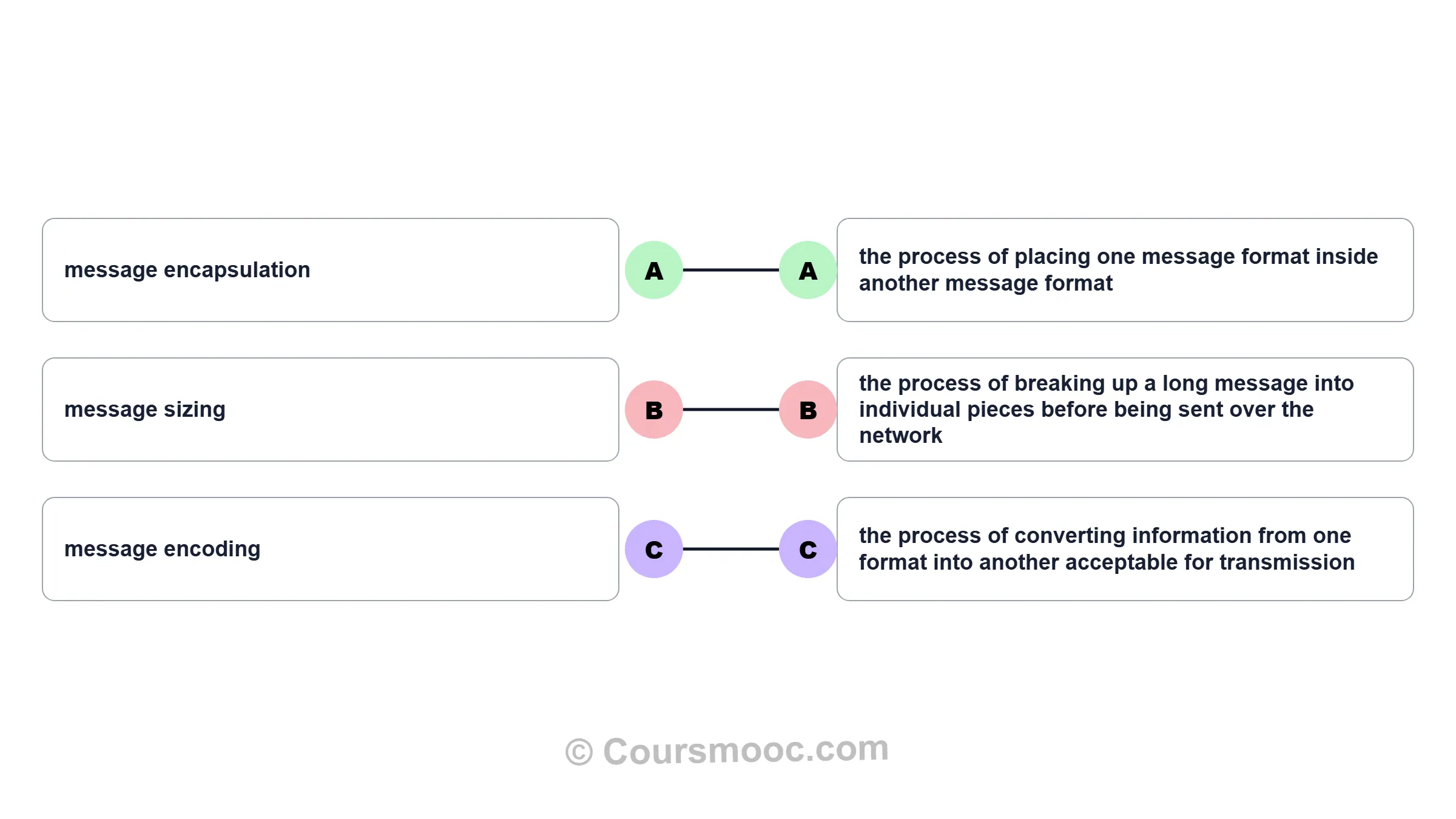
Explanation: Topic 3.1.5
| Term | Description |
|---|---|
| message encapsulation | the process of placing one message format inside another message format |
| message sizing | the process of breaking up a long message into individual pieces before being sent over the network |
| message encoding | the process of converting information from one format into another acceptable for transmission |
146. A user sends an HTTP request to a web server on a remote network. During encapsulation for this request, what information is added to the address field of a frame to indicate the destination?
Explanation: Topic 9.1.2 – A frame is encapsulated with source and destination MAC addresses. The source device will not know the MAC address of the remote host. An ARP request will be sent by the source and will be responded to by the router. The router will respond with the MAC address of its interface, the one which is connected to the same network as the source.
147. What is an advantage to using a protocol that is defined by an open standard?
Explanation: Topic 3.4.1 – A monopoly by one company is not a good idea from a user point of view. If a protocol can only be run on one brand, it makes it difficult to have mixed equipment in a network. A proprietary protocol is not free to use. An open standard protocol will in general be implemented by a wide range of vendors.
148. Data is being sent from a source PC to a destination server. Which three statements correctly describe the function of TCP or UDP in this situation? (Choose three.)
Explanation: Topic 14.4.2 – Layer 4 port numbers identify the application or service which will handle the data. The source port number is added by the sending device and will be the destination port number when the requested information is returned. Layer 4 segments are encapsulated within IP packets. UDP, not TCP, is used when low overhead is needed. A source IP address, not a TCP source port number, identifies the sending host on the network. Destination port numbers are specific ports that a server application or service monitors for requests.
149. Match each description with the corresponding TCP mechanism. (Not all options are used.)
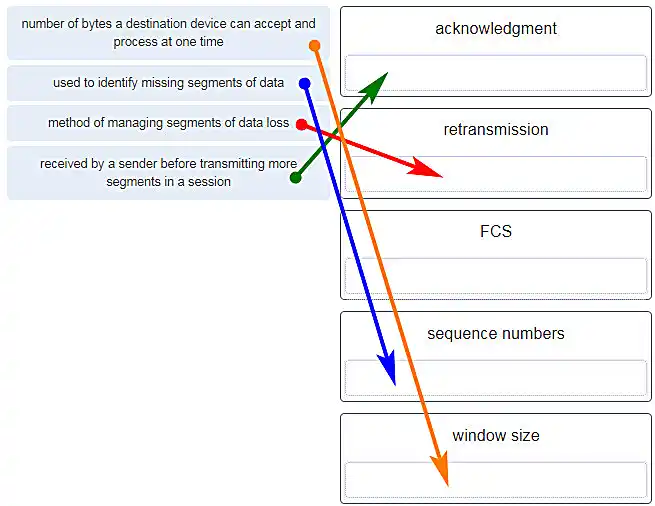
Explanation: Topic 14.6
| Description | Mechanism |
|---|---|
| number of bytes a destination device can accept and process at one time | window size |
| used to identify missing segments of data | sequence numbers |
| method of managing segments of data loss | retransmission |
| received by a sender before transmitting more segments in a session | acknowledgment |
150. Refer to the exhibit. A company uses the address block of 128.107.0.0/16 for its network. What subnet mask would provide the maximum number of equal size subnets while providing enough host addresses for each subnet in the exhibit?
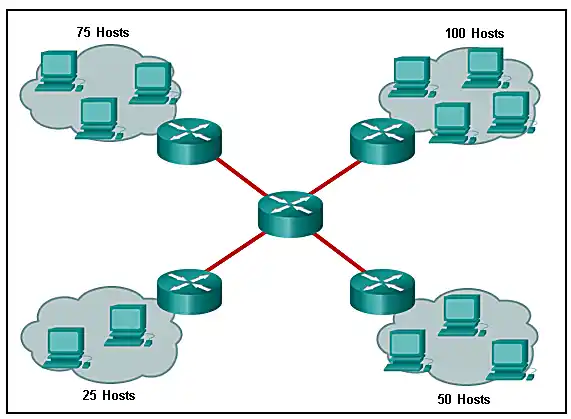
Explanation: Topic 11.7.2 – The largest subnet in the topology has 100 hosts in it so the subnet mask must have at least 7 host bits in it (27-2=126). 255.255.255.0 has 8 hosts bits, but this does not meet the requirement of providing the maximum number of subnets.
151. A network administrator wants to have the same subnet mask for three subnetworks at a small site. The site has the following networks and numbers of devices:
Subnetwork A: IP phones – 10 addresses,
Subnetwork B: PCs – 8 addresses,
Subnetwork C: Printers – 2 addresses.
What single subnet mask would be appropriate to use for the three subnetworks?
Explanation: Topic 11.7.2 – If the same mask is to be used, then the network with the most hosts must be examined for number of hosts. Because this is 10 hosts, 4 host bits are needed. The /28 or 255.255.255.240 subnet mask would be appropriate to use for these networks.
152. Match each item to the type of topology diagram on which it is typically identified. (Not all options are used.)
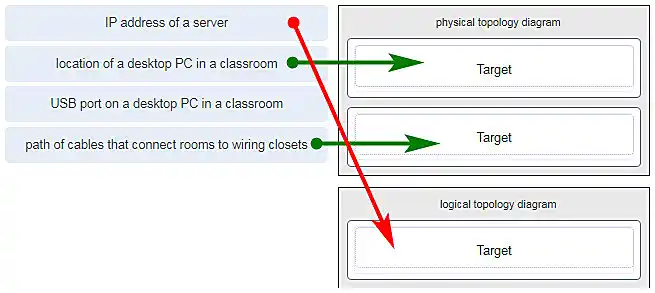
Explanation: Topic 1.3.2 - A logical topology diagram typically depicts the IP addressing scheme and groupings of devices and ports. A physical topology diagram shows how those devices are connected to each other and the network, focusing on the physical locations of intermediary devices, configured ports, and cabling.
| physical topology diagram | logical topology diagram |
|---|---|
| location of a desktop PC in a classroom | IP address of a server |
| path of cables that connect rooms to wiring closets |
153. What two pieces of information are displayed in the output of the show ip interface brief command? (Choose two.)
Explanation: Topic 10.2.3 – The command show ip interface brief shows the IP address of each interface, as well as the operational status of the interfaces at both Layer 1 and Layer 2. In order to see interface descriptions and speed and duplex settings, use the command show running-config interface. Next-hop addresses are displayed in the routing table with the command show ip route, and the MAC address of an interface can be seen with the command show interfaces.
154. A user is complaining that an external web page is taking longer than normal to load. The web page does eventually load on the user machine. Which tool should the technician use with administrator privileges in order to locate where the issue is in the network?
Explanation: Topic 17.4.3 – tracert maps the path and measures transit delays.
155. Which value, that is contained in an IPv4 header field, is decremented by each router that receives a packet?
Explanation: Topic 8.2.2 – When a router receives a packet, the router will decrement the Time-to-Live (TTL) field by one. When the field reaches zero, the receiving router will discard the packet and will send an ICMP Time Exceeded message to the sender.
156. A network technician is researching the use of fiber optic cabling in a new technology center. Which two issues should be considered before implementing fiber optic media? (Choose two.)
Explanation: Topic 4.5.6 – Fiber optic media is more expensive than copper cabling used over the same distance. Fiber optic cables use light instead of an electrical signal, so EMI and RFI are not issues. However, fiber optic does require different skills to terminate and splice.
157. Match each description with an appropriate IP address. (Not all options are used.)
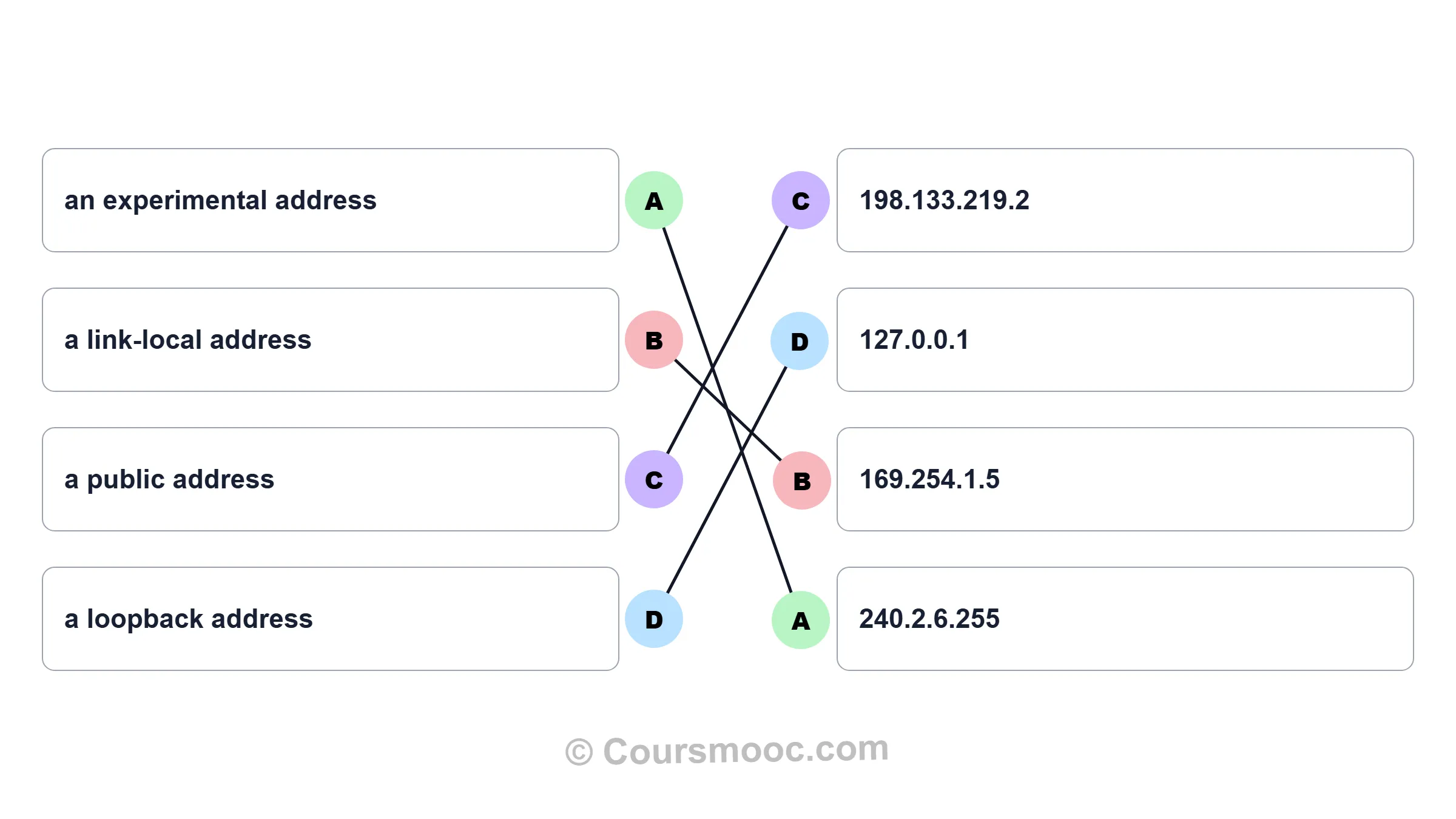
Explanation: Topic 11.3.4
| Description | IP Address |
|---|---|
| an experimental address | 240.2.6.255 |
| a link-local address | 169.254.1.5 |
| a public address | 198.133.219.2 |
| a loopback address | 127.0.0.1 |
158. A user is executing a tracert to a remote device. At what point would a router, which is in the path to the destination device, stop forwarding the packet?
Explanation: Topic 13.1.4 – When a router receives a traceroute packet, the value in the TTL field is decremented by 1. When the value in the field reaches zero, the receiving router will not forward the packet, and will send an ICMP Time Exceeded message back to the source.
159. Users report that the network access is slow. After questioning the employees, the network administrator learned that one employee downloaded a third-party scanning program for the printer. What type of malware might be introduced that causes slow performance of the network?
Explanation: Topic 16.2.1 – A cybersecurity specialist needs to be familiar with the characteristics of the different types of malware and attacks that threaten an organization.
🚀 Ace Your CCNA Exam - Complete Study Pack!
Get 500+ exam-realistic questions, Packet Tracer labs, and detailed explanations.
Understanding the CCNA 1 v7.0 Final Exam – Introduction to Networks
Passing the CCNA 1 v7.0 Final Exam requires a comprehensive understanding of networking fundamentals, from the OSI and TCP/IP models to Ethernet, IP addressing, routing, and network security. This final exam covers the entire Introduction to Networks (ITNv7) curriculum, testing your knowledge on all 17 modules.
Why the Final Exam Matters for Your Networking Career
The CCNA 1 v7.0 Final Exam is the culmination of the Introduction to Networks course. It validates your understanding of network fundamentals, OSI and TCP/IP models, Ethernet concepts, IP addressing, routing, ARP, and basic network security. Passing this exam demonstrates that you have the foundational knowledge required for more advanced CCNA courses and real-world networking roles.
Key Topics Covered in the Final Exam
Our verified answers address common exam questions on:
- Network Fundamentals: Network models, protocols, and communication rules.
- Ethernet and Switching: MAC addresses, frame structure, switching methods, and VLANs.
- IP Addressing and Subnetting: IPv4 and IPv6 addressing, subnet masks, CIDR, and VLSM.
- Routing and ARP: Router configuration, routing tables, ARP operation, and ICMP.
- Network Services and Security: DNS, DHCP, HTTP, FTP, SMTP, and basic security threats.
- Network Troubleshooting: Using ping, traceroute, ipconfig, and nslookup.
The exam consists of 60 questions, requiring 70% to pass, with a time limit of 1 hour and 15 minutes. Questions include multiple-choice, drag-and-drop, and simulation-based items.
Common Pitfalls to Avoid
Students often confuse OSI and TCP/IP model layers – remember that the TCP/IP application layer maps to the OSI application, presentation, and session layers. Another common mistake is misunderstanding subnetting – always calculate the number of host bits needed (2n–2) to determine the correct subnet mask. Also, pay attention to well-known port numbers – know which ports are used by HTTP (80), HTTPS (443), FTP (21), SSH (22), DNS (53), DHCP (67/68), POP3 (110), and IMAP (143).
When practicing with our answers, avoid memorizing letter choices (A, B, C, D). Cisco often reorders options. Focus on the concept behind each correct answer.
Study Strategies That Work
To retain this material long-term, combine our exam answers with hands-on practice. Download Cisco Packet Tracer and build a small network with routers, switches, and PCs. Configure IP addresses, default gateways, and static routes. Use ping and traceroute to verify connectivity. Observe ARP behavior and examine routing tables. This practical approach cements the theory from all 17 modules.
We also recommend creating flashcards for key terms: OSI and TCP/IP layers, well-known ports, subnet masks, ARP, TTL, FCS, and the three router boot phases. Quiz yourself daily until you can define each term without hesitation.
How to Use This Answer Page Effectively
Our goal at CoursMooc.com is to provide accurate, up-to-date answers for the latest CCNA v7 curriculum. For each question, we include an explanation—not just the correct choice. Read those explanations carefully. If you find a concept unclear, refer to the official Cisco NetAcad course materials or our additional tutorials linked below.
We regularly update this page to match any changes in the exam. If you notice discrepancies, please let us know through the comments. Your feedback helps other learners succeed.
What's Next After the Final Exam?
After passing the CCNA 1 v7.0 Final Exam, you are ready to move on to CCNA 2: Switching, Routing, and Wireless Essentials (SRWE) and CCNA 3: Enterprise Networking, Security, and Automation (ENSA). These courses build on the fundamentals you've mastered here and prepare you for the full CCNA certification exam (200-301).
Final Tips for Exam Day
Before starting the real exam:
- Get a good night's sleep – fatigue leads to misreading questions.
- Read each question twice. Some ask "Which two statements are correct?" – don't just pick one answer.
- Manage your time. You have 75 minutes for 60 questions – about 1.25 minutes per question. Skip difficult ones and return later.
- Look for keywords like "not", "except", or "only". One word changes the entire meaning.
- Trust your first instinct unless you find clear evidence you misread.
Remember: The CCNA v7 curriculum emphasizes practical troubleshooting. If you can explain why a packet is dropped or why a certain subnet mask is used, you're ready. Use our answers to verify your thinking, then reinforce with simulation tools. Good luck on your exam – and on your journey to networking expertise.