CCNA 1 (Version 7.00) ITNv7 Practice Final Exam Answers
Practice Final Exam for Introduction to Networks v7.0 (ITN). This comprehensive study guide covers all modules, including network fundamentals, OSI model, IP addressing, subnetting, Ethernet, switching, routing, and network security.
1. A client packet is received by a server. The packet has a destination port number of 22. What service is the client requesting?
Explanation: Topic 14.4.3 – Port 22 is used by SSH.
2. Refer to the exhibit. What does the value of the window size specify?
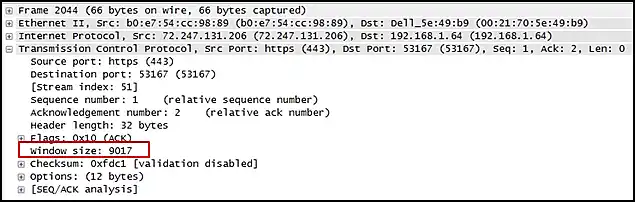
Explanation: Topic 14.6.5 – The window size determines the number of bytes that can be sent before expecting an acknowledgment.
3. To which TCP port group does the port 414 belong?
Explanation: Topic 14.4.3 – Well Known Ports: 0 through 1023.
Registered Ports: 1024 through 49151.
Dynamic/Private : 49152 through 65535.
4. Refer to the exhibit. An administrator is trying to configure the switch but receives the error message that is displayed in the exhibit. What is the problem?

Explanation: Topic 2.2.1 – In order to enter global configuration mode, the command configure terminal, or a shortened version such as config t, must be entered from privileged EXEC mode. In this scenario the administrator is in user EXEC mode, as indicated by the > symbol after the hostname. The administrator would need to use the enable command to move into privileged EXEC mode before entering the configure terminal command.
5. What is a user trying to determine when issuing a ping 10.1.1.1 command on a PC?
Explanation: Topic 13.2.1 – The ping command tests connectivity to a destination.
6. What is a characteristic of a switch virtual interface (SVI)?
Explanation: Topic 2.6.2 – Cisco IOS Layer 2 switches have physical ports for devices to connect. These ports do not support Layer 3 IP addresses. Therefore, switches have one or more switch virtual interfaces (SVIs). These are virtual interfaces because there is no physical hardware on the device associated with it. An SVI is created in software. The virtual interface lets you remotely manage a switch over a network using IPv4 and IPv6. Each switch comes with one SVI appearing in the default configuration “out-of-the-box.” The default SVI is interface VLAN1.
7. Match the descriptions to the terms. (Not all options are used.)
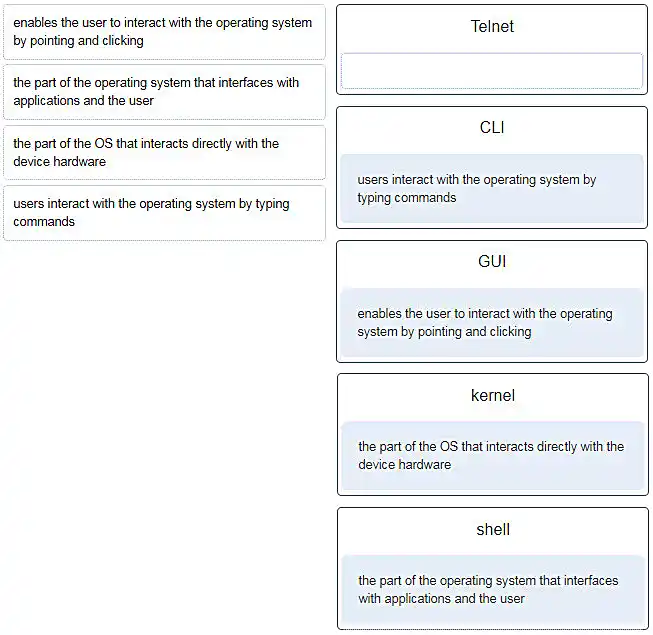
Explanation: Topic 2.1.1 - A GUI, or graphical user interface, allows the user to interact with the operating system by pointing and clicking at elements on the screen. A CLI, or command-line interface, requires users to type commands at a prompt in order to interact with the OS. The shell is the part of the operating system that is closest to the user. The kernel is the part of the operating system that interfaces with the hardware.
| Description | Term |
|---|---|
| the part of the operating system that interfaces with applications and the user | shell |
| users interact with the operating system by typing commands | CLI |
| enables the user to interact with the operating system by pointing and clicking | GUI |
| the part of the OS that interacts directly with the device hardware | kernel |
8. What happens when a switch receives a frame and the calculated CRC value is different than the value that is in the FCS field?
Explanation: Topic 7.1.4 – The purpose of the CRC value in the FCS field is to determine if the frame has errors. If the frame does have errors, then the frame is dropped by the switch.
9. Two network engineers are discussing the methods used to forward frames through a switch. What is an important concept related to the cut-through method of switching?
Explanation: Topic 7.4.2 – Fast-forward switching offers the lowest level of latency and it is the typical cut-through method of switching. Fragment-free switching can be viewed as a compromise between store-and-forward switching and fast-forward switching. Because fast-forward switching starts forwarding before the entire packet has been received, there may be times when packets are relayed with errors.
10. Which two issues can cause both runts and giants in Ethernet networks? (Choose two.)
Explanation: Topic 7.1.4 – Because collisions are a normal aspect of half-duplex communications, runt and giant frames are common by-products of those operations. A malfunctioning NIC can also place frames on the network that are either too short or longer than the maximum allowed length. CRC errors can result from using the wrong type of cable or from electrical interference. Using a cable that is too long can result in late collisions rather than runts and giants.
11. Which two functions are performed at the LLC sublayer of the OSI Data Link Layer to facilitate Ethernet communication? (Choose two.)
Explanation: Topic 7.1.2 – The data link layer is actually divided into two sublayers:
+ Logical Link Control (LLC): This upper sublayer defines the software processes that provide services to the network layer protocols. It places information in the frame that identifies which network layer protocol is being used for the frame. This information allows multiple Layer 3 protocols, such as IPv4 and IPv6, to utilize the same network interface and media.
+ Media Access Control (MAC): This lower sublayer defines the media access processes performed by the hardware. It provides data link layer addressing and delimiting of data according to the physical signaling requirements of the medium and the type of data link layer protocol in use.
11. (Other case) Which two functions are performed at the LLC sublayer of the OSI Data Link Layer to facilitate Ethernet communication? (Choose two.)
Explanation: Topic 7.1.2 – LLC enables multiple Layer 3 protocols and provides interface to upper layers.
11. (Other case) Which two functions are performed at the LLC sublayer of the OSI Data Link Layer to facilitate Ethernet communication? (Choose two.)
Explanation: Topic 7.1.2 – LLC adds control info and enables multiple Layer 3 protocols.
11. (Other case) Which two functions are performed at the LLC sublayer of the OSI Data Link Layer to facilitate Ethernet communication? (Choose two.)
Explanation: Topic 7.1.2 – LLC adds control info and identifies the network layer protocol.
12. Which two commands could be used to check if DNS name resolution is working properly on a Windows PC? (Choose two.)
Explanation: Topic 17.7.5 – The ping command tests the connection between two hosts. When ping uses a host domain name to test the connection, the resolver on the PC will first perform the name resolution to query the DNS server for the IP address of the host. If the ping command is unable to resolve the domain name to an IP address, an error will result. Nslookup is a tool for testing and troubleshooting DNS servers.
13. A small advertising company has a web server that provides critical business service. The company connects to the Internet through a leased line service to an ISP. Which approach best provides cost effective redundancy for the Internet connection?
Explanation: Topic 17.1.4 – With a separate DSL connection to another ISP, the company will have a redundancy solution for the Internet connection, in case the leased line connection fails. The other options provide other aspects of redundancy, but not the Internet connection. The options of adding a second NIC and adding multiple connections between the switches and the edge router will provide redundancy in case one NIC fails or one connection between the switches and the edge router fails. The option of adding another web server provides redundancy if the main web server fails.
14. Only employees connected to IPv6 interfaces are having difficulty connecting to remote networks. The analyst wants to verify that IPv6 routing has been enabled. What is the best command to use to accomplish the task?
Explanation: Topic 12.5.1 – show running-config shows IPv6 routing configuration.
15. Refer to the exhibit. A network administrator is connecting a new host to the Registrar LAN. The host needs to communicate with remote networks. What IP address would be configured as the default gateway on the new host?
Floor(config)# interface gi0/1
Floor(config-if)# description Connects to the Registrar LAN
Floor(config-if)# ip address 192.168.235.234 255.255.255.0
Floor(config-if)# no shutdown
Floor(config-if)# interface gi0/0
Floor(config-if)# description Connects to the Manager LAN
Floor(config-if)# ip address 192.168.234.114 255.255.255.0
Floor(config-if)# no shutdown
Floor(config-if)# interface s0/0/0
Floor(config-if)# description Connects to the ISP
Floor(config-if)# ip address 10.234.235.254 255.255.255.0
Floor(config-if)# no shutdown
Floor(config-if)# interface s0/0/1
Floor(config-if)# description Connects to the Head Office WAN
Floor(config-if)# ip address 203.0.113.3 255.255.255.0
Floor(config-if)# no shutdown
Floor(config-if)# end
Explanation: Topic 10.3.1 – The default gateway is the IP address of the router interface on the same network as the host (192.168.235.234).
16. Match the command with the device mode at which the command is entered. (Not all options are used.)
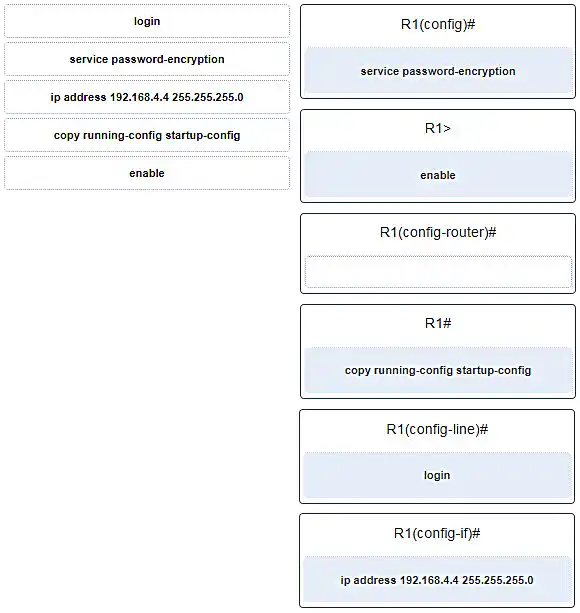
Explanation: Topic 10.1.1 - The enable command is entered in R1> mode. The login command is entered in R1(config-line)# mode. The copy running-config startup-config command is entered in R1# mode. The ip address 192.168.4.4 255.255.255.0 command is entered in R1(config-if)# mode. The service password-encryption command is entered in global configuration mode.
| Command | Mode |
|---|---|
| login | R1(config-line)# |
| ip address 192.168.4.4 255.255.255.0 | R1(config-if)# |
| service password-encryption | R1(config)# |
| enable | R1> |
| copy running-config startup-config | R1# |
17. A router boots and enters setup mode. What is the reason for this?
Explanation: Topic 10.1.1 – The startup configuration file is stored in NVRAM and contains the commands needed to initially configure a router. It also creates the running configuration file that is stored in in RAM.
18. What service is provided by POP3?
Explanation: Topic 15.3.4 – POP3 downloads email to the local client.
19. Two students are working on a network design project. One student is doing the drawing, while the other student is writing the proposal. The drawing is finished and the student wants to share the folder that contains the drawing so that the other student can access the file and copy it to a USB drive. Which networking model is being used?
Explanation: Topic 1.2.2 – File sharing between two devices without a dedicated server is peer-to-peer.
20. Which command is used to manually query a DNS server to resolve a specific host name?
Explanation: Topic 15.4.4 – The nslookup command was created to allow a user to manually query a DNS server to resolve a given host name. The ipconfig /displaydns command only displays previously resolved DNS entries. The tracert command was created to examine the path that packets take as they cross a network and can resolve a hostname by automatically querying a DNS server. The net command is used to manage network computers, servers, printers, and network drives.
21. Which PDU is processed when a host computer is de-encapsulating a message at the transport layer of the TCP/IP model?
Explanation: Topic 3.6.3 – At the transport layer, a host computer will de-encapsulate a segment to reassemble data to an acceptable format by the application layer protocol of the TCP/IP model.
22. Which two OSI model layers have the same functionality as two layers of the TCP/IP model? (Choose two.)
Explanation: Topic 3.5.4 – The OSI transport layer is functionally equivalent to the TCP/IP transport layer, and the OSI network layer is equivalent to the TCP/IP internet layer. The OSI data link and physical layers together are equivalent to the TCP/IP network access layer. The OSI session layer (with the presentation layer) is included within the TCP/IP application layer.
23. Which three layers of the OSI model are comparable in function to the application layer of the TCP/IP model? (Choose three.)
Explanation: Topic 3.5.4 – The TCP/IP model consists of four layers: application, transport, internet, and network access. The OSI model consists of seven layers: application, presentation, session, transport, network, data link, and physical. The top three layers of the OSI model: application, presentation, and session map to the application layer of the TCP/IP model.
24. Network information:
* local router LAN interface: 172.19.29.254 / fe80:65ab:dcc1::10 * local router WAN interface: 198.133.219.33 / 2001:db8:FACE:39::10
* remote server: 192.135.250.103
What task might a user be trying to accomplish by using the ping 2001:db8:FACE:39::10 command?
Explanation: Topic 17.4.1 – Pinging the WAN interface of the local router tests Internet connectivity.
25. Which two ICMP messages are used by both IPv4 and IPv6 protocols? (Choose two.)
Explanation: Topic 13.1.1 – The ICMP messages common to both ICMPv4 and ICMPv6 include: host confirmation, destination (net, host, protocol, port) or service unreachable, time exceeded, and route redirection. Router solicitation, neighbor solicitation, and router advertisement are new protocols implemented in ICMPv6.
26. A network technician types the command ping 127.0.0.1 at the command prompt on a computer. What is the technician trying to accomplish?
Explanation: Topic 13.2.2 – 127.0.0.1 is the loopback address, used to test the local TCP/IP stack.
27. Although CSMA/CD is still a feature of Ethernet, why is it no longer necessary?
Explanation: Topic 7.1.3 – Full-duplex switches eliminate collisions, making CSMA/CD unnecessary.
28. What does a router do when it receives a Layer 2 frame over the network medium?
Explanation: Topic 6.1.3 – Routers are responsible for encapsulating a frame with the proper format for the physical network media they connect. At each hop along the path, a router does the following:Accepts a frame from a medium De-encapsulates the frame Determines the best path to forward the packet Re-encapsulates the packet into a new frame Forwards the new frame appropriate to the medium of that segment of the physical network
29. Which two acronyms represent the data link sublayers that Ethernet relies upon to operate? (Choose two.)
Explanation: Topic 7.1.2 – For Layer 2 functions, Ethernet relies on logical link control (LLC) and MAC sublayers to operate at the data link layer. FCS (Frame Check Sequence) and SFD (Start Frame Delimiter) are fields of the Ethernet frame. CSMA (Carrier Sense Multiple Access) is the technology Ethernet uses to manage shared media access.
30. A network team is comparing topologies for connecting on a shared media. Which physical topology is an example of a hybrid topology for a LAN?
Explanation: Topic 6.2.4 – An extended star topology is an example of a hybrid topology as additional switches are interconnected with other star topologies. A partial mesh topology is a common hybrid WAN topology. The bus and ring are not hybrid topology types.
31. Given network 172.18.109.0, which subnet mask would be used if 6 host bits were available?
Explanation: Topic 11.5.2 – With an IPv4 network, the subnet mask is determined by the hosts bits that are required:
11 host bits required – 255.255.248.0
10 host bits required – 255.255.252.0
9 host bits required – 255.255.254.0
8 host bits required – 255.255.255.0
7 host bits required – 255.255.255.128
6 host bits required – 255.255.255.192
5 host bits required – 255.255.255.224
4 host bits required – 255.255.255.240
3 host bits required – 255.255.255.248
2 host bits required – 255.255.255.252
32. Three devices are on three different subnets. Match the network address and the broadcast address with each subnet where these devices are located. (Not all options are used.)
Device 1: IP address 192.168.10.77/28 on subnet 1
Device 2: IP address192.168.10.17/30 on subnet 2
Device 3: IP address 192.168.10.35/29 on subnet 3
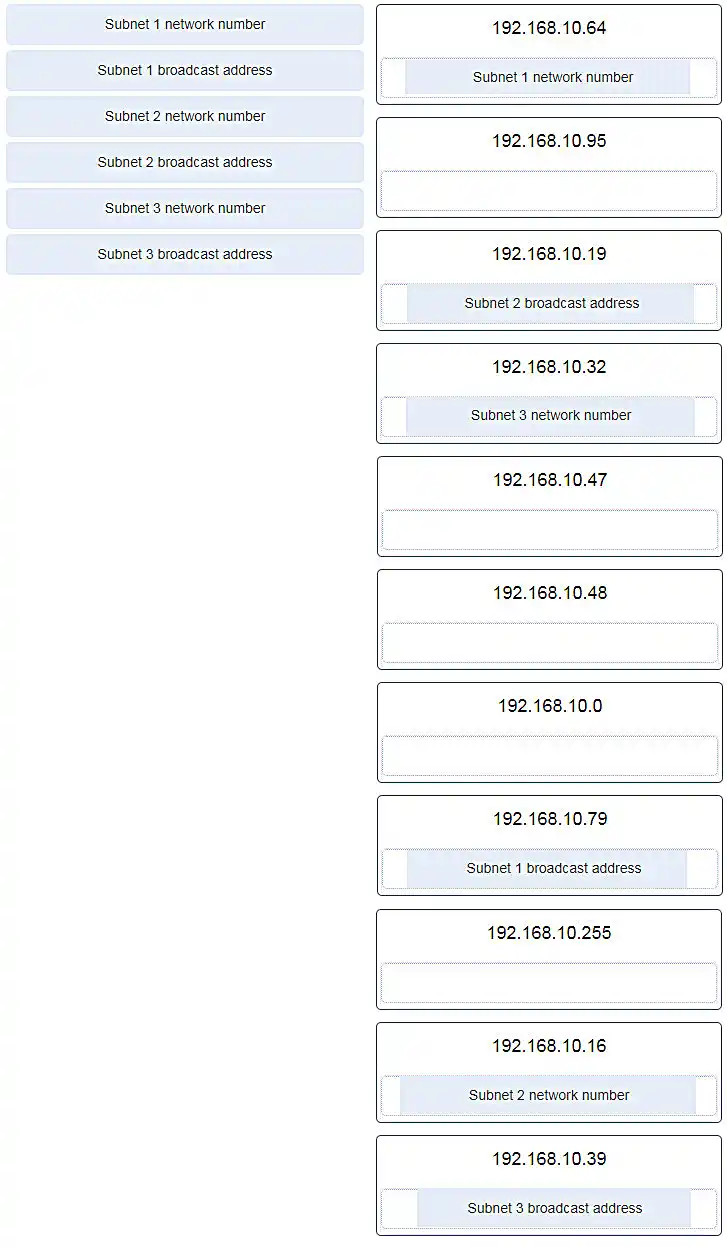
Explanation: Topic 11.5.2 - To calculate any of these addresses, write the device IP address in binary. Draw a line showing where the subnet mask 1s end. For example, with Device 1, the final octet (77) is 01001101. The line would be drawn between the 0100 and the 1101 because the subnet mask is /28. Change all the bits to the right of the line to 0s to determine the network number (01000000 or 64). Change all the bits to the right of the line to 1s to determine the broadcast address (01001111 or 79).
| Item | Address |
|---|---|
| Subnet 2 network number | 192.168.10.16 |
| Subnet 1 broadcast address | 192.168.10.79 |
| Subnet 3 broadcast address | 192.168.10.39 |
| Subnet 2 broadcast address | 192.168.10.19 |
| Subnet 1 network number | 192.168.10.64 |
| Subnet 3 network number | 192.168.10.32 |
33. What type of address is 198.133.219.162?
Explanation: Topic 11.3.1 – 198.133.219.162 is a public IPv4 address.
34. What does the IP address 192.168.1.15/29 represent?
Explanation: Topic 11.1.6 – A broadcast address is the last address of any given network. This address cannot be assigned to a host, and it is used to communicate with all hosts on that network.
35. Why is NAT not needed in IPv6?
Explanation: Topic 12.1.1 – The large number of public IPv6 addresses eliminates the need for NAT. Sites from the largest enterprises to single households can get public IPv6 network addresses. This avoids some of the NAT-induced application problems that are experienced by applications that require end-to-end connectivity.
36. What routing table entry has a next hop address associated with a destination network?
Explanation: Topic 8.5.2 – Routing table entries for remote routes will have a next hop IP address. The next hop IP address is the address of the router interface of the next device to be used to reach the destination network. Directly-connected and local routes have no next hop, because they do not require going through another router to be reached.
37. Which term describes a field in the IPv4 packet header that contains a unicast, multicast, or broadcast address?
Explanation: Topic 8.2.2 – The destination IPv4 address can be unicast, multicast, or broadcast.
38. If the default gateway is configured incorrectly on the host, what is the impact on communications?
Explanation: Topic 10.3.1 – A default gateway is only required to communicate with devices on another network. The absence of a default gateway does not affect connectivity between devices on the same local network.
39. Which is the compressed format of the IPv6 address fe80:0000:0000:0000:0220:0b3f:f0e0:0029?
Explanation: Topic 12.2.3 – Compress leading zeros and use :: once.
40. Refer to the exhibit. A user issues the command netstat –r on a workstation. Which IPv6 address is one of the link-local addresses of the workstation?
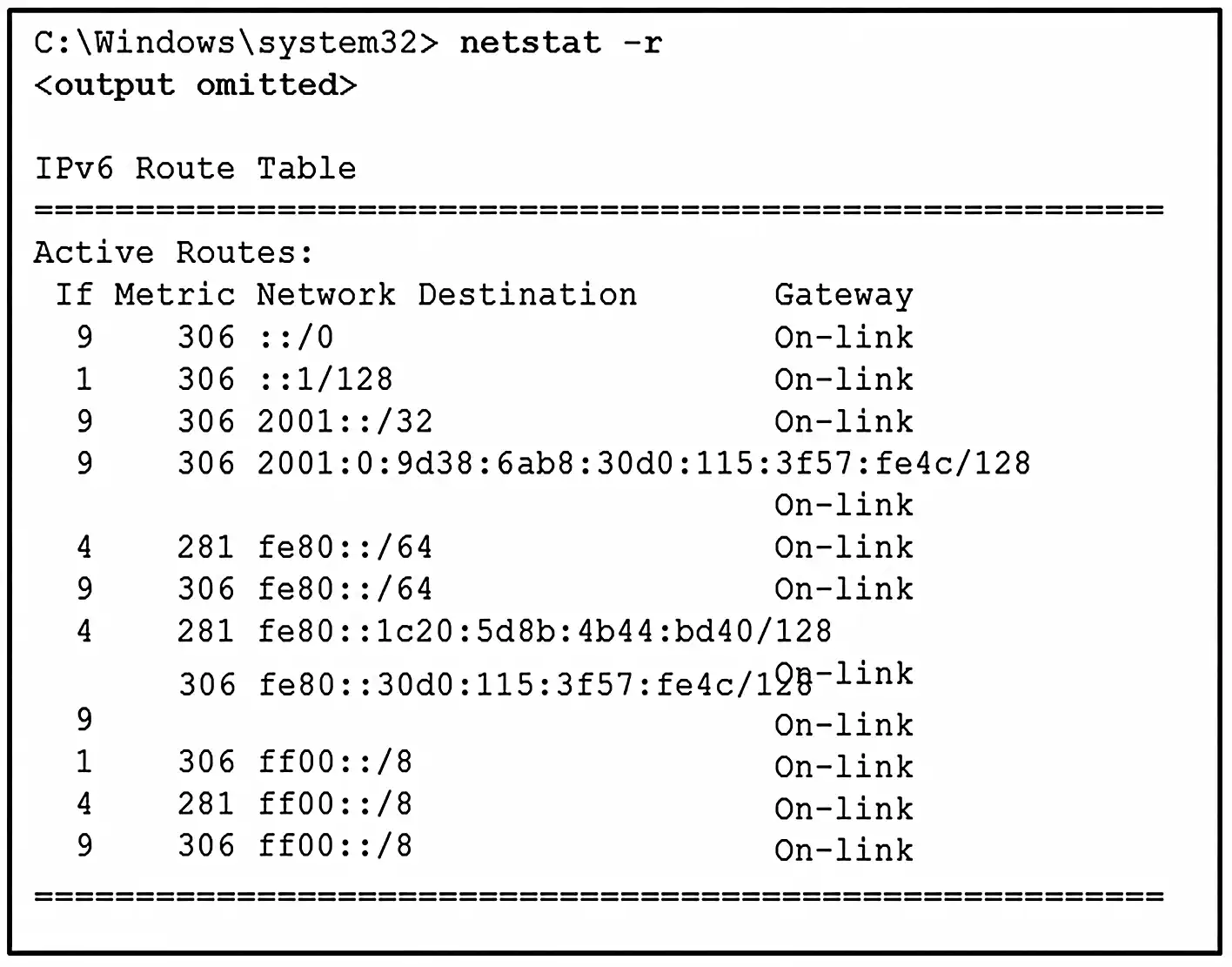
Explanation: Topic 12.3.7 – In the IPv6 address scheme, the network of fe80::/10 is reserved for link-local addresses. The address fe80::/64 is a network address that indicates, in this workstation, fe80::/64 is actually used for link-local addresses. Thus the address fe80::30d0:115:3f57:fe4c/128 is a valid IPv6 link-local address.
41. What type of IPv6 address is represented by ::1/128?
Explanation: Topic 12.3.3 – ::1 is the IPv6 loopback address.
42. Which statement describes network security?
Explanation: Topic 1.6.5 – Network security protects data confidentiality and availability.
43. Which two devices would be described as intermediary devices? (Choose two.)
Explanation: Topic 1.2.4 – Intermediary devices include wireless LAN controllers and IPS.
44. What characteristic describes spyware?
Explanation: Topic 1.8.1 – Spyware collects user information without consent.
45. Refer to the exhibit. The exhibit shows a small switched network and the contents of the MAC address table of the switch. PC1 has sent a frame addressed to PC3. What will the switch do with the frame?
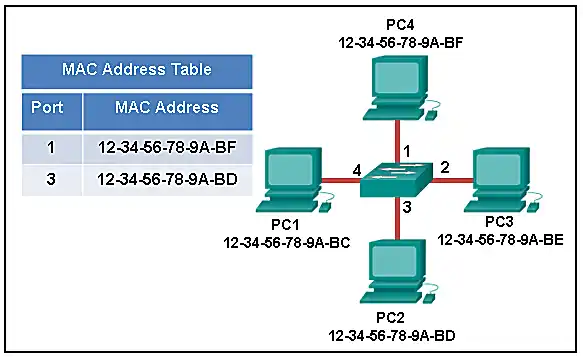
Explanation: Topic 7.3.2 – The MAC address of PC3 is not present in the MAC table of the switch. Because the switch does not know where to send the frame that is addressed to PC3, it will forward the frame to all the switch ports, except for port 4, which is the incoming port.
46. Which destination address is used in an ARP request frame?
Explanation: Topic 9.2.3 – The purpose of an ARP request is to find the MAC address of the destination host on an Ethernet LAN. The ARP process sends a Layer 2 broadcast to all devices on the Ethernet LAN. The frame contains the IP address of the destination and the broadcast MAC address, FFFF.FFFF.FFFF. The host with the IP address that matches the IP address in the ARP request will reply with a unicast frame that includes the MAC address of the host. Thus the original sending host will obtain the destination IP and MAC address pair to continue the encapsulation process for data transmission.
47. Refer to the exhibit. PC1 issues an ARP request because it needs to send a packet to PC3. In this scenario, what will happen next?
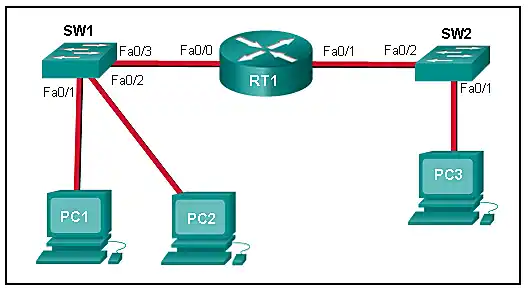
Explanation: Topic 9.2.5 – When a network device has to communicate with a device on another network, it broadcasts an ARP request asking for the default gateway MAC address. The default gateway (RT1) unicasts an ARP reply with the Fa0/0 MAC address.
48. A network administrator is issuing the login block-for 180 attempts 2 within 30 command on a router. Which threat is the network administrator trying to prevent?
Explanation: Topic 16.4.3 – The login block-for 180 attempts 2 within 30 command will cause the device to block authentication after 2 unsuccessful attempts within 30 seconds for a duration of 180 seconds. A device inspecting the traffic on a link has nothing to do with the router. The router configuration cannot prevent unauthorized access to the equipment room. A worm would not attempt to access the router to propagate to another part of the network.
49. Which statement describes the characteristics of packet-filtering and stateful firewalls as they relate to the OSI model?
Explanation: Topic 16.3.6 – Packet filtering firewalls can always filter Layer 3 content and sometimes TCP and UDP-based content. Stateful firewalls monitor connections and thus have to be able to support up to the session layer of the OSI model.
50. What are two ways to protect a computer from malware? (Choose two.)
Explanation: Topic 1.8.2 – Antivirus and software updates are key defenses.
51. The employees and residents of Ciscoville cannot access the Internet or any remote web-based services. IT workers quickly determine that the city firewall is being flooded with so much traffic that a breakdown of connectivity to the Internet is occurring. Which type of attack is being launched at Ciscoville?
Explanation: Topic 16.2.4 – A DoS attack floods a service, making it unavailable.
52. Which two statements describe the characteristics of fiber-optic cabling? (Choose two.)
Explanation: Topic 4.5.6 – Fiber-optic cabling is primarily used for high-traffic backbone cabling and does not conduct electricity. Multimode fiber uses LEDs for signaling and single-mode fiber uses laser technology. FIber-optic cabling carries signals from only one device to another.
53. What OSI physical layer term describes the measure of the transfer of bits across a medium over a given period of time?
Explanation: Topic 4.2.6 – Throughput measures actual bit transfer rate.
54. Refer to the exhibit. What is the maximum possible throughput between the PC and the server?

Explanation: Topic 4.2.6 – The maximum throughput is determined by the slowest link (128 kb/s).
55. Match the description with the media. (Not all options are used.)
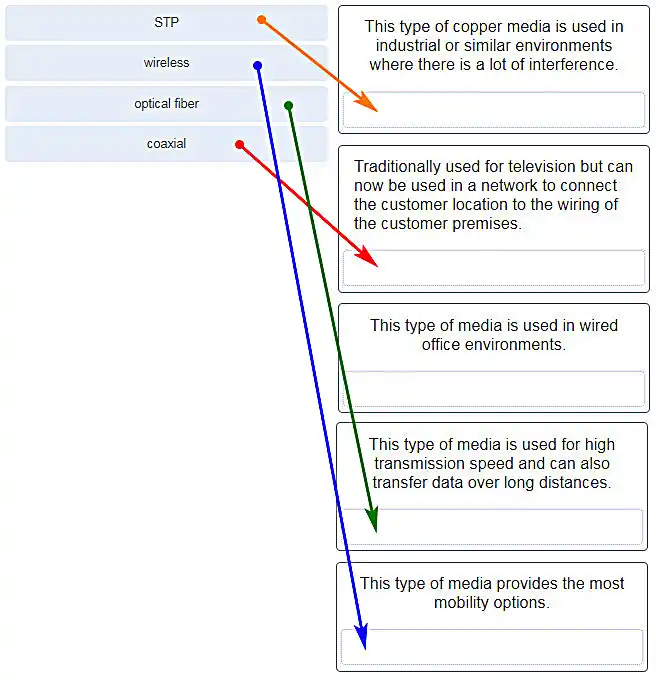
Explanation: Topic 4.3.2 - UTP cables are used in wired office environments. Coaxial cables are used to connect cable modems and televisions. Fiber optics are used for high transmission speeds and to transfer data over long distances. STP cables are used in environments where there is a lot of interference.
| Media | Description |
|---|---|
| wireless | This type of media provides the most mobility options. |
| coaxial | Traditionally used for television but can now be used in a network to connect the customer location to the wiring of the customer premises. |
| optical fiber | This type of media is used for high transmission speed and can also transfer data over long distances. |
| STP | This type of copper media is used in industrial or similar environments where there is a lot of interference. |
56. A Wireshark capture is shown with the Transmission Control Protocol section expanded. The item highlighted states Window size: 9017.
Explanation: Topic 13.2.2 – 127.0.0.1 is the loopback address, used to test the local TCP/IP stack.
🚀 Ace Your CCNA Exam - Complete Study Pack!
Get 500+ exam-realistic questions, Packet Tracer labs, and detailed explanations.
CCNA 1 v7 ITNv7 Practice Final Exam
This practice final exam covers all topics from the Introduction to Networks v7.0 (ITN) course. It is designed to test your knowledge of networking fundamentals, OSI and TCP/IP models, IP addressing, subnetting, Ethernet, switching, routing, network security, and troubleshooting. Use this comprehensive study guide to prepare for the actual course final exam.
Key Topics Covered
- Network Fundamentals: Network types, topologies, models (client-server, peer-to-peer), and common protocols.
- OSI and TCP/IP Models: Layers and their functions, encapsulation, de-encapsulation, PDUs.
- IP Addressing and Subnetting: IPv4 and IPv6 addressing, subnet masks, prefix lengths, VLSM, and CIDR.
- Ethernet and Switching: Frame structure, MAC addressing, switch operation, CSMA/CD, switching methods (store-and-forward, cut-through).
- Routing: Router operation, routing tables, default gateway, ARP, and ICMP.
- Network Security: Threats, attacks (DoS, reconnaissance), firewalls, SSH, and password policies.
- Troubleshooting: Ping, traceroute, show commands, CDP, and protocol analyzers.
Practice these questions to solidify your understanding and identify areas for further study. Good luck on your final exam!