Canon Foundation Research Fellowship (2026-2027)
Fellowship Description
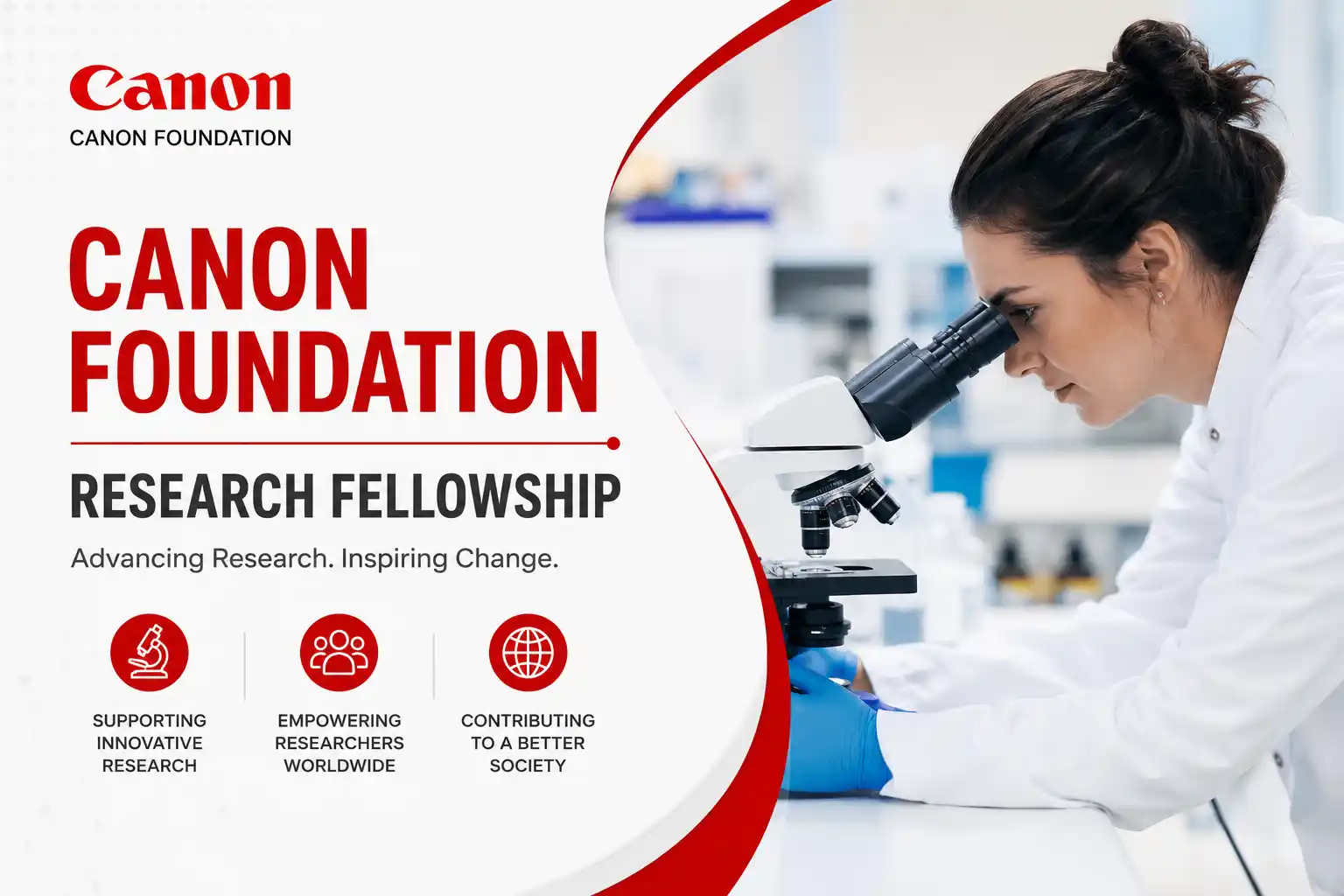
The Canon Foundation Research Fellowship is a prestigious programme that annually grants up to 15 Fellowships to highly qualified European and Japanese researchers. European Fellows are expected to pursue a period of research in Japan, whereas Japanese Fellows are expected to conduct their research in Europe. The fellowship aims to advance research, inspire change, and contribute to a better society by fostering international research collaboration between Europe and Japan.
The Canon Foundation in Europe supports all fields of research without any limitations or restrictions. Applicants do not have to be currently enrolled or employed at the time of applying. Fellowships may be awarded to members of commercial, industrial, governmental, or professional organisations, provided an agreement on cooperation and a research plan has been reached between the guest researcher and the proposed host institution.
Fellowship Location
European researchers conduct research in Japan at a host institution of their choice.
Japanese researchers conduct research in Europe at a host institution of their choice.
Fellows are free to choose their host institutes and hosts in the destination region.
Application Deadline
The next application deadline is 15 September 2026 for fellowships starting between January and December 2027.
Application Deadline: September 15, 2026
Final decision notification: By mid-December 2026 (via email)
Fellowship period: Minimum 3 months – Maximum 12 months (starting between January and December 2027)
Host Institution
The Canon Foundation in Europe – a philanthropic organisation established by Canon Inc. to promote international scientific and cultural relations between Europe and Japan. Fellows may choose any recognised research institution, university, laboratory, or organisation in the host country, provided an agreement has been reached with the proposed host.
Fields of Study
All fields of research are supported. There are no limitations or restrictions. Examples include but are not limited to: natural sciences, engineering, social sciences, humanities, medical sciences, environmental studies, arts, economics, law, political science, and interdisciplinary research.
Target Group
European researchers (including UK, Israel, Switzerland, Turkey, Balkan countries, and Baltic countries) who wish to conduct research in Japan.
Japanese researchers who wish to conduct research in Europe.
Priority is given to applicants who are going to Europe or Japan for the first time.
Fellowship Duration & Amount
Duration: Minimum 3 months – Maximum 12 months (pro-rata for different periods).
Financial support: Up to €30,000 per year (pro-rated for shorter periods).
Usage of funds: The Research Fellow can decide what costs the grant can be used for. There are no restrictions. Examples include:
- Living costs (accommodation, meals, daily expenses)
- Travel expenses (international and local transportation)
- Research costs (materials, equipment, laboratory fees)
- Books and academic literature
- Insurance (health, travel, liability)
- Any other reasonable costs related to the research stay
💰 Funding Summary:
Up to €30,000 per year (pro-rated for periods shorter than 12 months).
Flexible usage: Fellows decide how to allocate the grant (living, travel, research, books, insurance, etc.).
Number of fellowships: Up to 15 fellowships awarded annually.
Eligibility Criteria
Nationality / Residency:
- European applicants: All Europeans are eligible to apply, including nationals of the United Kingdom, Israel, Switzerland, Turkey, Balkan countries, and Baltic countries.
- Japanese applicants: Japanese nationals.
Academic qualification: Applicants should have obtained at least a Master's or PhD degree within the last ten years of applying. The Foundation will also consider candidates who obtained their qualification more than ten years ago, provided they include further supporting information in their application.
Host institution agreement: Applicants must have reached an agreement on cooperation and a research plan with the proposed host institution before applying.
Employment status: Applicants do not have to be currently enrolled or employed at the time of applying. Members of commercial, industrial, governmental, or professional organisations may also apply.
Priority criteria: Priority is given to:
- Applicants going to Europe or Japan for the first time (rather than prolonging a current stay).
- Applicants with a well-defined research plan, strong reference letters, and host confirmation.
✅ Eligible Candidates
- European nationals (including UK, Israel, Switzerland, Turkey, Balkan & Baltic countries) applying to research in Japan.
- Japanese nationals applying to research in Europe.
- Hold at least a Master's or PhD degree (obtained within the last 10 years preferred; older qualifications considered with supporting information).
- Have secured an agreement with a host institution in the destination country.
- All fields of research are welcome.
❌ Less Competitive / Ineligible Candidates
- Applicants who do not hold at least a Master's degree.
- Those who have not secured a host institution agreement before applying.
- Applicants who have already spent significant research time in the destination country (priority given to first-time researchers).
- Nationals from countries outside Europe (for European Fellowship) and outside Japan (for Japanese Fellowship).
Application Procedure
- Identify a host institution and host researcher – Before applying, you must reach an agreement on cooperation and a research plan with a proposed host institution in your destination country (Europe for Japanese applicants; Japan for European applicants).
- Prepare your research proposal – Develop a clear, well-defined research plan outlining your objectives, methodology, expected outcomes, and the relevance of conducting the research in the host country.
- Secure reference letters – Arrange for at least two strong reference letters from academic or professional referees who can attest to your qualifications and research potential.
- Register and complete the online application – Apply through the Canon Foundation's online application form (available on their website). After registering, you will be directed to the application form and will see the documents required for upload.
- Submit all required documents – Upload your research plan, host confirmation letter, reference letters, CV, degree certificates, and any supporting information (especially if your degree was obtained more than 10 years ago).
- Submit before the deadline – Ensure your complete application is submitted by 15 September 2026.
- Await decision – The Selection Committee's final decision will be emailed to applicants by mid-December 2026. Please note that the Foundation does not enter into correspondence regarding decisions on individual applications.
Success rate: The average success rate is around 10%. Funding decisions are based on the quality of the research plan, the reference letters, and the host confirmation. The success rate is not influenced by gender, age, or nationality.
Important note: The Foundation does not enter into any correspondence regarding decisions taken on any individual application. No negative inference should be drawn from the failure of a candidate to secure a Fellowship, given the large number of applicants.
Official Website & Application Link
Canon Foundation – Research Fellowships Official Page
Application: Online application form available on the Canon Foundation website. After registering, you will be directed to the application form.
💡 Final Thoughts and Key Recommendations
The Canon Foundation Research Fellowship is a unique and prestigious opportunity for European and Japanese researchers to conduct international research with substantial financial support (up to €30,000) and complete flexibility in how the grant is used. With only up to 15 fellowships awarded annually and a success rate of approximately 10%, the competition is strong.
Key strategies for a successful application:
- Secure a host institution agreement early – This is mandatory. Reach out to potential hosts well before the deadline and establish a clear collaboration plan.
- Develop a strong, well-defined research proposal – Explain why conducting the research in the host country (Europe or Japan) is essential and what unique resources or expertise the host institution offers.
- Obtain excellent reference letters – Choose referees who can speak to your research abilities and potential for cross-cultural collaboration.
- Highlight first-time travel to the destination region – Priority is given to those going to Europe or Japan for the first time rather than prolonging a current stay.
- If your degree was obtained more than 10 years ago – Include additional supporting information explaining your continued research engagement and why this fellowship is important at this stage of your career.
- Apply early – While the deadline is 15 September, submitting earlier allows time to resolve any technical issues with the online application system.
Important reminders: The Foundation does not enter into correspondence regarding individual decisions. A rejection should not be seen negatively given the high volume of applicants. The selection committee's decision is final and based solely on the quality of the research plan, reference letters, and host confirmation — not on gender, age, or nationality.
Canon Foundation Research Fellowship 2026-2027 – FAQ
What does the Canon Foundation Research Fellowship cover?
The fellowship provides up to €30,000 per year (pro-rated for shorter periods). Fellows decide how to use the grant — for living costs, travel, research expenses, books, insurance, or any other reasonable costs with no restrictions.
What is the application deadline?
The deadline is 15 September 2026 for fellowships starting between January and December 2027.
Who is eligible to apply?
European researchers (including UK, Israel, Switzerland, Turkey, Balkan and Baltic countries) for research in Japan, and Japanese researchers for research in Europe. Applicants must hold at least a Master's or PhD degree (preferably within the last 10 years).
Do I need a host institution before applying?
Yes. You must reach an agreement on cooperation and a research plan with a proposed host institution in your destination country before submitting your application.
How long is the fellowship?
Minimum 3 months, maximum 12 months.
What is the success rate?
The average success rate is around 10%. Decisions are based on the quality of the research plan, reference letters, and host confirmation.
Can I apply if I obtained my degree more than 10 years ago?
Yes, but you must provide additional supporting information in your application explaining your continued research engagement.
Is there priority for first-time researchers?
Yes. Priority is given to applicants who are going to Europe or Japan for the first time, rather than those prolonging a current stay.
🎓 Countries Scholarships
 Austria scholarships
 Australia scholarships
 Belgium scholarships
 Brazil scholarships
- Belgium scholarships
 Canada scholarships
 China scholarships
- CSC China scholarships
 Czech Republic scholarships
 Denmark scholarships
 Finland scholarships
 France scholarships
 Germany scholarships
 Hungary scholarships
 Indonesia scholarships
 Ireland scholarships
 Italy scholarships
 Japan scholarships
 Kenya scholarships
 Luxembourg scholarships
 Malaysia scholarships
 Nepal scholarships
 Netherlands scholarships
 Newzealand scholarships
 Nigeria scholarships
 Norway scholarships
 Pakistan scholarships
 Poland scholarships
 Portugal scholarships
 Qatar scholarships
 Russia scholarships
 Saudi Arabia scholarships
 Singapore scholarships
 South Africa scholarships
 South Korea scholarships
 Spain scholarships
 Sweden scholarships
 Switzerland scholarships
 Taiwan scholarships
 Tanzania scholarships
 Thailand scholarships
 Turkey scholarships
 UAE scholarships
 Uganda scholarships
 UK scholarships
 USA scholarships
 Vietnam scholarships