DAAD Weimar Triangle PhD Scholarship 2026 – Fully Funded Research in Germany
Scholarship Description
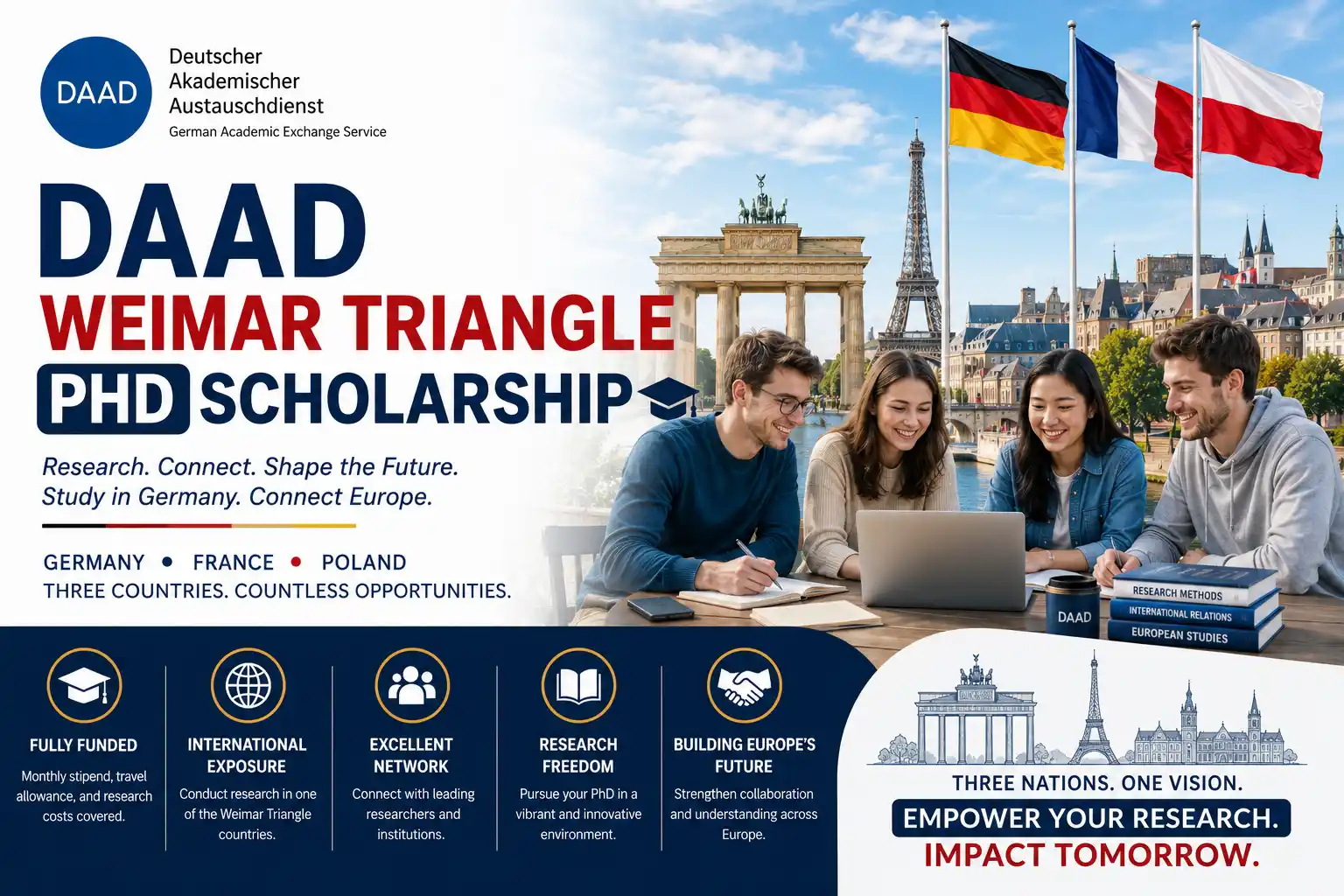
The DAAD Weimar Triangle PhD Scholarship (Future Network Weimar Triangle: Science for Europe) is a prestigious, fully funded programme for doctoral candidates from all disciplines. It aims to expand the political initiative "Weimar Triangle" — launched in 1991 by the foreign ministers of Germany, France, and Poland — into a sustainable science platform promoting trilateral cooperation between these three nations.
The programme funds research stays in Germany lasting 3 to 12 months and supports innovative research projects addressing European and global challenges. Scholars become part of interdisciplinary working groups that build long-term networks, fostering European integration and strengthening the European Research Area.
Scholarship Location
The scholarship funds research stays at universities or non-university research institutions in Germany. The programme promotes cooperation between Germany, France, and Poland (the Weimar Triangle countries). Scholars are part of a trilateral network.
Scholarship Deadline
Application Deadline: June 15, 2026 (DAAD portal closes at 24:00 CET/CEST)
Selection Period: July through mid-August 2026
Earliest Funding Start: October 2026
Recommendation: Apply at least 2–3 weeks before the deadline. Do not submit on the final date.
Host Institution
DAAD (German Academic Exchange Service) – the largest German support organisation for international academic cooperation. Research stays take place at German universities or non-university research institutions (e.g., Max Planck Institutes, Fraunhofer Institutes, Helmholtz centres, Leibniz institutes).
Level and Research Areas
Level: PhD / Doctoral candidates (from all disciplines).
Eligible research topics (five future-oriented clusters):
- Technologies for climate-neutral energy production and mobility, and climate protection (e.g., fusion technologies, decarbonisation, renewable energy, energy storage, cross-border infrastructure)
- Artificial intelligence and digitalisation, and microelectronics (e.g., strengthening Europe's digital sovereignty, AI applications, ethical standards, cybersecurity, AI-enabled chip applications)
- Security in Europe and the resilience of the scientific system (e.g., knowledge security, research data security, countering hybrid threats, risk management, critical raw materials, science communication)
- Biotechnology and medicine of the future (e.g., resilient agricultural and food systems, innovative diagnostics and therapies, bioeconomy, medical technology, sustainable health research)
- Challenges, impacts, and benefits of new technologies on and for society (social sciences and humanities research, e.g., human-machine interaction, challenges posed by new technologies to the state and society in Europe)
Target Group
PhD students from all disciplines who wish to apply for a research stay in Germany (3–12 months) and would like to get involved in the Weimar Triangle network. Applicants should be enrolled in a doctoral programme (or individual doctorate) in France or Poland, or wish to conduct research in Germany as part of their doctorate. Applications may also be submitted as a tandem (joint research project with other applicants).
Residency requirement: Your application cannot be considered if you have been resident in Germany for longer than 15 months at the application deadline.
Scholarship Duration & Amount
Duration: 3 to 12 months (funding may be used flexibly for several shorter stays within a 12-month period starting October 2026, if necessary).
Financial benefits include:
- Monthly scholarship instalment: €1,400 per month
- Lump sum towards international travel costs (amount varies by country)
- Payments towards health, accident, and personal liability insurance
- Monthly lump sum for research expenses: €102 per month
- Lump sum grants for attending conferences in the countries of the Weimar Triangle
- Monthly allowance for accompanying family members (only for funding periods over 6 months)
- Monthly rent subsidy (only for funding periods over 6 months, subject to conditions)
- Allowance for language courses taken during the scholarship period
- Subsidy for additional costs resulting from disability or chronic illness (if not covered by other providers)
- Funding for an annual in-person networking meeting organised by the selected working group
Additional opportunity: Outstanding trilateral projects will be awarded a research prize at the closing forum in Germany.
📊 Summary of Benefits:
€1,400/month stipend + €102/month research expenses + Travel allowance + Insurance + Conference grants + Family/rent allowances (for stays >6 months) + Language course allowance + Networking meeting funding
Scholarship Eligibility
Academic timeline requirements:
- As a rule, applicants should not have graduated any longer than 6 years before the application deadline.
- If you have already started your doctorate, the start of the doctorate should not be longer than 3 years ago.
Residency in Germany: Your application cannot be considered if you have been resident in Germany for longer than 15 months at the application deadline.
Language skills: Very good English language skills are essential. However, DAAD does not require an official English test. The author of the invitation letter must confirm that your English language skills are sufficient to pursue the research project in Germany.
Working group participation: Applicants must choose which of the five future-focused working groups they wish to join and demonstrate how they will contribute.
✅ Eligible Candidates
- PhD students from all disciplines.
- Graduated within the last 6 years; doctorate started within last 3 years.
- Resident in Germany for less than 15 months at deadline.
- Very good English skills (confirmed by host).
- Research project aligns with one of the five future-oriented topics.
- Enrolled in a doctoral programme (or individual doctorate) in France or Poland, or applying from elsewhere to conduct research in Germany.
❌ Ineligible Candidates
- Applicants who graduated more than 6 years ago.
- Doctoral candidates who started their PhD more than 3 years ago.
- Those resident in Germany for more than 15 months.
- Applicants without sufficient English language skills.
- Research projects that do not align with the five priority areas.
Application Procedure
- Register on the DAAD portal – Access the DAAD scholarship portal at https://portal.daad.de. Registration is required to complete the online application.
- Identify a host supervisor/institution in Germany – Contact a potential academic host at a German university or research institution. Obtain a confirmation that includes details of the working language, confirmation of your English skills, and a guarantee of a workplace.
- Prepare required documents – Gather all application materials in PDF format.
- Request recommendation form – Generate the DAAD recommendation form in the portal as a writable PDF. Send it to a university teacher who can provide a supporting letter of recommendation.
- Complete the online application – Fill out the application form in the DAAD portal. Upload all required documents under the appropriate sections. Submit the application online before June 15, 2026.
- Selection process – Applications are reviewed by selection committees composed of professors and lecturers from German universities and research institutions. Selection criteria include academic qualifications, quality of research proposal, feasibility, and alignment with programme objectives.
- Notification – Successful applicants are notified after the selection period (July–mid-August 2026). Funding begins in October 2026.
Required application documents (to be uploaded to DAAD portal):
- Full CV in tabular form (max. 3 pages)
- Letter of motivation (1–3 pages) – addressing personal/professional gains, which working group you wish to join, why, and how you will contribute
- Research proposal and description of previous research work (max. 10 pages total)
- Schedule of planned research work
- University degree certificate and transcripts of records (Master or equivalent; Bachelor if Master not yet completed)
- Declaration from scientific supervisor in Germany on safety-relevant and ethical aspects of the research project
- Confirmation from academic host or host institution in Germany (including working language, English skill confirmation, workplace guarantee)
- Proof of admission as a doctoral candidate at the home university
- Summary of final thesis (Master or equivalent, approx. 1 page)
- List of publications (max. 10 pages, if applicable)
- Proof of language proficiency (only if fieldwork/interviews in a language other than the working language)
- One recent letter of recommendation from a university teacher (on DAAD form)
- Optional: other supporting documents (employment certificates, proof of social commitment, etc.)
Documents that are not yet available can be submitted later — upload a free-form statement explaining when they will be available.
Official Website & Application Link
DAAD Scholarship Database – Weimar Triangle PhD Scholarship
DAAD Portal: https://portal.daad.de
Programme Email: weimartriangle@daad.de
DAAD Info-Center Phone: +49 228 882 180 (Mon–Thu 9am–12pm & 2pm–4pm, Fri 9am–2pm CET/CEST)
Technical Portal Hotline: +49 (0) 228 882-8888 (weekdays 9am–12pm and 2pm–4pm CET/CEST)
Technical Email: portal@daad.de
💡 Final Thoughts and Key Requirements
The DAAD Weimar Triangle PhD Scholarship is a unique opportunity for doctoral candidates to conduct research in Germany while becoming part of a trilateral network spanning Germany, France, and Poland. With a generous monthly stipend of €1,400 plus research expenses, travel allowance, and conference funding, scholars can focus entirely on their research and networking activities.
Key strategies for a successful application:
- Ensure your research project aligns with one of the five future-oriented topics.
- Identify a host supervisor in Germany early and secure a confirmation letter that includes confirmation of your English skills.
- Prepare a detailed research proposal (max. 10 pages) with a clear schedule.
- Write a compelling motivation letter explaining which working group you wish to join and how you will contribute.
- Secure a strong recommendation letter from a university teacher.
- Submit your application well before the June 15, 2026 deadline.
- If possible, apply as a tandem with another researcher working on a joint project.
Important reminders: You cannot have been resident in Germany for more than 15 months. Your graduation should be within the last 6 years, and if you have started your doctorate, it should be within the last 3 years. The scholarship may be used flexibly for several shorter stays within the 12-month funding period. Outstanding projects may receive a research prize at the closing forum.
DAAD Weimar Triangle PhD Scholarship 2026 – FAQ
What does the Weimar Triangle PhD Scholarship cover?
€1,400 monthly stipend, €102 monthly research expenses, travel allowance, health/accident/liability insurance, conference grants, family allowance (if applicable), rent subsidy (for stays >6 months), language course allowance, and networking meeting funding.
What is the application deadline?
The deadline is June 15, 2026. Applications are submitted online through the DAAD portal.
Who is eligible to apply?
PhD students from all disciplines who graduated within the last 6 years (doctorate started within last 3 years), have very good English skills, have been resident in Germany for less than 15 months, and whose research aligns with one of the five future-oriented topics.
Do I need to know German?
No. Very good English language skills are essential. German is not required, but knowledge of the local language is considered an asset in the motivation criteria.
Can I split the funding into several shorter stays?
Yes. The scholarship may be used flexibly for several shorter stays within a 12-month period starting October 2026. You must provide a timetable outlining the breakdown of stays.
How do I apply for the scholarship?
Register on the DAAD portal (portal.daad.de), identify a host supervisor in Germany, prepare your documents (CV, motivation letter, research proposal, recommendation letter, host confirmation), and submit the online application by June 15, 2026.
Can I apply as part of a tandem?
Yes. Applications may be submitted as a tandem (joint research project with other applicants). Indicate this in the comments field of the application form.
When does funding begin?
The earliest funding start is October 2026.
🎓 Countries Scholarships
 Austria scholarships
 Australia scholarships
 Belgium scholarships
 Brazil scholarships
- Belgium scholarships
 Canada scholarships
 China scholarships
- CSC China scholarships
 Czech Republic scholarships
 Denmark scholarships
 Finland scholarships
 France scholarships
 Germany scholarships
 Hungary scholarships
 Indonesia scholarships
 Ireland scholarships
 Italy scholarships
 Japan scholarships
 Kenya scholarships
 Luxembourg scholarships
 Malaysia scholarships
 Nepal scholarships
 Netherlands scholarships
 Newzealand scholarships
 Nigeria scholarships
 Norway scholarships
 Pakistan scholarships
 Poland scholarships
 Portugal scholarships
 Qatar scholarships
 Russia scholarships
 Saudi Arabia scholarships
 Singapore scholarships
 South Africa scholarships
 South Korea scholarships
 Spain scholarships
 Sweden scholarships
 Switzerland scholarships
 Taiwan scholarships
 Tanzania scholarships
 Thailand scholarships
 Turkey scholarships
 UAE scholarships
 Uganda scholarships
 UK scholarships
 USA scholarships
 Vietnam scholarships