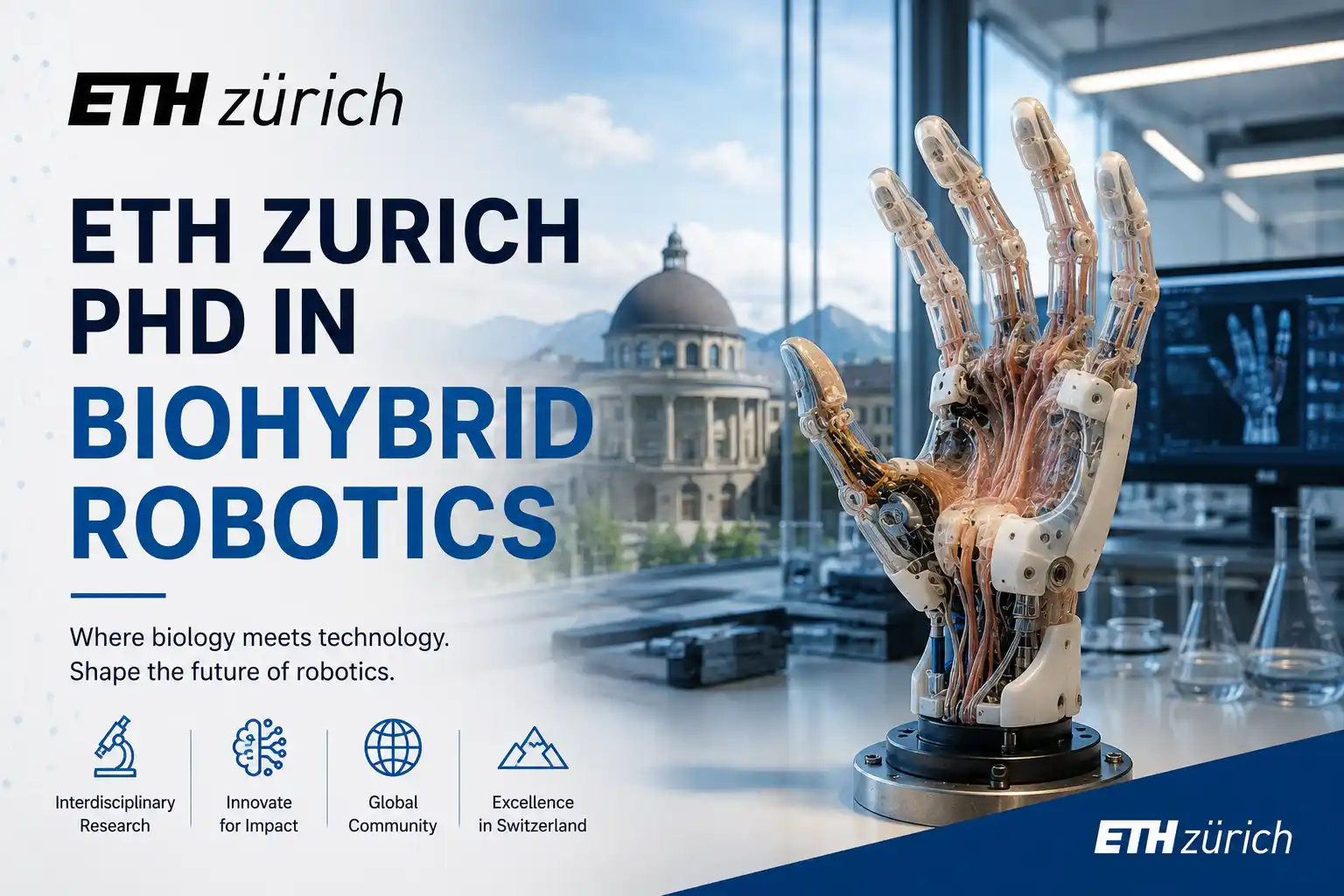
ETH Zurich PhD Scholarship in Biohybrid Robotics (2026) – Soft Robotics Lab
Scholarship Description
The ETH Zurich PhD position in Biohybrid Robotics offers a unique opportunity to build the next generation of muscle-actuated robots at the world-renowned Soft Robotics Lab (SRL) within the Institute of Robotics and Intelligent Systems. The lab's recent groundbreaking work has been published in Science Advances and Advanced Intelligent Systems, demonstrating 3D-bioprinted muscle-tendon interfaces with enhanced force transmission and sensor-embedded muscle enabling closed-loop proprioceptive control.
Biohybrid robotics sits at the frontier of soft robotics, replacing classic soft materials used for actuators with biological muscle tissue to take advantage of the innate adaptability, energy efficiency, and softness of biological systems. Recent work in the field has demonstrated fish-like swimming bio-bots, caterpillar-like walking bio-bots, and even pick-and-place biological machines powered by engineered muscle tissue.
The doctoral candidate will join an interdisciplinary team working at the intersection of tissue engineering, biofabrication, robotics, and control. Day-to-day mentorship comes from senior biohybrid researchers in the lab, including Miriam Filippi and Aiste Balciunaite — co-authors on the lab's high-impact publications. The position offers active international collaborations with IBEC Barcelona, the University of Tokyo, and Empa.
Scholarship Location
The position is based at ETH Zurich in Zurich, Switzerland, within the Soft Robotics Lab at the Institute of Robotics and Intelligent Systems. Zurich is one of the world's most liveable and innovative cities, offering a high quality of life.
Scholarship Deadline
Applications must be submitted by 15 July 2026. Only applications submitted through the ETH Zurich online application portal will be considered.
Application Deadline: 15 July 2026
Start Date: Flexible start date in autumn 2026
Recommendation: Submit your application well before the deadline. Applications via email or postal services will not be considered.
Host Institution
ETH Zurich – one of the world's leading universities specialising in science and technology, consistently ranked among the top universities globally. The Soft Robotics Lab (SRL) is a world-class research group at the forefront of biohybrid robotics, with recent high-impact publications in Science Advances, Advanced Intelligent Systems, Advanced Healthcare Materials, and PNAS.
Level and Fields of Study
Level: PhD (Doctoral) – upon completion, awarded the title "Doctor of Sciences (Dr. sc. ETH Zurich)".
Fields of study: Biohybrid Robotics, Soft Robotics, Tissue Engineering, Biofabrication, Bioprinting, Biomechanics, Muscle Tissue Engineering, Biomaterials, Robotics and Control.
Research areas:
- Designing and engineering bioreactors for mechanical tensioning, electrical stimulation, and long-term maturation of engineered muscle constructs
- Bioprinting of complex muscle architectures using extrusion- and light-based approaches
- Fabrication, characterization, and motion modelling of muscle-actuated biohybrid robots
- Machine-learning approaches for control and motion prediction
- Integration of engineered neural networks with muscle constructs
- Development of proprioceptive sensing in living actuators
- Exploration of new scaffolding materials and cell sources for sustainable biohybrid robotics
Target Group
This position is open to highly qualified candidates from all nationalities who hold a Master's degree in mechanical engineering, bioengineering, materials science, robotics, or a closely related engineering discipline. An engineering mindset is essential — a purely biological background will not be sufficient for this role.
Scholarship Duration & Amount
Duration: Typically 4 years (100% position).
Funding: Fully funded at the ETH-standard PhD salary. The position comes with a competitive salary with full social benefits.
Estimated annual salary: Approximately CHF 47,000 – 55,000 (gross) for the first year, with increases in subsequent years as per ETH Zurich regulations.
Benefits include:
- Full social security and pension benefits
- Paid holiday leave (5 weeks per year)
- Parental leave and family benefits under Swiss law
- Generous travel budget for international conferences and lab visits
- Access to dedicated BSL2 wet lab, multiple extrusion- and light-based bioprinters, electrical stimulation rigs, and motion-tracking setups
- Active international collaborations with IBEC Barcelona, University of Tokyo, and Empa
- Membership in a vibrant interdisciplinary research community
📊 Summary of Benefits:
Salary: CHF 47,000–55,000/year (ETH standard)
Duration: 4 years (100%)
Additional: Pension + health insurance + 5 weeks holiday + generous travel budget
Scholarship Eligibility
Required qualifications:
- Master's degree in mechanical engineering or a closely related engineering discipline (e.g., bioengineering, materials science and engineering, robotics).
- Engineering mindset – essential for this role.
- Excellent track record meeting the general admission requirements for a doctorate at ETH Zurich.
- Foundational understanding of cell biology, basic mechanics principles, and materials science/engineering.
- Prior research experience with cell or bacterial culture, at minimum as a course project.
- English proficiency – the working language of the lab.
Desirable (strongly preferred):
- Experience with mammalian or non-mammalian cell culture
- Experience with biomaterials or biofabrication
✅ Eligible Candidates
- Master's degree in Mechanical Engineering, Bioengineering, Materials Science, Robotics, or related engineering discipline.
- Strong engineering mindset and interdisciplinary interest.
- Foundational knowledge in cell biology and materials science.
- Research experience with cell culture (academic or project-based).
- Excellent academic track record.
❌ Ineligible Candidates
- Purely biological background without engineering training.
- No prior experience with cell or bacterial culture.
- Insufficient mechanical engineering or materials science knowledge.
- Lack of English proficiency.
Application Procedure
- Prepare your application package – Create a single merged PDF document titled with your last name, initials, and application date (e.g.,
20260901_DoeJane_application) containing the following in order:- Cover letter – describing your research achievements and research interests
- Detailed CV
- Transcripts of all degrees (in English)
- Names and contact information of 2–3 references, at least one of which is a research project supervisor
- Representative published research work (e.g., papers and/or thesis)
- Submit online – Applications are accepted exclusively through the ETH Zurich online application portal (job reference JOPG_ethz_YUctWn3aOHyvwf4ytr).
- Application deadline – Submit by 15 July 2026.
- Informal inquiries – Welcome before submitting a formal application. Contact Federica Poltronieri at federica.poltronieri@srl.ethz.ch (no applications).
- Application review – The Soft Robotics Lab reviews applications and shortlists candidates.
- Interviews – Shortlisted candidates are contacted for interviews.
- Offer – Successful candidates receive a formal offer from ETH Zurich.
Important notes:
- Applications via email or postal services will not be considered.
- For questions regarding the position, contact Federica Poltronieri (informal inquiries welcome).
- The start date is flexible in autumn 2026.
- ETH Zurich values diversity and sustainability and encourages applications from all qualified candidates, especially those from groups underrepresented in engineering.
Official Website & Application Link
ETH Zurich – PhD Position in Biohybrid Robotics
Soft Robotics Lab Website: https://srl.ethz.ch
ETH Zurich Website: https://ethz.ch
Informal inquiries: federica.poltronieri@srl.ethz.ch (no applications)
💡 Final Thoughts and Key Requirements
The ETH Zurich PhD position in Biohybrid Robotics is a truly exceptional opportunity to conduct groundbreaking research at the intersection of biology and robotics. The Soft Robotics Lab has a proven track record of high-impact publications in leading journals like Science Advances and Advanced Intelligent Systems, and offers a supportive, interdisciplinary environment with state-of-the-art facilities and international collaborations.
Key strategies for a successful application:
- Highlight your engineering background (mechanical engineering, bioengineering, materials science, or robotics) — this is essential.
- Demonstrate prior experience with cell culture or bacterial culture, even if only as a course project.
- Showcase your understanding of mechanics, materials science, and cell biology — the role requires a balance of these disciplines.
- Include representative research work (papers, thesis) that demonstrates your technical capabilities.
- Write a compelling cover letter explaining your research achievements and interests in biohybrid robotics.
- Ensure your CV includes contact information for 2–3 references, with at least one research project supervisor.
- Submit your application as a single merged PDF with the specified naming convention.
- Apply well before the 15 July 2026 deadline.
Important reminders: Applications are only accepted through the ETH Zurich online portal. Informal inquiries are welcome before submitting a formal application. The lab is committed to diversity and encourages applications from groups underrepresented in engineering.
ETH Zurich PhD Scholarship in Biohybrid Robotics – FAQ
What is the duration of the PhD position?
The position is for 4 years (100% employment), with a flexible start date in autumn 2026.
What is the salary?
The position is fully funded at the ETH-standard PhD salary, approximately CHF 47,000–55,000 per year gross, with full social benefits and a generous travel budget.
What qualifications are required?
A Master's degree in mechanical engineering, bioengineering, materials science, robotics, or a closely related engineering discipline. An engineering mindset is essential — a purely biological background is not sufficient.
Do I need prior experience with cell culture?
Yes, at minimum as a course project. Experience with mammalian or non-mammalian cell culture, biomaterials, or biofabrication is a strong plus.
What is the application deadline?
The deadline is 15 July 2026. Applications are only accepted through the ETH Zurich online portal.
What research topics will I work on?
You will work on designing bioreactors for muscle constructs, bioprinting complex muscle architectures, fabricating and characterising muscle-actuated biohybrid robots, and exploring machine-learning approaches for control and motion prediction.
Can I make informal inquiries before applying?
Yes, informal inquiries are welcome. Contact Federica Poltronieri at federica.poltronieri@srl.ethz.ch (no applications).
🎓 Countries Scholarships
 Austria scholarships
 Australia scholarships
 Belgium scholarships
 Brazil scholarships
- Belgium scholarships
 Canada scholarships
 China scholarships
- CSC China scholarships
 Czech Republic scholarships
 Denmark scholarships
 Finland scholarships
 France scholarships
 Germany scholarships
 Hungary scholarships
 Indonesia scholarships
 Ireland scholarships
 Italy scholarships
 Japan scholarships
 Kenya scholarships
 Luxembourg scholarships
 Malaysia scholarships
 Nepal scholarships
 Netherlands scholarships
 Newzealand scholarships
 Nigeria scholarships
 Norway scholarships
 Pakistan scholarships
 Poland scholarships
 Portugal scholarships
 Qatar scholarships
 Russia scholarships
 Saudi Arabia scholarships
 Singapore scholarships
 South Africa scholarships
 South Korea scholarships
 Spain scholarships
 Sweden scholarships
 Switzerland scholarships
 Taiwan scholarships
 Tanzania scholarships
 Thailand scholarships
 Turkey scholarships
 UAE scholarships
 Uganda scholarships
 UK scholarships
 USA scholarships
 Vietnam scholarships