ETH Zurich PhD Scholarship in Vehicle Sensor and Remote Sensing Analysis for Road Safety (2026)
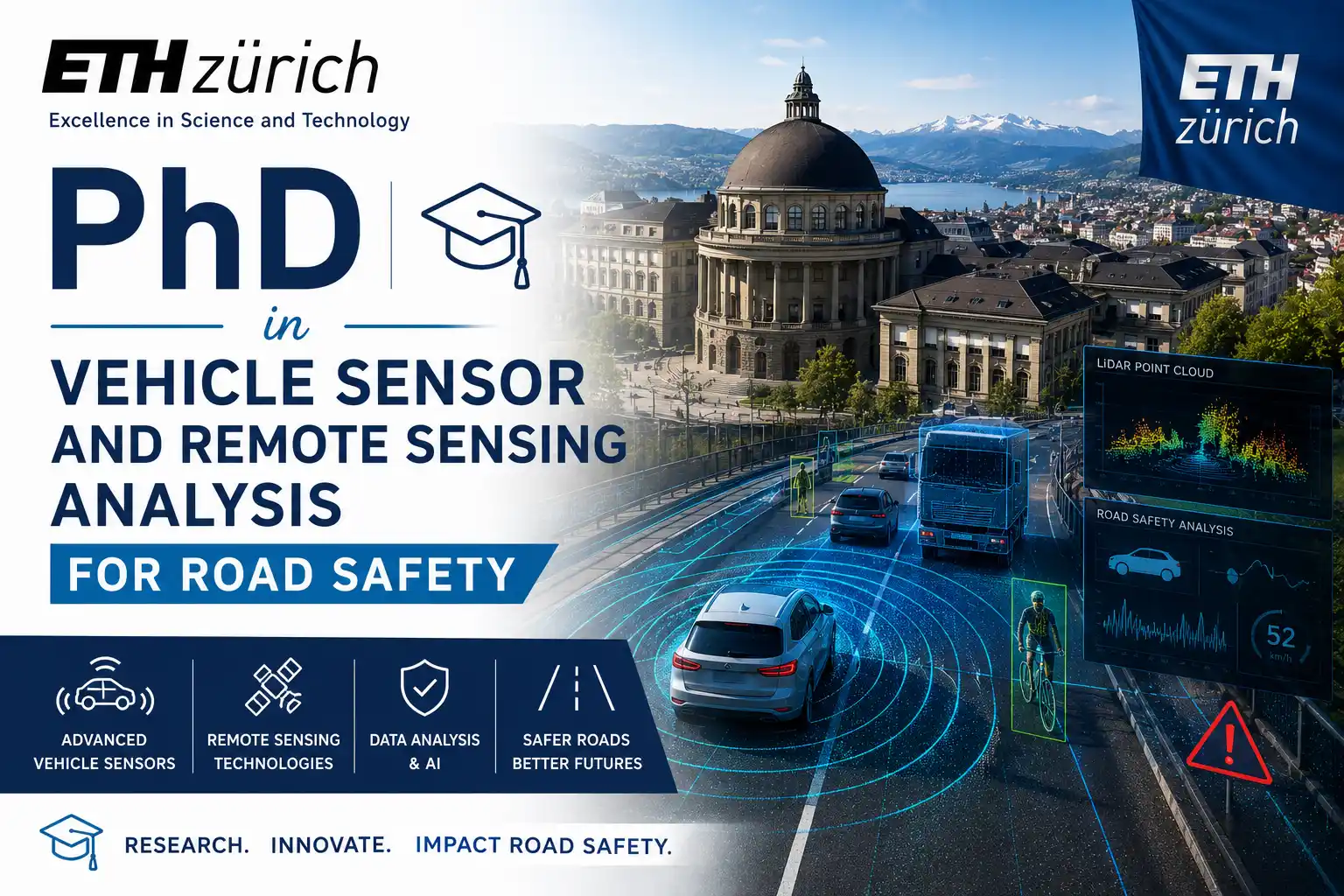
Scholarship Description
The ETH Zurich PhD position in Vehicle Sensor and Remote Sensing Analysis for Road Safety offers a unique opportunity to conduct cutting-edge research at the intersection of artificial intelligence, computer vision, machine learning, and urban transport infrastructure safety. Hosted by the Chair of Infrastructure Management (Professor Dr. Bryan T. Adey) within the Institute of Construction and Infrastructure Management, this fully funded doctoral position is part of a larger EU Horizon project aimed at advancing safe active mobility and road safety across Europe.
The project focuses on leveraging vehicle sensors, remote sensing, and machine learning to support modern urban road safety analysis. Moving beyond conventional crash-focused approaches, it captures near-misses, dynamic interactions, and embodied safety experiences of pedestrians, cyclists, and micromobility users (e-bikes, e-cargo bikes, e-scooters). The candidate will develop new tools and methods that integrate big data, computer vision, and machine learning to process multi-source vehicle sensor, camera, and remote sensing data streams.
The position is 100% fixed-term at ETH Zurich, one of the world's leading universities specialising in science and technology, with over 30,000 people from more than 120 countries.
Scholarship Location
The position is based at ETH Zurich in Zurich, Switzerland, within the Department of Civil, Environmental, and Geomatic Engineering. The research will involve collaboration with international consortium partners and real-world pilot cities across Europe.
Scholarship Deadline
Applications must be submitted by 31 July 2026 through the ETH Zurich online application portal. Screening of applications starts on 1 August 2026, and applications will be accepted until the position is filled.
Application Deadline: 31 July 2026
Screening Starts: 1 August 2026
Preferred Start Date: 1 November 2026 (negotiable)
Recommendation: Submit your application well before the deadline. Applications via email or postal services will not be considered.
Host Institution
ETH Zurich – one of the world's leading universities specialising in science and technology, consistently ranked among the top universities globally. The Chair of Infrastructure Management, led by Professor Dr. Bryan T. Adey, is part of the Institute of Construction and Infrastructure Management within the Department of Civil, Environmental, and Geomatic Engineering.
Level and Fields of Study
Level: PhD (Doctoral) – part of the EU Horizon project.
Fields of study: Urban Analytics, Artificial Intelligence, Machine Learning, Computer Vision, Transport Planning/Engineering, Geomatics, Data Science, Signal Processing, Urban Transport Infrastructure Safety.
Core research tasks:
- Develop a scalable sensing pipeline to process multi-source vehicle sensor, camera, and remote sensing data streams
- Automate feature and factor identification using machine learning and computer vision models
- Generate mapping and diagnostic outputs for spatial mapping, risk diagnosis, and predictive safety modelling
- Collaborate with international consortium partners on real-world pilot cities
Target Group
The position is open to highly qualified candidates from all nationalities with a master's degree in urban analytics, artificial intelligence, computer science, transport planning/engineering, geomatics, or a related field. The ideal candidate has a strong grasp of machine learning, computer vision, statistics, and signal processing, and is passionate about applying these skills to improve road safety and urban mobility.
Scholarship Duration & Amount
Duration: Fixed-term position (100%). Standard ETH Zurich PhD duration is typically 3–4 years.
Salary: In accordance with ETH Zurich's PhD salary scale (competitive Swiss salary with full social benefits).
Estimated annual salary: Approximately CHF 47,000 – 55,000 (gross) for the first year, with increases in subsequent years.
Additional benefits:
- Full social security and pension benefits
- Paid holiday leave (5 weeks per year)
- Parental leave and family benefits under Swiss law
- Access to ETH Zurich's world-class research facilities and library resources
- Opportunity to collaborate with international consortium partners
- Opportunity to attend workshops, conferences, and research exchanges
- Involvement in real-world pilot projects in European cities
📊 Summary of Benefits:
Salary: CHF 47,000–55,000/year (ETH scale)
Duration: 3–4 years (100%)
Additional: Pension + health insurance + 5 weeks holiday + international collaboration + conference funding
Scholarship Eligibility
Required qualifications:
- A Master's degree in urban analytics, artificial intelligence, computer science, transport planning/engineering, geomatics, or a related field.
- A good grasp of machine learning, computer vision techniques, statistics, and signal processing.
- High proficiency in programming environments (e.g., R, Python) and spatial analysis tools (GIS).
- Good knowledge of English (professional proficiency, written and spoken).
Desirable skills:
- Knowledge of German is beneficial but not required.
- Experience with remote sensing data, LiDAR point clouds, or vehicle sensor data.
- Familiarity with urban transport infrastructure and road safety analysis.
✅ Eligible Candidates
- Master's degree in relevant fields (urban analytics, AI, computer science, transport, geomatics).
- Strong machine learning, computer vision, and programming skills (R, Python).
- Experience with GIS and spatial analysis tools.
- Good English proficiency.
- Interest in road safety, urban mobility, and data-driven infrastructure analysis.
❌ Ineligible Candidates
- Without a relevant Master's degree.
- No background in machine learning, computer vision, or programming.
- Insufficient English proficiency.
- No experience with spatial analysis or GIS.
Application Procedure
- Prepare required documents – Gather the following:
- Letter of interest – including your ideas of potential research in the project
- Curriculum vitae – with list of publications (if applicable) and contact information of at least two referees
- Grades of all university courses taken as well as diplomas
- Submit online application – Applications must be submitted exclusively through the ETH Zurich online application portal (job reference JOPG_ethz_Afh8kTDkVYogvWKaOy).
- Application deadline – Submit by 31 July 2026.
- Screening and review – Screening of applications starts on 1 August 2026. Applications will be accepted until the position is filled.
- Interviews – Shortlisted candidates are contacted for interviews.
- Offer – Successful candidates receive a formal offer from ETH Zurich.
Important notes:
- Applications via email or postal services will not be considered.
- For questions regarding the position, contact Ms. Nathalie Dietrich at dietrich@ibi.baug.ethz.ch (no applications).
- The preferred start date is 1 November 2026, although other dates are possible.
- ETH Zurich values diversity and sustainability and encourages applications from all qualified candidates.
Official Website & Application Link
ETH Zurich – PhD Position in Vehicle Sensor and Remote Sensing Analysis for Road Safety
Institute of Construction and Infrastructure Management Website: https://ibi.baug.ethz.ch
ETH Zurich Website: https://ethz.ch
Questions: dietrich@ibi.baug.ethz.ch (no applications)
💡 Final Thoughts and Key Requirements
The ETH Zurich PhD position in Vehicle Sensor and Remote Sensing Analysis for Road Safety offers an exceptional opportunity to conduct research at the frontier of artificial intelligence, computer vision, and urban infrastructure safety. As part of a major EU Horizon project, the successful candidate will work with multi-source sensor data, develop machine learning pipelines, and contribute to making European roads safer for pedestrians, cyclists, and micromobility users.
Key strategies for a successful application:
- Highlight your master's degree in urban analytics, AI, computer science, transport, or geomatics.
- Demonstrate strong programming skills (Python, R) and experience with machine learning and computer vision.
- Showcase experience with spatial analysis tools (GIS) and handling large datasets.
- Emphasise any experience with remote sensing, LiDAR, or vehicle sensor data.
- Submit a compelling letter of interest that outlines your ideas for potential research within the project.
- Ensure your CV includes contact information for at least two referees.
- Submit your application well before the 31 July 2026 deadline.
Important reminders: Applications are only accepted through the ETH Zurich online portal. Do not send applications by email or post. The preferred start date is 1 November 2026. ETH Zurich is committed to diversity and sustainability — all qualified candidates are encouraged to apply. The screening process begins on 1 August 2026, so early applications are advantageous.
ETH Zurich PhD Scholarship – Vehicle Sensor and Remote Sensing Analysis for Road Safety – FAQ
What is the duration of the PhD position?
The position is a fixed-term (100%) position, typically lasting 3–4 years.
What is the salary?
The salary is in accordance with ETH Zurich's PhD salary scale, approximately CHF 47,000–55,000 per year gross, with full social benefits.
What qualifications are required?
A master's degree in urban analytics, AI, computer science, transport planning/engineering, geomatics, or a related field, with strong skills in machine learning, computer vision, programming (Python/R), and GIS.
What is the application deadline?
The deadline is 31 July 2026. Screening starts on 1 August 2026, and applications are accepted until the position is filled.
What research topics will I work on?
You will develop scalable sensing pipelines for vehicle sensor and remote sensing data, apply machine learning and computer vision to road safety analysis, and collaborate with international partners on real-world pilot projects in European cities.
Do I need to speak German?
No, the research is conducted in English. Knowledge of German is beneficial but not required.
What documents do I need to submit?
A letter of interest (including your ideas for potential research), a CV (with publications and contact details for at least two referees), and grades/diplomas from all university courses.
🎓 Countries Scholarships
 Austria scholarships
 Australia scholarships
 Belgium scholarships
 Brazil scholarships
- Belgium scholarships
 Canada scholarships
 China scholarships
- CSC China scholarships
 Czech Republic scholarships
 Denmark scholarships
 Finland scholarships
 France scholarships
 Germany scholarships
 Hungary scholarships
 Indonesia scholarships
 Ireland scholarships
 Italy scholarships
 Japan scholarships
 Kenya scholarships
 Luxembourg scholarships
 Malaysia scholarships
 Nepal scholarships
 Netherlands scholarships
 Newzealand scholarships
 Nigeria scholarships
 Norway scholarships
 Pakistan scholarships
 Poland scholarships
 Portugal scholarships
 Qatar scholarships
 Russia scholarships
 Saudi Arabia scholarships
 Singapore scholarships
 South Africa scholarships
 South Korea scholarships
 Spain scholarships
 Sweden scholarships
 Switzerland scholarships
 Taiwan scholarships
 Tanzania scholarships
 Thailand scholarships
 Turkey scholarships
 UAE scholarships
 Uganda scholarships
 UK scholarships
 USA scholarships
 Vietnam scholarships