ETH Zurich Postdoctoral Scholarship for 3-Year Projects on Quantum Networks and Quantum Sensing (2026)
Scholarship Description
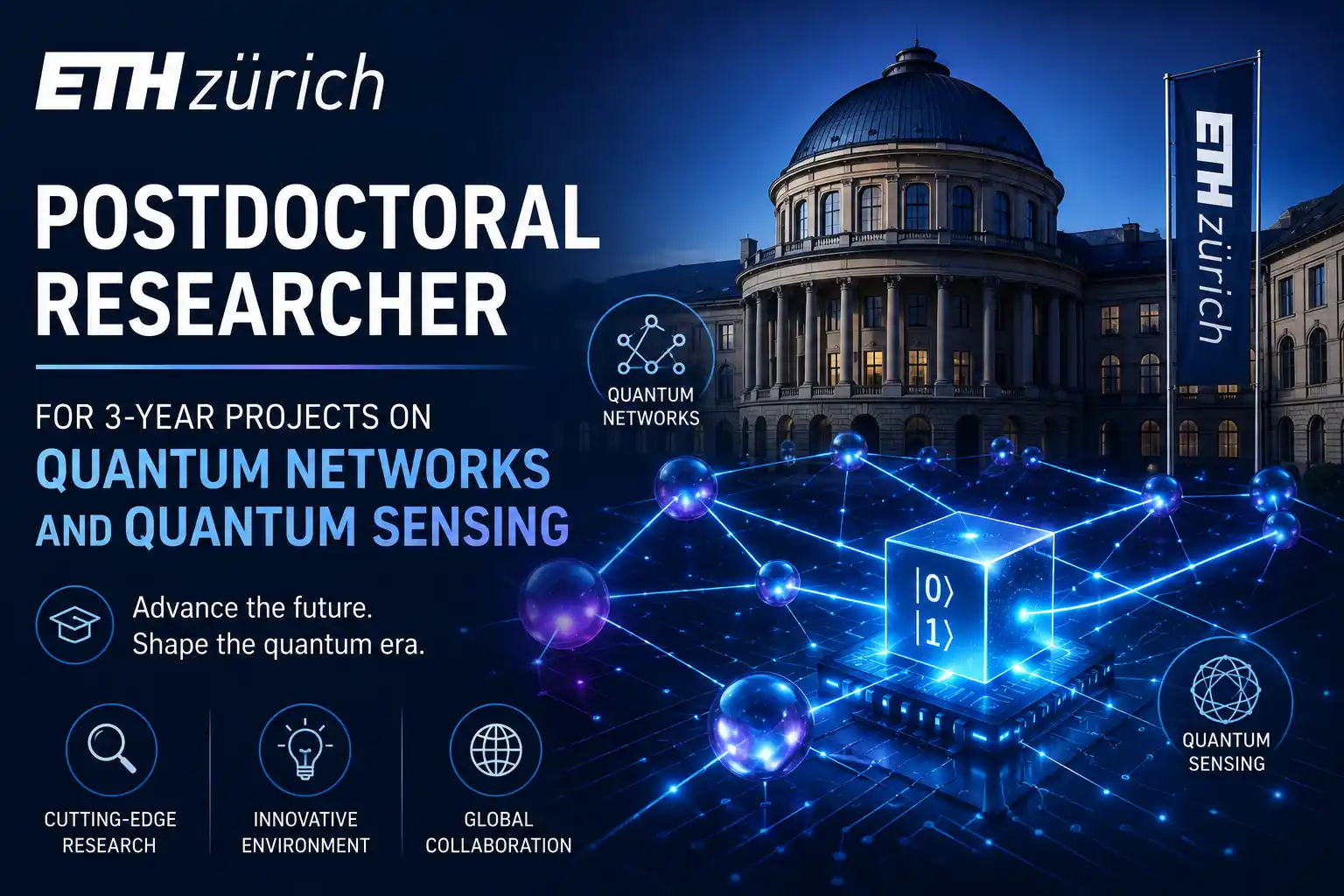
The ETH Zurich Postdoctoral Scholarship for 3-Year Projects on Quantum Networks and Quantum Sensing offers a unique opportunity for two experienced researchers to join the Optical Nanomaterial Group in the Physics Department at ETH Zurich. These positions focus on cutting-edge research in thin film lithium niobate (TFLN) photonic integrated circuits for applications in quantum information processing and precision sensing.
Photonic integrated circuits promise advanced functionality for applications such as quantum information processing and precision sensing. TFLN is a maturing photonics platform that can integrate frequency conversion, quantum light sources, and high-speed electro-optic modulation on a single device. The Optical Nanomaterial Group specializes in the nanofabrication and optical characterization of TFLN photonic circuits for applications in nonlinear optics, quantum communications, and quantum sensing.
Two positions are available:
- Quantum Networks: This project focuses on entangling distant quantum memories using TFLN photonics for sources of non-degenerate entangled photon-pairs — with one photon at the quantum memory wavelength (visible) and the other in the telecom band for long-distance transmission. This position is part of a Switzerland-wide consortium on quantum networks.
- Quantum Sensing: This project focuses on using TFLN photonics for generating squeezed vacuum for gas sensing applications, where periodically poled waveguides and photon number resolution detection provide a quantum advantage. This position is part of a QuantERA project with Imperial College London, the University of Oxford, and ICFO.
Scholarship Location
The positions are based at ETH Zurich in Zurich, Switzerland, within the Physics Department's Optical Nanomaterial Group. ETH Zurich is one of the world's leading universities for science and technology, located in the heart of Europe.
Scholarship Deadline
Applications must be submitted by 31 July 2026. Only applications submitted through the ETH Zurich online application portal will be considered.
Application Deadline: 31 July 2026
Target Start Dates: Between October 2026 and January 2027
Recommendation: Submit your application well before the deadline. Applications via email or postal services will not be considered.
Host Institution
ETH Zurich – one of the world's leading universities specialising in science and technology, consistently ranked among the top universities globally. The Optical Nanomaterial Group in the Physics Department is a world-class research group specialising in nanofabrication, photonics, and quantum technologies.
Level and Fields of Study
Level: Postdoctoral Research (3-year fixed-term positions).
Fields of study: Quantum Networks, Quantum Sensing, Photonic Integrated Circuits, Thin Film Lithium Niobate (TFLN), Nonlinear Optics, Quantum Photonics, Quantum Information, Spontaneous Parametric Down-Conversion, Nanofabrication.
Key responsibilities:
- Background theory, simulation, and design of photonic circuits
- Nanofabrication and optical characterisation of TFLN photonic circuits
- Performing quantum information experiments
- Collaborating with other postdocs and PhD students
- Regular participation in project and group meetings
- Contributing to Switzerland-wide or international consortium collaborations
Target Group
These positions are open to highly qualified Postdoctoral Researchers from all nationalities with experience in integrated photonics, nonlinear optics, quantum photonics, quantum information, and/or spontaneous parametric down-conversion. The ideal candidates are passionate about advancing quantum technologies and working in a collaborative, interdisciplinary environment.
Scholarship Duration & Amount
Duration: 3 years (fixed-term positions).
Salary: Competitive salary according to ETH Zurich standards for postdoctoral researchers (approximately CHF 80,000–100,000 gross per year, depending on experience, with full social benefits).
Benefits include:
- Full social security and pension benefits
- Paid holiday leave
- Public transport season tickets and car sharing
- Wide range of sports offered by the ASVZ
- Childcare support
- Attractive pension benefits
- Opportunity to work on cutting-edge quantum technologies
- Collaboration with leading international research groups (Imperial College London, University of Oxford, ICFO)
- Participation in Switzerland-wide quantum network consortium
📊 Summary of Benefits:
Salary: Competitive (ETH Zurich standards)
Duration: 3 years (100%)
Additional: Pension + sports + transport + childcare + international collaboration
Scholarship Eligibility
Required qualifications:
- A PhD in physics, photonics, quantum information, or a related field.
- Experience in one or more of the following areas: integrated photonics, nonlinear optics, quantum photonics, quantum information, spontaneous parametric down-conversion, or nanofabrication.
- Strong background in the theory, simulation, and design of photonic circuits.
- Experience with optical characterisation and quantum optics experiments.
- Ability to work collaboratively in an interdisciplinary research team.
- Good written and spoken English communication skills.
Desirable (not required):
- Experience with thin film lithium niobate (TFLN) or similar photonic platforms.
- Familiarity with quantum networks or quantum sensing applications.
- Nanofabrication experience (e.g., electron beam lithography, etching, deposition).
✅ Eligible Candidates
- Hold a PhD in physics, photonics, quantum information, or related field.
- Experience in integrated photonics, quantum optics, or nonlinear optics.
- Strong theoretical and experimental skills.
- Good English proficiency.
- Motivation for collaborative research.
❌ Ineligible Candidates
- Without a relevant PhD.
- No experience in photonics, quantum optics, or related areas.
- Insufficient laboratory or research skills.
- Lack of English proficiency.
Application Procedure
- Prepare required documents – Gather the following:
- Cover letter – explaining your interest in the position and relevant experience
- Curriculum Vitae (CV) – detailing your academic background, research experience, publications, and skills
- Transcripts of BSc and MSc degrees
- PhD degree certificate
- Contact information of two referees (no letters are needed at this point)
- Submit online application – Applications must be submitted exclusively through the ETH Zurich online application portal (job reference JOPG_ethz_TjHEAJOI8dRecXyJlK).
- Application deadline – Submit by 31 July 2026.
- Application review – The Optical Nanomaterial Group reviews applications and shortlists candidates.
- Interviews – Shortlisted candidates are contacted for interviews (likely online).
- Offer – Successful candidates receive a formal offer from ETH Zurich.
Important notes:
- Applications via email or postal services will not be considered.
- For questions regarding the position, contact Robert Chapman at rchapman@phys.ethz.ch (no applications).
- Target start dates are between October 2026 and January 2027.
- ETH Zurich values diversity and sustainability and encourages applications from all qualified candidates regardless of background.
- Pre-selection is carried out by responsible recruiters, not by artificial intelligence.
Official Website & Application Link
ETH Zurich – Postdoctoral Researchers in Quantum Networks and Quantum Sensing
Optical Nanomaterial Group Website: https://phys.ethz.ch
ETH Zurich Website: https://ethz.ch
Questions: Robert Chapman (rchapman@phys.ethz.ch) – no applications
💡 Final Thoughts and Key Requirements
The ETH Zurich Postdoctoral Scholarship offers a truly exceptional opportunity for experienced researchers to advance their careers at one of the world's top universities while working on cutting-edge quantum technologies. With 3-year projects in quantum networks and quantum sensing, successful candidates will contribute to major international collaborations (Switzerland-wide quantum network consortium, QuantERA with Imperial College London, Oxford, and ICFO) and develop advanced photonic integrated circuits for quantum information processing.
Key strategies for a successful application:
- Highlight your PhD in physics, photonics, or quantum information and any relevant postdoctoral experience.
- Emphasise experience with integrated photonics, nonlinear optics, quantum photonics, or spontaneous parametric down-conversion.
- Showcase your theoretical, simulation, and design skills for photonic circuits.
- Demonstrate nanofabrication and optical characterisation experience.
- Mention any experience with thin film lithium niobate (TFLN) or similar platforms.
- Write a compelling cover letter explaining your interest in quantum networks or quantum sensing.
- Ensure your CV includes contact information for two referees.
- Submit your application well before the 31 July 2026 deadline.
Important reminders: Applications are only accepted through the ETH Zurich online portal. Do not send applications by email or post. Target start dates are between October 2026 and January 2027. ETH Zurich is committed to diversity and sustainability — all qualified candidates are encouraged to apply. For questions, contact Robert Chapman (no applications).
ETH Zurich Postdoctoral Scholarship – Quantum Networks & Sensing – FAQ
What is the duration of the postdoctoral positions?
Both positions are for 3 years (fixed-term).
What is the salary?
The salary is competitive according to ETH Zurich standards for postdoctoral researchers, approximately CHF 80,000–100,000 gross per year with full social benefits.
What qualifications are required?
A PhD in physics, photonics, quantum information, or a related field, with experience in integrated photonics, quantum optics, nonlinear optics, or spontaneous parametric down-conversion.
What is the application deadline?
The deadline is 31 July 2026. Applications are only accepted through the ETH Zurich online portal.
What projects will I work on?
There are two projects: (1) Quantum Networks – using TFLN photonics for sources of non-degenerate entangled photon-pairs, part of a Switzerland-wide consortium; (2) Quantum Sensing – generating squeezed vacuum for gas sensing, part of a QuantERA project with Imperial College London, Oxford, and ICFO.
Do I need to speak German?
No, the research is conducted in English.
When is the target start date?
The target start dates are between October 2026 and January 2027.
🎓 Countries Scholarships
 Austria scholarships
 Australia scholarships
 Belgium scholarships
 Brazil scholarships
- Belgium scholarships
 Canada scholarships
 China scholarships
- CSC China scholarships
 Czech Republic scholarships
 Denmark scholarships
 Finland scholarships
 France scholarships
 Germany scholarships
 Hungary scholarships
 Indonesia scholarships
 Ireland scholarships
 Italy scholarships
 Japan scholarships
 Kenya scholarships
 Luxembourg scholarships
 Malaysia scholarships
 Nepal scholarships
 Netherlands scholarships
 Newzealand scholarships
 Nigeria scholarships
 Norway scholarships
 Pakistan scholarships
 Poland scholarships
 Portugal scholarships
 Qatar scholarships
 Russia scholarships
 Saudi Arabia scholarships
 Singapore scholarships
 South Africa scholarships
 South Korea scholarships
 Spain scholarships
 Sweden scholarships
 Switzerland scholarships
 Taiwan scholarships
 Tanzania scholarships
 Thailand scholarships
 Turkey scholarships
 UAE scholarships
 Uganda scholarships
 UK scholarships
 USA scholarships
 Vietnam scholarships