GO Styria Doctoral Scholarship Programme 2026 – Fully Funded PhD in Austria
Scholarship Description
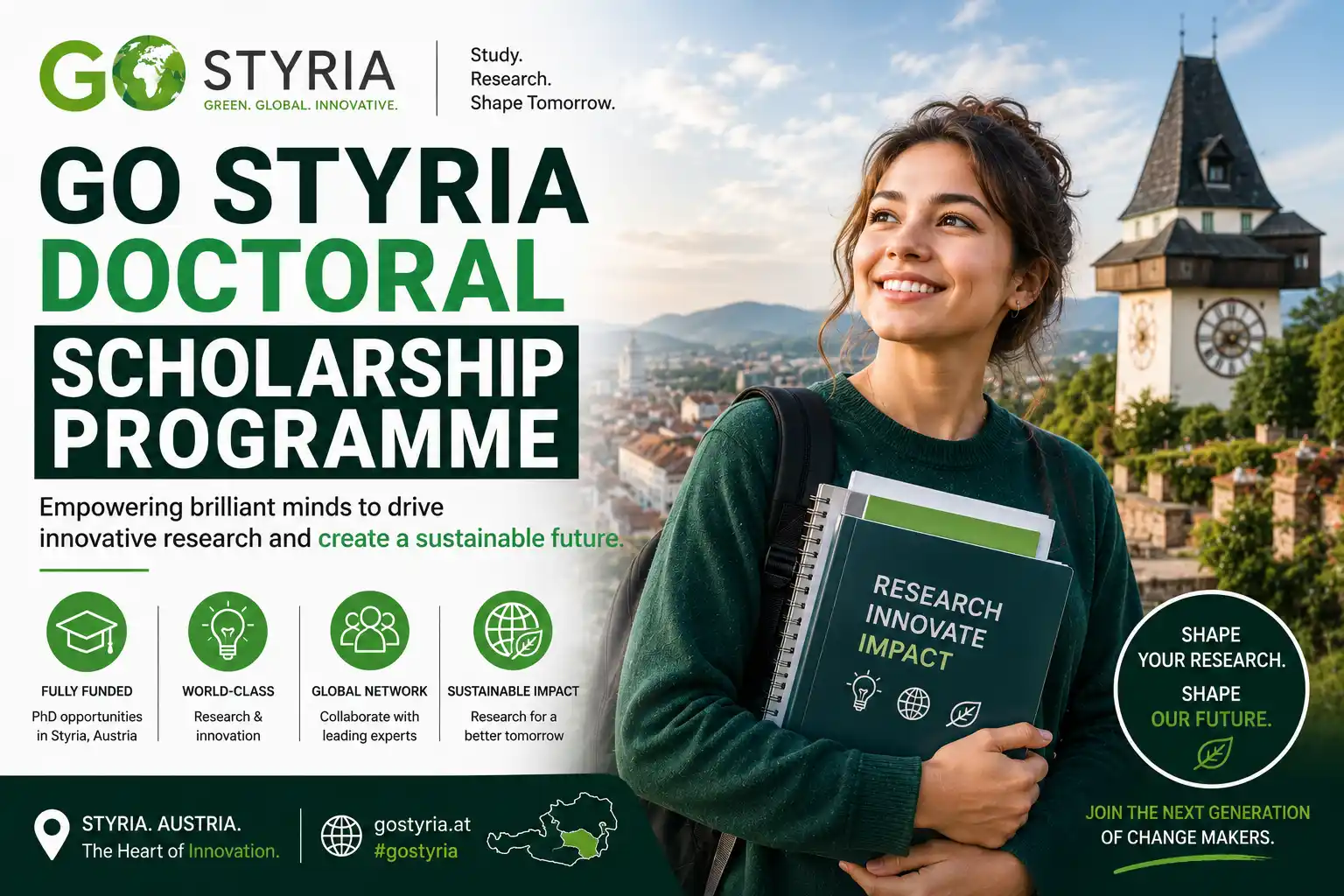
The GO Styria Doctoral Scholarship Programme is a prestigious, fully funded PhD opportunity offered through a cooperation between the University of Graz and the Province of Styria (Land Steiermark) in Austria. The programme empowers brilliant minds to drive innovative research and create a sustainable future in the heart of Europe.
The University of Graz, founded in 1585, is one of Austria's oldest and most respected universities, known for its research excellence, international collaboration, and commitment to sustainability. The GO Styria scholarship supports doctoral candidates working in green, global, and innovative research fields, contributing to Styria's reputation as a hub of innovation and scientific excellence.
Scholarship Location
The scholarship is tenable at the University of Graz in the city of Graz, the capital of Styria, Austria. Graz is a vibrant university city with a rich cultural heritage, known for its high quality of life and innovative spirit. Styria is recognised as one of Europe's leading regions for research and innovation.
Scholarship Deadline
Application deadlines for the GO Styria Doctoral Scholarship Programme are typically announced annually. Prospective applicants are strongly advised to check the official University of Graz website for current application dates.
Application Period: Annually — check the University of Graz website for updates
Recommended: Start preparing your application early, including identifying a supervisor at the University of Graz
Note: Deadlines are typically announced several months before the start of the academic year
Host Institution
The University of Graz – Austria's second-oldest university, founded in 1585. The university is a research-intensive institution with a strong international profile, offering doctoral programmes across all disciplines. The GO Styria programme is a cooperation between the University of Graz and the Province of Styria (Land Steiermark).
Level and Fields of Study
Level: PhD (Doctoral) — full-time doctoral research positions.
Fields: The GO Styria programme supports research across all disciplines, with a particular emphasis on green, global, and innovative research themes. Eligible fields include but are not limited to:
- Sustainability and Environmental Sciences
- Climate Change and Green Technologies
- Life Sciences and Health
- Digital Transformation and Artificial Intelligence
- Social Sciences and Humanities
- Engineering and Natural Sciences
- Business and Economics
- Law and Governance
Target Group
The programme targets highly qualified international doctoral candidates from around the world who wish to pursue their PhD at the University of Graz. The scholarship seeks to attract brilliant minds who are passionate about research and innovation and who will contribute to Styria's vibrant academic community.
Scholarship Duration & Amount
Duration: The scholarship typically covers the full duration of the PhD programme (3 to 4 years), subject to satisfactory academic progress.
Scholarship benefits include:
- Full tuition fee coverage – no tuition fees for doctoral candidates at the University of Graz.
- Competitive monthly stipend – to cover living expenses in Austria.
- Research funding – access to research resources, laboratory facilities, and library services.
- International network – opportunity to collaborate with leading experts and researchers from around the world.
- Career development – professional development opportunities and training programmes.
Note: The exact stipend amount may vary and is confirmed upon offer of the scholarship.
📊 Summary of Benefits:
Tuition: Full coverage
Stipend: Competitive monthly allowance
Duration: 3–4 years (full PhD)
Additional: Research funding + international network + career development
Scholarship Eligibility
Essential criteria:
- Academic qualification: Applicants must hold a Master's degree (or equivalent) with excellent grades in a relevant field.
- Research proposal: Must have a well-defined research proposal that aligns with the research strengths of the University of Graz.
- Supervisor agreement: Applicants must identify a potential supervisor at the University of Graz who is willing to support the research project.
- Language proficiency: English language proficiency (IELTS or TOEFL) or German language proficiency, depending on the programme requirements.
- International perspective: The programme is open to international students from all countries.
- Research alignment: The proposed research should align with the thematic priorities of the GO Styria programme (green, global, innovative).
✅ Eligible Candidates
- Hold a Master's degree with excellent grades.
- All nationalities welcome.
- Strong research proposal aligned with GO Styria themes.
- Secured supervisor at the University of Graz.
- English or German language proficiency.
❌ Ineligible Candidates
- Without a Master's degree.
- Insufficient academic record.
- No research proposal or supervisor identified.
- Inadequate language proficiency.
- Research not aligned with programme themes.
Application Procedure
- Identify research interests – Explore the research areas and doctoral programmes offered at the University of Graz to identify a topic that aligns with your interests and the GO Styria themes.
- Find a supervisor – Contact potential supervisors at the University of Graz to discuss your research proposal and secure their agreement to supervise your PhD.
- Prepare your research proposal – Develop a detailed research proposal that outlines your research question, methodology, expected outcomes, and alignment with the GO Styria programme.
- Check the official website – Visit the University of Graz International Office website for the current application deadlines and procedures for the GO Styria programme.
- Prepare application documents – Gather the following:
- Curriculum Vitae (CV)
- Academic transcripts and degree certificates
- Research proposal
- Supervisor's letter of support
- Letters of recommendation (typically 2)
- Language proficiency certificate (IELTS/TOEFL or German equivalent)
- Submit your application – Submit your application through the University of Graz application portal or as directed by the International Office.
- Selection process – Applications are reviewed by a selection committee at the University of Graz. Shortlisted candidates may be invited for an interview.
- Scholarship offer – Successful candidates receive a scholarship offer from the University of Graz.
Important notes: The GO Styria programme is a cooperation between the University of Graz and the Province of Styria. For the most accurate and up-to-date information, always refer to the official University of Graz website.
Official Website & Application Links
University of Graz – GO Styria Scholarship Programme
University of Graz International Office: https://international.uni-graz.at
GO Styria Website: https://gostyria.at
💡 Final Thoughts and Key Requirements
The GO Styria Doctoral Scholarship Programme offers an outstanding opportunity for international researchers to pursue a fully funded PhD at one of Austria's most prestigious universities. With full tuition coverage, a competitive stipend, and the chance to conduct research in one of Europe's most innovative regions, successful candidates can make a significant impact in their fields while enjoying a high quality of life in Styria.
Key strategies for a successful application:
- Identify your research interests early and develop a compelling research proposal aligned with GO Styria's themes of green, global, and innovative research.
- Secure a supervisor at the University of Graz — this is a critical step in the application process.
- Ensure your academic record is strong — a Master's degree with excellent grades is essential.
- Prepare your application documents carefully and submit them before the deadline.
- Check the University of Graz website regularly for updates on deadlines and application procedures.
- Contact the University of Graz International Office if you have questions about the programme or application process.
Important reminders: The GO Styria programme is a cooperation between the University of Graz and the Province of Styria. All nationalities are welcome to apply. The scholarship covers the full duration of the PhD programme. For the most accurate information, always refer to the official University of Graz website.
GO Styria Doctoral Scholarship Programme 2026 – FAQ
What is the GO Styria Doctoral Scholarship Programme?
It is a fully funded PhD programme offered through a cooperation between the University of Graz and the Province of Styria in Austria, supporting international researchers in green, global, and innovative fields.
What does the scholarship cover?
Full tuition fee coverage, a competitive monthly stipend, research funding, access to world-class facilities, and professional development opportunities.
Who is eligible to apply?
International applicants from all countries who hold a Master's degree with excellent grades, have a strong research proposal, and have secured a supervisor at the University of Graz.
What is the application deadline?
Deadlines are announced annually on the University of Graz website. Prospective applicants should check the official page for current dates.
How do I apply for the GO Styria programme?
Identify your research interests, secure a supervisor at the University of Graz, prepare your research proposal, and submit your application through the University of Graz International Office.
Do I need to speak German to apply?
English proficiency is required (IELTS or TOEFL). German proficiency may be required depending on the specific programme requirements. Check the official website for details.
What are the research priorities of the programme?
The programme emphasises green, global, and innovative research themes, including sustainability, climate change, digital transformation, life sciences, and social sciences.
🎓 Countries Scholarships
 Austria scholarships
 Australia scholarships
 Belgium scholarships
 Brazil scholarships
- Belgium scholarships
 Canada scholarships
 China scholarships
- CSC China scholarships
 Czech Republic scholarships
 Denmark scholarships
 Finland scholarships
 France scholarships
 Germany scholarships
 Hungary scholarships
 Indonesia scholarships
 Ireland scholarships
 Italy scholarships
 Japan scholarships
 Kenya scholarships
 Luxembourg scholarships
 Malaysia scholarships
 Nepal scholarships
 Netherlands scholarships
 Newzealand scholarships
 Nigeria scholarships
 Norway scholarships
 Pakistan scholarships
 Poland scholarships
 Portugal scholarships
 Qatar scholarships
 Russia scholarships
 Saudi Arabia scholarships
 Singapore scholarships
 South Africa scholarships
 South Korea scholarships
 Spain scholarships
 Sweden scholarships
 Switzerland scholarships
 Taiwan scholarships
 Tanzania scholarships
 Thailand scholarships
 Turkey scholarships
 UAE scholarships
 Uganda scholarships
 UK scholarships
 USA scholarships
 Vietnam scholarships