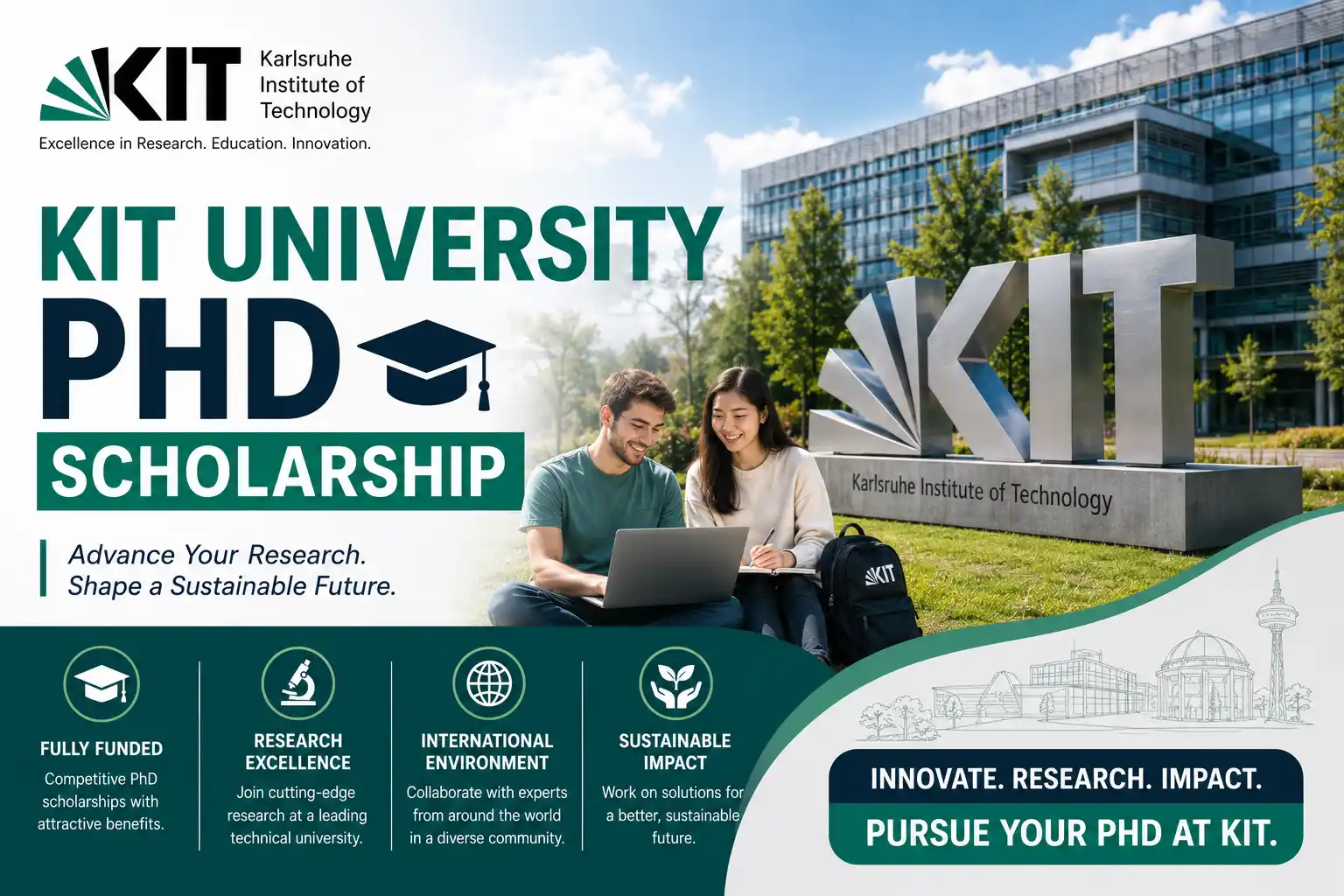
KIT (Karlsruhe Institute of Technology) University PhD Scholarship (2026)
Scholarship Description
The Karlsruhe Institute of Technology (KIT) offers a fully funded PhD position (Doktorarbeit) in the field of Photocatalytic Membranes for Contaminant Removal. This prestigious research position is hosted by the Institute for Advanced Membrane Technology (IAMT) at KIT, one of the world's largest research institutions, formed by the merger of the National Research Centre of the Helmholtz Association and the former Technical University of Karlsruhe.
The PhD project builds on ongoing research in photocatalytic membranes and will explore novel materials and membrane preparation methods. The research focuses on photocatalyst selection (looking beyond commonly used materials), catalyst deposition and coating methods, system design from small-scale to pilot scale, and application to micropollutant removal. The successful candidate will work at the intersection of membrane technology, photocatalysis, and environmental engineering, with opportunities for collaboration with internal and external partners, supervising Master's students, presenting at international conferences, publishing in high-impact journals, and teaching.
Multiple positions are available for highly motivated candidates with a Master's degree in Chemical, Process, Environmental Engineering, or equivalent disciplines.
Scholarship Location
The scholarship is tenable at the Karlsruhe Institute of Technology (KIT), Karlsruhe, Germany. The PhD will be registered in the Faculty of Chemical and Process Engineering at KIT. The research will be conducted at the Institute for Advanced Membrane Technology (IAMT), collaborating with the Nanophotonics for Energy group (IMT & LTI).
Application Deadline
Applications are accepted on a rolling basis until the positions are filled. Interested candidates are strongly encouraged to apply as early as possible.
Application Status: Open – multiple positions available.
Recommendation: Apply as soon as possible, as positions may close once suitable candidates are found.
Host Institution
Karlsruhe Institute of Technology (KIT) – one of the largest research institutions worldwide, combining a university with a national research centre. KIT offers state-of-the-art research facilities and is renowned for excellence in engineering, natural sciences, and technology. The Institute for Advanced Membrane Technology (IAMT) hosts this project, collaborating with the Nanophotonics for Energy group led by Prof. Dr. Bryce Richards.
Level and Fields of Study
Level: PhD (Doctoral) – 4-year research position.
Fields: Chemical Engineering, Process Engineering, Environmental Engineering, Membrane Technology, Photocatalysis, Water Treatment, Micropollutant Removal, Materials Science.
Research focus: Photocatalytic membranes for contaminant removal, including photocatalyst selection, catalyst deposition and coating, system design (small-scale to pilot scale), and application to micropollutant degradation.
Target Group
Highly motivated candidates from around the world who hold a Master's degree in Chemical, Process, Environmental Engineering, or an equivalent discipline. The position welcomes international applicants with excellent English proficiency.
Scholarship Duration & Amount
Duration: 4 years (typical PhD period). The preliminary research proposal should include a timetable for the four-year research project.
Funding: Fully funded PhD position with competitive salary/stipend according to German public sector pay scales (TV-L E13, typically 65-100% position). The exact amount depends on experience and funding arrangements.
Benefits include:
- Fully funded research position with competitive compensation
- Access to state-of-the-art research facilities at KIT
- Opportunities for cooperation with internal and external partners
- Supervision of Master's students
- Oral presentation opportunities at international conferences
- High-impact journal article publication support
- Teaching experience (knowledge sharing via teaching)
- Opportunity to integrate experiment and modelling at molecular and process scale
Scholarship Eligibility
Educational background: Master's degree in Chemical Engineering, Process Engineering, Environmental Engineering, or an equivalent discipline.
Research interest: Naturally curious person who is eager to learn more and has a strong interest in research.
Experience (advantages):
- Experience with membrane filtration systems (of any scale)
- Comfortable in specifying system components
- Sound experimental problem-solving skills
- Good common sense
Language requirements:
- Excellent English language proficiency (essential)
- Basic German language skills (advantage but not required)
Licence: A valid driver's licence will be required.
✅ Eligible Candidates
- Master's degree in Chemical, Process, Environmental Engineering or equivalent.
- Strong interest in membrane technology and photocatalysis research.
- Excellent English language proficiency (written and spoken).
- Experimental problem-solving skills and curiosity.
- International applicants from all countries.
❌ Ineligible Candidates
- Applicants without a Master's degree in a relevant engineering discipline.
- Those with insufficient English language proficiency.
- Candidates lacking a valid driver's licence (required).
- Applicants without strong research motivation.
Application Procedure
- Prepare application documents – Gather the following materials:
- Curriculum Vitae (CV)
- Publication list and your contribution to publications (if relevant)
- Academic transcripts (Bachelor's and Master's degrees)
- University degree certificates
- Contact details for three academic or professional references
- A preliminary research proposal with a timetable for the four-year research project
- Conduct a literature survey – The PhD project will begin with an identification of a set of research questions based on a detailed literature survey. Include your initial research ideas in the proposal.
- Send application by email – Submit all documents to Prof. Dr.-Ing. Andrea I. Schäfer at the Institute for Advanced Membrane Technology (IAMT).
- Include key research questions – Address the following core research questions in your application:
- Can a photocatalytic membrane fully degrade contaminants, and how can full degradation be verified?
- What are the most suitable photocatalytic material characteristics for micropollutant degradation in water, and what are selection criteria/tools?
- What are the mechanisms behind membrane photocatalysis, and how can these be quantified?
- Interview process – Shortlisted candidates will be contacted for interviews.
- Acceptance and enrolment – Successful candidates will be enrolled in the PhD programme at the Faculty of Chemical and Process Engineering at KIT.
Research project phases: The project will focus on: i) photocatalyst selection (looking beyond commonly used materials), ii) exploring options of catalyst deposition and coating, iii) investigation of system design from small-scale to potentially pilot scale, and iv) application to micropollutant removal. Modelling aspects are open to exploration at molecular and process scale.
Contact Information & Application Submission
Contact Person: Prof. Dr.-Ing. Andrea I. Schäfer
Institute: Institute for Advanced Membrane Technology (IAMT), Karlsruhe Institute of Technology (KIT)
Phone: +49(0)721 608 26906
Email: Andrea.Iris.Schaefer@kit.edu
Website: https://www.iamt.kit.edu
How to apply: Send your complete application (CV, publication list, academic transcripts, degree certificates, contact details for three references, and a preliminary research proposal) to Prof. Dr.-Ing. Andrea I. Schäfer at the email address above.
💡 Final Thoughts and Key Requirements
The KIT PhD position in Photocatalytic Membranes for Contaminant Removal offers an exceptional opportunity to conduct cutting-edge research at one of the world's leading technical universities. With multiple positions available, motivated candidates with a Master's degree in Chemical, Process, or Environmental Engineering are strongly encouraged to apply.
Key strategies for a successful application:
- Prepare a strong preliminary research proposal with a realistic four-year timetable.
- Conduct a detailed literature survey and formulate clear research questions.
- Highlight any experience with membrane filtration systems (even at small scale).
- Demonstrate experimental problem-solving skills and common sense.
- Show your curiosity and eagerness to learn — these are key qualities sought by the supervisor.
- Provide complete contact details for three references.
- Ensure your English proficiency is excellent (essential for success).
- Obtain a valid driver's licence before starting the position (required).
Research impact: The successful candidate will work on solutions for a better, sustainable future, addressing critical challenges in water treatment and micropollutant removal. The PhD journey at KIT will prepare you to become an independent researcher with skills in experimental design, analytical methods, modelling, scientific writing, and teaching.
Important reminder: The position is experimental in nature, and the PhD will begin with a detailed literature survey to identify research questions. Required equipment will be set up, and analytical methods will be developed. There are multiple opportunities for cooperation, supervising Master's students, conference presentations, and publishing in high-impact journals.
KIT PhD Scholarship 2026 – FAQ
What is the research focus of this PhD position?
The PhD focuses on photocatalytic membranes for contaminant removal, including photocatalyst selection, catalyst deposition and coating, system design (small-scale to pilot scale), and micropollutant removal.
What qualifications do I need?
A Master's degree in Chemical Engineering, Process Engineering, Environmental Engineering, or an equivalent discipline. Experience with membrane filtration systems is a definite advantage.
Is the position fully funded?
Yes, this is a fully funded PhD position with competitive salary/stipend according to German public sector pay scales (TV-L E13).
Do I need to speak German?
Excellent English proficiency is essential. Basic German language skills are an advantage but not required.
How do I apply?
Send your CV, publication list, academic transcripts, degree certificates, contact details for three references, and a preliminary research proposal to Prof. Dr.-Ing. Andrea I. Schäfer at Andrea.Iris.Schaefer@kit.edu.
Is a driver's licence required?
Yes, a valid driver's licence will be required for this position.
Are there multiple positions available?
Yes, the announcement states that multiple positions are available.
What is the duration of the PhD?
The typical PhD duration is 4 years, and the preliminary research proposal should include a timetable for the four-year research project.
🎓 Countries Scholarships
 Austria scholarships
 Australia scholarships
 Belgium scholarships
 Brazil scholarships
- Belgium scholarships
 Canada scholarships
 China scholarships
- CSC China scholarships
 Czech Republic scholarships
 Denmark scholarships
 Finland scholarships
 France scholarships
 Germany scholarships
 Hungary scholarships
 Indonesia scholarships
 Ireland scholarships
 Italy scholarships
 Japan scholarships
 Kenya scholarships
 Luxembourg scholarships
 Malaysia scholarships
 Nepal scholarships
 Netherlands scholarships
 Newzealand scholarships
 Nigeria scholarships
 Norway scholarships
 Pakistan scholarships
 Poland scholarships
 Portugal scholarships
 Qatar scholarships
 Russia scholarships
 Saudi Arabia scholarships
 Singapore scholarships
 South Africa scholarships
 South Korea scholarships
 Spain scholarships
 Sweden scholarships
 Switzerland scholarships
 Taiwan scholarships
 Tanzania scholarships
 Thailand scholarships
 Turkey scholarships
 UAE scholarships
 Uganda scholarships
 UK scholarships
 USA scholarships
 Vietnam scholarships