NMBU PhD Position within Quaternary Geology – Fully Funded Scholarship (2026)
Scholarship Description
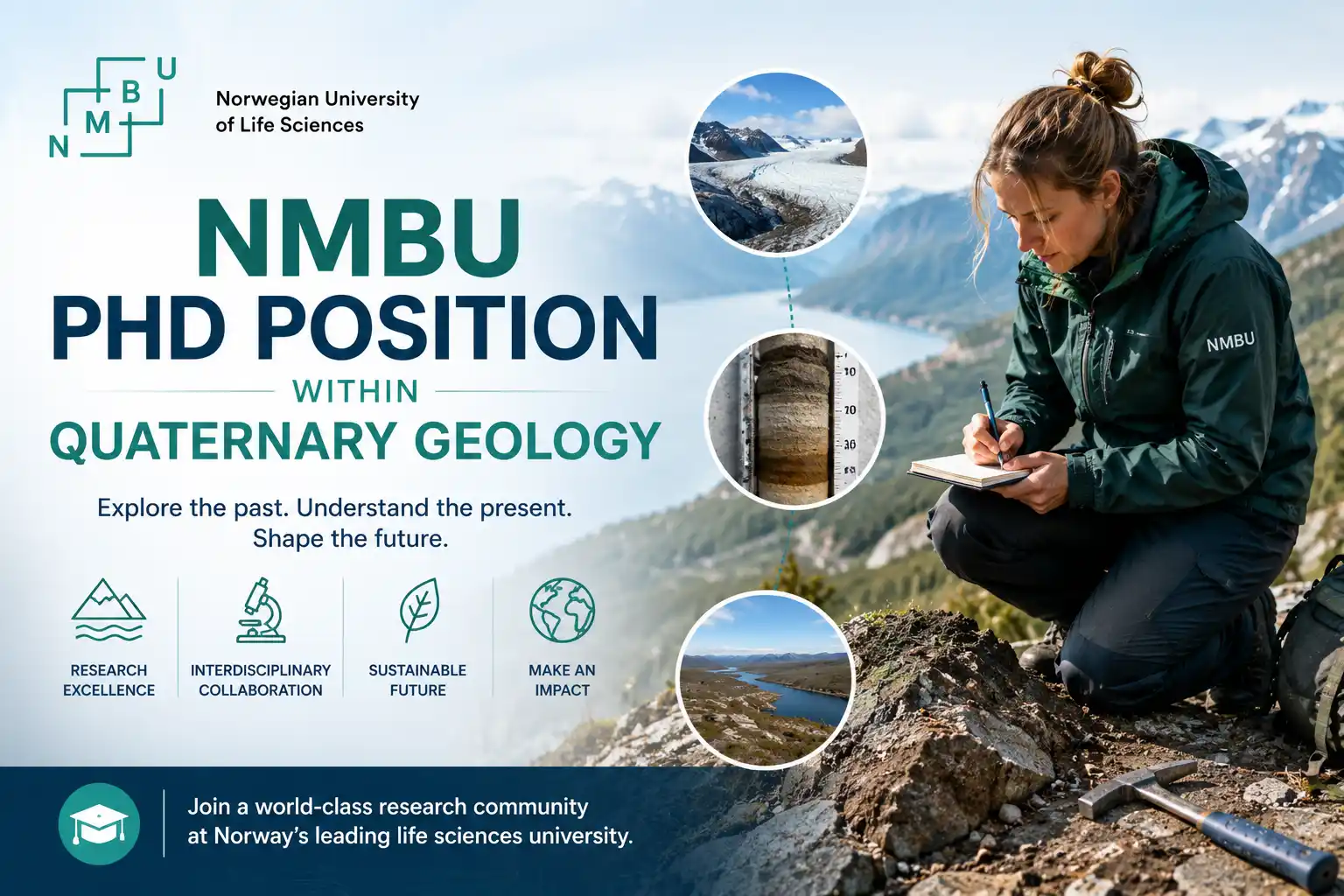
The Norwegian University of Life Sciences (NMBU) invites applications for a fully funded PhD position within Quaternary Geology. This exciting research opportunity focuses on understanding glacial and Quaternary processes, landscape evolution, sedimentology, stratigraphy, and climate history. The successful candidate will join a world-class research community at Norway's leading life sciences university, contributing to cutting-edge research on past environmental changes and their implications for future landscapes.
Quaternary Geology is the study of geological processes and environmental changes that occurred during the Quaternary Period (the last 2.6 million years), including multiple glacial-interglacial cycles. This research is crucial for understanding landscape evolution, natural hazards, groundwater resources, and climate change impacts. The PhD project will involve field-based investigations, laboratory analyses, and spatial data interpretation to reconstruct Quaternary environments.
NMBU is located in Ås, Norway, approximately 30 kilometres south of Oslo. The university is internationally recognised for its research in environmental sciences, geosciences, and sustainable development. Norway offers a high quality of life, stunning natural landscapes (fjords, mountains, glaciers), and excellent working conditions for researchers.
Scholarship Location
The PhD position is based at the Norwegian University of Life Sciences (NMBU) in Ås, Norway. Ås is a charming university town with a rich academic tradition, located about 30 km south of Oslo with excellent public transport connections to the capital. Fieldwork may be conducted across various Quaternary geological sites in Norway and potentially other Nordic regions.
Application Deadline
The position is open until filled, with applications reviewed on a rolling basis. Candidates are strongly encouraged to apply as soon as possible.
Application Deadline: Open until filled (applications reviewed continuously)
Recommendation: Apply as early as possible — positions may close when a suitable candidate is found.
Desired Start Date: Negotiable, but preferably within 2026 or early 2027.
Host Institution
Norwegian University of Life Sciences (NMBU) – a leading international university specialising in environmental sciences, geosciences, natural resource management, and sustainable development. NMBU has strong expertise in Quaternary Geology, glacial processes, sedimentology, and landscape evolution, with access to excellent laboratory facilities and field sites across Norway.
Level and Field of Study
Level: PhD (Doctoral) – typically 3 years (with possible extension to 4 years including teaching or other duties).
Field: Quaternary Geology. Specific research areas may include:
- Glacial geomorphology and sedimentology
- Quaternary stratigraphy and chronology
- Landscape evolution in deglaciated terrains
- Palaeoenvironmental reconstruction using sediment cores (lakes, bogs)
- Glacial history and ice-sheet dynamics
- Periglacial and paraglacial processes
- Geohazards related to Quaternary deposits (landslides, quick clays)
- Application of GIS, remote sensing, and spatial analysis in Quaternary mapping
- Groundwater resources in Quaternary aquifers
Target Group
The scholarship is open to highly motivated candidates from all countries with a strong academic background in Quaternary geology, glacial geology, sedimentology, physical geography, geomorphology, or a related Earth science field. NMBU welcomes international applicants and provides a supportive, multicultural research environment.
Scholarship Duration & Amount
Duration: 3 years (standard PhD period in Norway), with the possibility of a 4th year for teaching or other departmental duties (25% workload).
Funding: This is a fully funded PhD position with a competitive salary according to the Norwegian state salary scale.
Estimated annual salary: Approximately NOK 532,000 – 575,000 (approx. €50,000 – 54,000 / USD $52,000 – 56,000) depending on qualifications and seniority.
Benefits include:
- Full social security and pension benefits (membership in the Norwegian Public Service Pension Fund)
- Paid holiday leave (5 weeks of annual vacation)
- Parental leave and family benefits under Norwegian welfare system
- Access to university housing at reduced rates
- Office space, computer equipment, GIS software, and laboratory facilities
- Funding for conference travel, fieldwork, and analytical costs
- Excellent work-life balance and a supportive research environment
📊 Summary of Benefits:
Annual Salary: NOK 532,000 – 575,000 (approx. €50,000–54,000)
Duration: 3 years (4 years with teaching duties)
Additional: Pension benefits + holiday pay + parental leave + fieldwork funding
Scholarship Eligibility
Required qualifications:
- A Master's degree (120 ECTS) or equivalent in Quaternary geology, glacial geology, sedimentology, physical geography, geomorphology, Earth sciences, or a closely related field.
- Strong academic record (typically a B average or higher in the Master's degree).
- Documented knowledge of Quaternary Geology, glacial processes, and/or sedimentology.
- Experience with field-based geological investigations and data collection.
- Proficiency in English (spoken and written) – IELTS 6.5 or TOEFL 90 (or equivalent).
- Ability to work independently and as part of a collaborative research team.
- Valid driver's licence (for fieldwork in remote locations) is an advantage.
Desirable skills (not mandatory):
- Experience with GIS software (ArcGIS, QGIS) and spatial data analysis.
- Experience with laboratory analyses (sedimentology, grain size analysis, geochemistry, OSL or radiocarbon dating).
- Knowledge of Norwegian or another Scandinavian language (helpful for fieldwork and collaboration).
- Experience with geophysical methods (GPR, resistivity) for subsurface investigation.
✅ Eligible Candidates
- Master's degree in Quaternary Geology, Glacial Geology, Sedimentology, Physical Geography, Geomorphology, or related Earth science field.
- Strong academic record (B average or higher).
- Knowledge of glacial processes and Quaternary stratigraphy.
- English proficiency meeting minimum requirements.
- Motivation for field-based and laboratory research in Quaternary Geology.
❌ Ineligible Candidates
- Applicants without a relevant Master's degree.
- Those who do not meet English language requirements.
- Candidates with insufficient background in Geology or Quaternary Science.
- Applicants who cannot relocate to Norway for the duration of the PhD.
Application Procedure
- Review the job advertisement – Visit the Jobbnorge portal (job ID 302880) or the NMBU website for the official announcement and any updates.
- Prepare application documents – Gather the following materials in PDF format:
- Cover letter (1–2 pages) – explaining your motivation for applying, your research interests in Quaternary Geology, and how your background aligns with the position.
- Curriculum Vitae (CV) – including education, work experience, research experience, publications (if any), technical skills (GIS, lab methods, field methods), and language proficiency.
- Copies of degree certificates and academic transcripts (Bachelor's and Master's degrees).
- Master's thesis (full text or summary) – if available, provide a copy or a detailed summary (2–3 pages).
- English language test results (IELTS, TOEFL, or equivalent).
- Contact information for 2–3 academic referees (letters may be requested later).
- List of publications or conference presentations (if applicable).
- Submit your application – Applications must be submitted through the official Jobbnorge portal (job ID 302880) or via the NMBU application system. Do not send applications via email unless specified.
- Application review – NMBU reviews applications on a rolling basis. Shortlisted candidates will be contacted for interviews (online or in-person).
- Interviews – Selected candidates will be invited for an interview to discuss their research background, technical skills, field experience, and motivation.
- Offer and acceptance – The successful candidate receives a formal offer of employment as a PhD Research Fellow.
- Relocation and start – NMBU provides support for international candidates with visa applications, housing, and relocation to Norway.
Important notes: The position is open until filled. Candidates are encouraged to apply as soon as possible. NMBU is an equal-opportunity employer and welcomes applications from all qualified candidates regardless of gender, ethnicity, disability, or background. Norwegian work visa regulations apply for non-EU/EEA candidates.
Official Website & Application Link
NMBU PhD Position – Official Jobbnorge Posting (ID: 302880)
NMBU Main Website: https://www.nmbu.no/en
For inquiries: Contact information for the supervising professor is available on the Jobbnorge job posting page.
💡 Final Thoughts and Key Requirements
The NMBU PhD position in Quaternary Geology offers an outstanding opportunity for early-career geoscientists to pursue cutting-edge research in glacial and Quaternary processes while enjoying excellent working conditions and a high quality of life in Norway. With competitive salary, full social benefits, access to world-class laboratory facilities, and spectacular field sites, successful candidates can focus entirely on their research and professional development.
Key strategies for a successful application:
- Tailor your cover letter specifically to the Quaternary Geology topic — demonstrate your understanding of glacial processes, sedimentology, and stratigraphy.
- Highlight any previous field experience in glacial or periglacial environments, sediment coring, or Quaternary mapping.
- Emphasise your analytical skills — experience with GIS, sedimentology labs, geochronology (radiocarbon, OSL), or geophysical methods is highly valued.
- Include specific examples of your research skills and independent work in your CV.
- Ensure your English proficiency meets the requirements (IELTS 6.5 or TOEFL 90).
- Apply early — rolling deadlines mean the position may close as soon as a suitable candidate is identified.
- Be prepared to relocate to Norway — NMBU provides support for international candidates with visa applications, housing, and relocation.
Why choose NMBU and Norway for Quaternary Geology research? Norway is a natural laboratory for Quaternary Geology, with spectacular glacial landscapes, fjords, and well-preserved Quaternary deposits. The country has a strong tradition of Quaternary research and excellent data resources. As a PhD candidate in Norway, you will be an employee with full salary and benefits, including pension, holiday pay, parental leave, and healthcare. The Norwegian work culture emphasises flat hierarchies, collaboration, work-life balance, and access to nature. Ås is a safe, family-friendly town with excellent schools and outdoor recreation opportunities, just 30 minutes from Oslo.
Important reminders: Only complete applications submitted through the official Jobbnorge portal will be considered. The position is open to international candidates, but non-EU/EEA candidates must be eligible for a Norwegian work visa. NMBU is committed to diversity and encourages applications from underrepresented groups. Applicants should have a valid driver's licence for fieldwork in remote locations.
NMBU PhD Position in Quaternary Geology – FAQ
What is the salary for this PhD position?
The annual salary is approximately NOK 532,000 – 575,000 (around €50,000–54,000) depending on qualifications, plus full pension benefits, holiday pay, and social security.
What qualifications are required?
A Master's degree in Quaternary Geology, Glacial Geology, Sedimentology, Physical Geography, Geomorphology, or a related Earth science field with a strong academic record (B average or higher). Field experience in glacial or Quaternary environments is highly desirable.
Do I need to speak Norwegian?
No, English proficiency is sufficient (IELTS 6.5 or TOEFL 90). However, knowledge of Norwegian or another Scandinavian language is an advantage for fieldwork and collaboration with local partners.
What is the application deadline?
The position is open until filled, with rolling review of applications. Candidates are encouraged to apply as early as possible.
Can international students apply?
Yes, the position is open to qualified candidates from all countries. NMBU provides support for visa applications and relocation for international candidates.
What research skills are most desirable?
Experience with GIS, sedimentology laboratory methods, geochronology (OSL, radiocarbon), geophysical methods (GPR, resistivity), and field-based geological mapping are highly desirable.
Is fieldwork required?
Yes, fieldwork in Norwegian Quaternary sites is a core component of the PhD. Candidates should be physically able to conduct fieldwork in potentially challenging Nordic conditions.
How long is the PhD program?
The standard duration is 3 years of full-time research. A 4th year may be added for teaching or other departmental duties (25% workload).
🎓 Countries Scholarships
 Austria scholarships
 Australia scholarships
 Belgium scholarships
 Brazil scholarships
- Belgium scholarships
 Canada scholarships
 China scholarships
- CSC China scholarships
 Czech Republic scholarships
 Denmark scholarships
 Finland scholarships
 France scholarships
 Germany scholarships
 Hungary scholarships
 Indonesia scholarships
 Ireland scholarships
 Italy scholarships
 Japan scholarships
 Kenya scholarships
 Luxembourg scholarships
 Malaysia scholarships
 Nepal scholarships
 Netherlands scholarships
 Newzealand scholarships
 Nigeria scholarships
 Norway scholarships
 Pakistan scholarships
 Poland scholarships
 Portugal scholarships
 Qatar scholarships
 Russia scholarships
 Saudi Arabia scholarships
 Singapore scholarships
 South Africa scholarships
 South Korea scholarships
 Spain scholarships
 Sweden scholarships
 Switzerland scholarships
 Taiwan scholarships
 Tanzania scholarships
 Thailand scholarships
 Turkey scholarships
 UAE scholarships
 Uganda scholarships
 UK scholarships
 USA scholarships
 Vietnam scholarships