NMBU Postdoctoral Fellowship in Soil Nitrogen Cycling and Greenhouse Gas Emissions (2026)
Fellowship Description
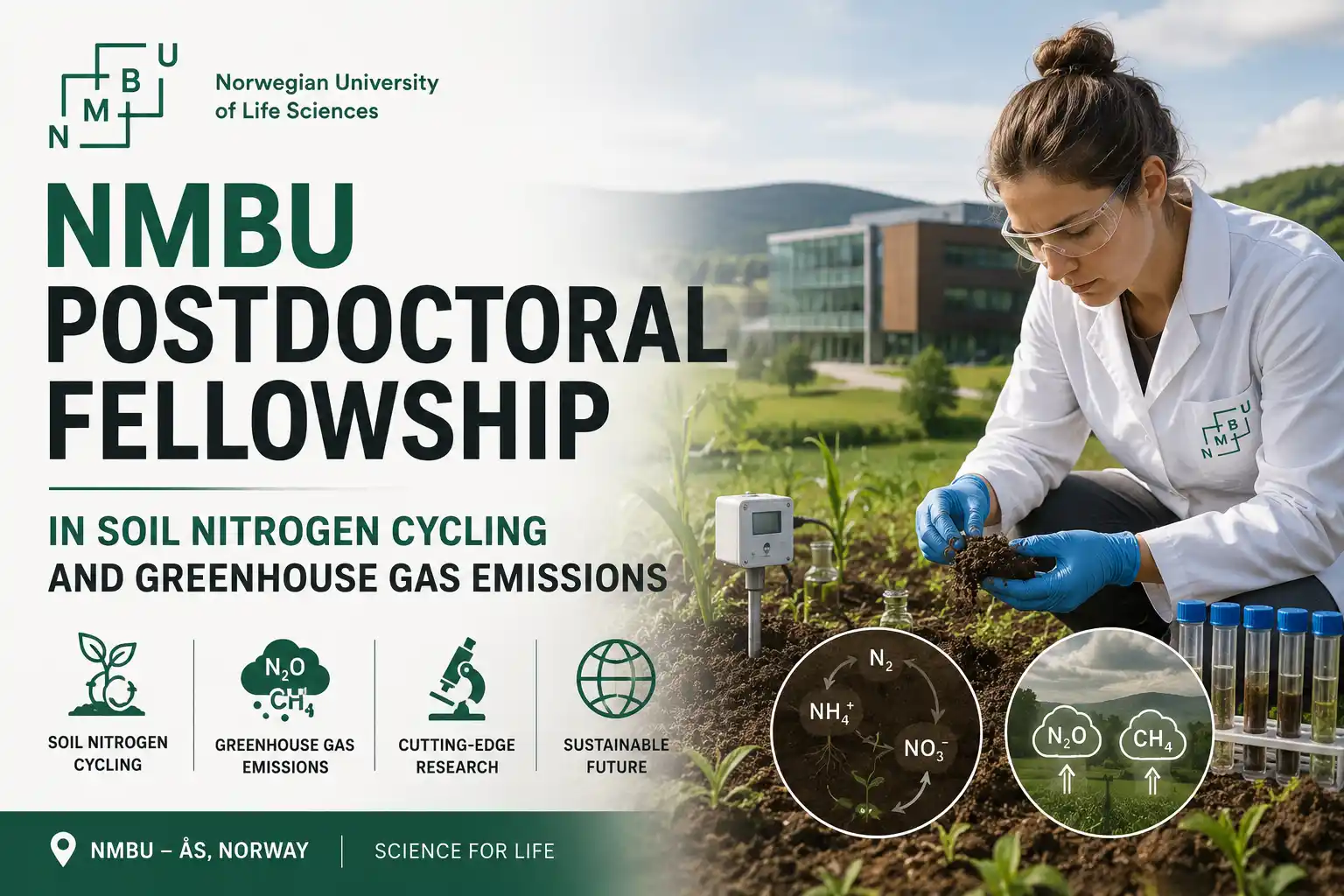
The Norwegian University of Life Sciences (NMBU) invites applications for a Postdoctoral Fellowship in Soil Nitrogen Cycling and Greenhouse Gas Emissions. This exciting research position focuses on understanding soil biogeochemical processes controlling nitrogen cycling and the production of greenhouse gases, particularly nitrous oxide (N₂O), a potent greenhouse gas with significant agricultural sources. The successful candidate will join a dynamic research team at the Faculty of Environmental Sciences and Natural Resource Management, contributing to cutting-edge research on sustainable agricultural practices, climate change mitigation, and soil health.
NMBU is located in Ås, Norway, approximately 30 kilometres south of Oslo. The university is internationally recognised for its research in environmental sciences, soil science, biogeochemistry, and sustainable agriculture. Norway offers an exceptional quality of life, stunning natural landscapes, and excellent working conditions for researchers.
Fellowship Location
The postdoctoral fellowship is based at the Norwegian University of Life Sciences (NMBU) in Ås, Norway. Ås is a charming university town located about 30 km south of Oslo, with excellent public transport connections to the capital. The region offers beautiful fjords, forests, and outdoor recreational opportunities.
Application Deadline
Interested candidates should check the official Jobbnorge posting (job ID 303370) for the most current deadline information. Postdoctoral positions at NMBU typically have application deadlines several weeks after announcement.
Application Deadline: Please refer to the official Jobbnorge job posting (reference 303370) for the exact deadline.
Recommendation: Apply as early as possible — positions may close when a suitable candidate is found.
Desired Start Date: Negotiable, but preferably within 2026 or early 2027.
Host Institution
Norwegian University of Life Sciences (NMBU) – a leading international university specialising in environmental sciences, sustainable development, natural resource management, agriculture, and life sciences. NMBU is consistently ranked among the world's top universities for its research impact and commitment to addressing global challenges related to climate, food security, and environmental sustainability.
Level and Field of Study
Level: Postdoctoral Fellowship (2–3 years, typically with 3-year funding).
Field: Soil Nitrogen Cycling and Greenhouse Gas Emissions. Specific research areas may include:
- Nitrogen transformation processes in agricultural soils (nitrification, denitrification, mineralization, immobilisation)
- Microbial mechanisms controlling nitrous oxide (N₂O) production and consumption
- Effects of agricultural management practices (fertilisation, tillage, crop rotation, organic amendments) on GHG emissions
- Soil biogeochemistry and nutrient cycling in temperate and boreal agroecosystems
- Use of stable isotopes (¹⁵N, ¹⁸O) to trace nitrogen fluxes and source partitioning of N₂O
- Measurement of greenhouse gas fluxes using chamber-based and eddy covariance techniques
- Process-based modelling of nitrogen cycling and GHG emissions at field to landscape scales
- Development of mitigation strategies to reduce N₂O emissions from agriculture
- Soil carbon and nitrogen interactions under climate change scenarios
Target Group
The fellowship is open to highly motivated early-career researchers from all countries with a PhD in soil science, biogeochemistry, environmental science, agricultural science, microbiology, or a related field. NMBU welcomes international applicants and provides a supportive, multicultural research environment. Preference may be given to candidates who have obtained their PhD within the last 3–5 years.
Fellowship Duration & Amount
Duration: Typically 2–3 years (3 years is common for Norwegian postdoctoral fellowships).
Funding: This is a fully funded postdoctoral position with a competitive salary according to the Norwegian state salary scale.
Estimated annual salary: Approximately NOK 565,000 – 620,000 (approx. €53,000 – 58,000 / USD $55,000 – 60,000) depending on qualifications and seniority.
Benefits include:
- Full social security and pension benefits (membership in the Norwegian Public Service Pension Fund)
- Paid holiday leave (5 weeks of annual vacation)
- Parental leave and family benefits under Norwegian welfare system
- Access to university housing at reduced rates
- Office space, computer equipment, and access to state-of-the-art laboratories
- Funding for conference travel, fieldwork, and research dissemination
- Excellent work-life balance and a supportive research environment
- Opportunities for professional development and teaching experience
📊 Summary of Benefits:
Annual Salary: NOK 565,000 – 620,000 (approx. €53,000–58,000)
Duration: 2–3 years (typically 3 years)
Additional: Pension benefits + holiday pay + parental leave + travel funding + state-of-the-art lab facilities
Eligibility Requirements
Required qualifications:
- A PhD in soil science, biogeochemistry, environmental science, agricultural science, microbiology, or a closely related field (PhD must be completed before the start date).
- Strong academic record and peer-reviewed publications in relevant fields.
- Documented experience with soil nitrogen cycling research and/or greenhouse gas flux measurements (e.g., gas chromatography, laser-based analyzers, chamber systems).
- Experience with stable isotope techniques (¹⁵N, ¹⁸O) is highly desirable.
- Proficiency in data analysis using statistical software (R, SAS, Python, or similar).
- Proficiency in English (spoken and written) – IELTS 6.5 or TOEFL 90 (or equivalent).
- Ability to work independently and as part of a collaborative research team.
Desirable skills (not mandatory):
- Knowledge of Norwegian or another Scandinavian language (helpful for fieldwork and collaboration).
- Experience with process-based modelling (e.g., DNDC, DayCent, or similar biogeochemical models).
- Fieldwork experience in agricultural or natural ecosystems.
- Experience with molecular microbiology techniques (e.g., qPCR, sequencing of nitrogen-cycling genes).
✅ Eligible Candidates
- PhD in soil science, biogeochemistry, environmental science, agricultural science, or related field.
- Strong research track record (publications in peer-reviewed journals).
- Experience with soil nitrogen cycling and/or greenhouse gas measurements.
- English proficiency meeting minimum requirements.
- Motivation for interdisciplinary research in soil biogeochemistry and climate change mitigation.
❌ Ineligible Candidates
- Applicants without a completed PhD.
- Those who do not meet English language requirements.
- Candidates with insufficient background in soil science or biogeochemistry.
- Applicants who cannot relocate to Norway for the duration of the fellowship.
Application Procedure
- Review the full job advertisement – Visit the Jobbnorge portal (job ID 303370) for the official announcement, detailed project description, and specific application requirements.
- Prepare application documents – Gather the following materials in PDF format:
- Cover letter (1–2 pages) – explaining your motivation for applying, your research interests in soil nitrogen cycling and GHG emissions, and how your background aligns with the position.
- Curriculum Vitae (CV) – including education, work experience, research experience, full publication list, technical skills, and language proficiency.
- PhD degree certificate and academic transcripts (including Bachelor's and Master's if relevant).
- Research statement (2–3 pages) – summarising your previous research, key findings, and future research plans related to the fellowship topic.
- Copies of up to 3 relevant publications (PDF format).
- English language test results (IELTS, TOEFL, or equivalent) – if applicable.
- Contact information for 2–3 academic referees (letters may be requested later).
- Submit your application – Applications must be submitted through the official Jobbnorge portal (job ID 303370). Do not send applications via email unless specified in the advertisement.
- Application review – NMBU reviews applications after the deadline. Shortlisted candidates will be contacted for interviews (online or in-person).
- Interviews – Selected candidates will be invited for an interview to discuss their research background, technical skills, and alignment with the project.
- Reference checks – NMBU will contact referees for finalist candidates.
- Offer and acceptance – The successful candidate receives a formal offer of employment as a Postdoctoral Fellow.
- Relocation and start – NMBU provides support for international candidates with visa applications, housing, and relocation to Norway.
Important notes: NMBU is an equal-opportunity employer and welcomes applications from all qualified candidates regardless of gender, ethnicity, disability, or background. Norwegian work visa regulations apply for non-EU/EEA candidates. For specific questions about the research project, contact information for the principal investigator is available on the Jobbnorge job posting.
Official Website & Application Link
NMBU Postdoctoral Fellowship – Official Jobbnorge Posting
NMBU Main Website: https://www.nmbu.no/en
Faculty of Environmental Sciences and Natural Resource Management: Available via NMBU website.
💡 Final Thoughts and Key Requirements
The NMBU Postdoctoral Fellowship in Soil Nitrogen Cycling and Greenhouse Gas Emissions offers an outstanding opportunity for early-career researchers to advance their scientific career while contributing to critical research on climate change mitigation and sustainable agriculture. With competitive salary, full social benefits, state-of-the-art laboratory facilities, and access to world-class research networks, successful candidates can develop their research portfolio in an excellent working environment.
Key strategies for a successful application:
- Tailor your cover letter specifically to the soil nitrogen cycling and GHG emissions research focus — demonstrate your understanding of N₂O sources, mitigation challenges, and relevant methodologies.
- Highlight your experience with greenhouse gas measurement techniques (gas chromatography, laser-based analyzers, static chambers, automated chambers).
- Emphasise any stable isotope (¹⁵N) experience — this is highly valued for source partitioning of N₂O emissions.
- Showcase your publication record in peer-reviewed journals related to soil biogeochemistry, nutrient cycling, or GHG emissions.
- Demonstrate proficiency in statistical analysis and data visualisation (R, Python, SAS, or similar).
- Include a well-written research statement that connects your past work to the proposed research at NMBU.
- Ensure your English proficiency meets the requirements (IELTS 6.5 or TOEFL 90).
Why choose NMBU and Norway? Norway offers a unique combination of high-quality research, work-life balance, and natural beauty. As a postdoctoral fellow, you will be an employee with full salary and benefits, including pension, holiday pay, parental leave, and healthcare. The Norwegian work culture emphasises flat hierarchies, collaboration, and respect for work-life balance. Ås is a safe, family-friendly town with excellent schools and outdoor recreation opportunities.
Important reminders: Only complete applications submitted through the official Jobbnorge portal will be considered. Check the official job posting for the exact application deadline. International candidates must be eligible for a Norwegian work visa. NMBU is committed to diversity and encourages applications from underrepresented groups.
NMBU Postdoctoral Fellowship – Soil Nitrogen Cycling & GHG Emissions – FAQ
What is the salary for this postdoctoral position?
The annual salary is approximately NOK 565,000 – 620,000 (around €53,000–58,000 / USD $55,000–60,000) depending on qualifications, plus full pension benefits, holiday pay, and social security.
What qualifications are required?
A PhD in soil science, biogeochemistry, environmental science, agricultural science, microbiology, or a related field with a strong publication record. Experience with soil nitrogen cycling and/or greenhouse gas measurement techniques is essential.
Do I need to speak Norwegian?
No, English proficiency is sufficient (IELTS 6.5 or TOEFL 90). However, knowledge of Norwegian or another Scandinavian language is helpful for fieldwork and collaboration.
What is the application deadline?
Please check the official Jobbnorge job posting (reference 303370) for the exact deadline. Applications are typically reviewed after the deadline.
Can international researchers apply?
Yes, the position is open to qualified candidates from all countries. NMBU provides support for visa applications and relocation for international candidates.
What techniques are most relevant for this position?
Experience with greenhouse gas flux measurements (gas chromatography, laser analyzers, chamber systems), stable isotope techniques (¹⁵N), soil biogeochemical analyses, and statistical data analysis (R, Python) are highly desirable.
How long is the postdoctoral fellowship?
The position is typically for 2–3 years, with 3 years being the standard duration for Norwegian postdoctoral fellowships.
Is there funding for conference travel and research?
Yes, the position includes funding for conference travel, fieldwork, and research dissemination activities.
🎓 Countries Scholarships
 Austria scholarships
 Australia scholarships
 Belgium scholarships
 Brazil scholarships
- Belgium scholarships
 Canada scholarships
 China scholarships
- CSC China scholarships
 Czech Republic scholarships
 Denmark scholarships
 Finland scholarships
 France scholarships
 Germany scholarships
 Hungary scholarships
 Indonesia scholarships
 Ireland scholarships
 Italy scholarships
 Japan scholarships
 Kenya scholarships
 Luxembourg scholarships
 Malaysia scholarships
 Nepal scholarships
 Netherlands scholarships
 Newzealand scholarships
 Nigeria scholarships
 Norway scholarships
 Pakistan scholarships
 Poland scholarships
 Portugal scholarships
 Qatar scholarships
 Russia scholarships
 Saudi Arabia scholarships
 Singapore scholarships
 South Africa scholarships
 South Korea scholarships
 Spain scholarships
 Sweden scholarships
 Switzerland scholarships
 Taiwan scholarships
 Tanzania scholarships
 Thailand scholarships
 Turkey scholarships
 UAE scholarships
 Uganda scholarships
 UK scholarships
 USA scholarships
 Vietnam scholarships