SANSA Postgraduate Bursaries for STEM 2026 – South African National Space Agency
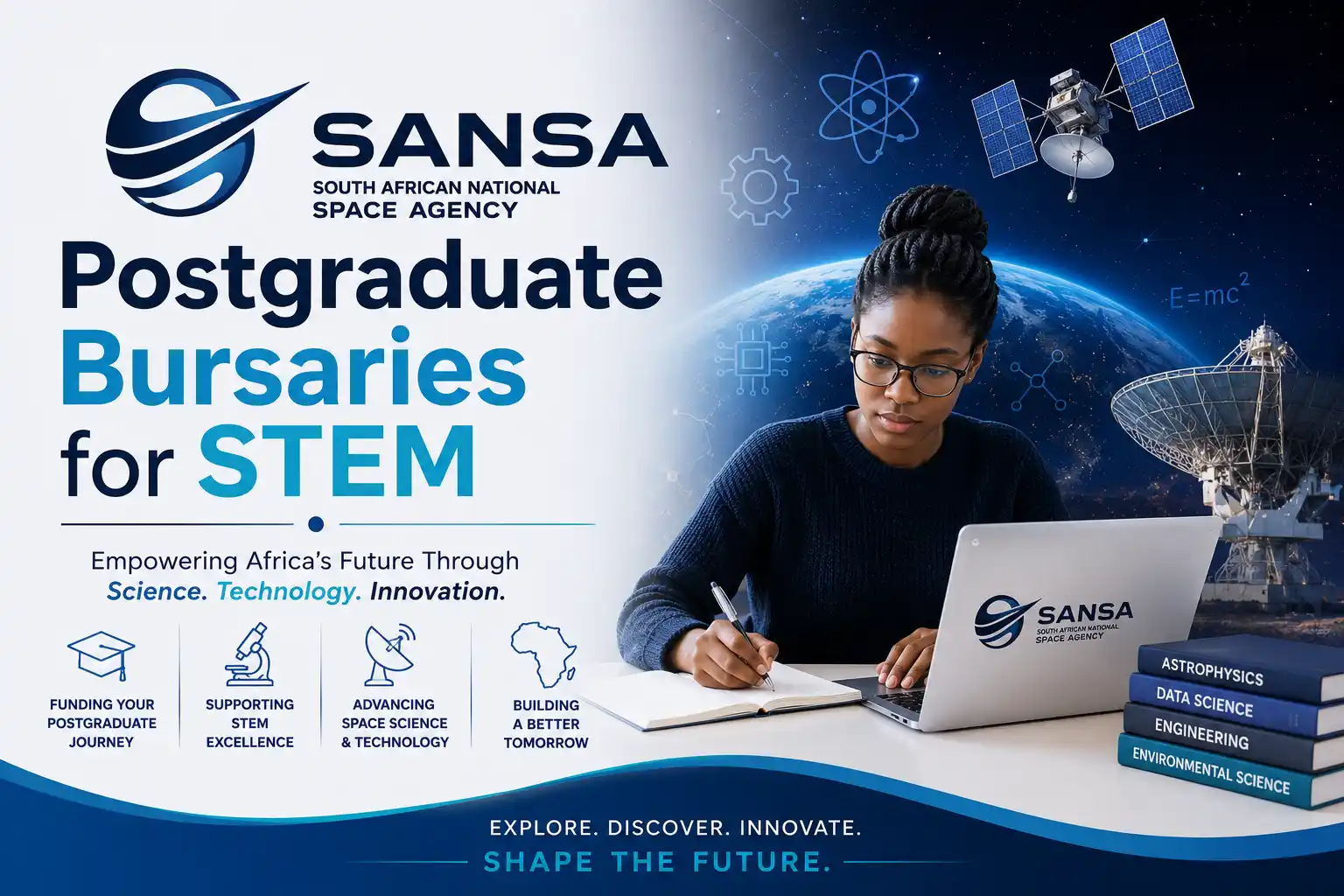
Scholarship Description
The South African National Space Agency (SANSA) offers prestigious postgraduate bursaries to South African students pursuing Honours, Masters, or Doctoral degrees in Science, Technology, Engineering, and Mathematics (STEM) fields. These bursaries are designed to contribute to the national target for qualified post-graduates in science and engineering, addressing critical skills shortages identified in the National Development Plan.
SANSA is South Africa's national space agency, responsible for coordinating and implementing space science and technology programmes in the country. The agency works on cutting-edge projects in space engineering, satellite technology, earth observation, and space science research.
The bursary provides substantial financial support: R150,000 per year for Honours, R160,000 per year for Masters, and R170,000 per year for Doctoral students. Successful candidates become part of South Africa's growing space science community, contributing to the advancement of technology and innovation on the African continent.
Scholarship Location
The bursary supports study at South African universities offering relevant STEM qualifications. SANSA's research facilities are located across South Africa, including in Gauteng, the Western Cape, and other provinces.
Scholarship Deadline
Applications for the 2027 SANSA Postgraduate Bursaries are now open. The exact deadline is typically announced annually on the SANSA website. Prospective applicants are strongly advised to check the official SANSA bursary page for the current deadline.
Application Deadline: To be confirmed – check the SANSA website for updates
Bursary Year: 2027 academic year
Recommendation: Submit your application as early as possible. Incomplete applications will not be considered.
Host Institution
South African National Space Agency (SANSA) – South Africa's official space agency, established to promote the peaceful use of space and coordinate space science and technology activities in the country. The bursary supports students at South African universities offering accredited STEM postgraduate programmes.
Level and Fields of Study
Levels: Honours (Bachelor of Science Honours), Masters, and Doctoral (PhD) qualifications.
Fields of study (not limited to these):
Earth Observation (EO):
- Applied Remote Sensing & GIS
- Botany, Ecology & Resource Management
- Environmental & Geographical Science
- Environmental & Water Science, Geology, Management
- Geographical Information Systems (GIS) & Remote Sensing
- Geoinformatics, Geography with Remote Sensing and/GIS
- Information Systems & Remote Sensing
- Plant & Environmental Science, Statistical Ecology
Space Engineering (SE):
- Computer & Electronic Engineering
- Computer Engineering, Computer Science
- Electrical and Electronic Engineering
- Electrical Engineering, Electronic Engineering
- Information Technology
- Mechanical Engineering, Mechatronics Engineering
Space Science (SS):
- Applied Mathematics, Energy Studies
- Mathematics, Physics, Space Science
Interdisciplinary fields combining the above are also considered.
Target Group
South African citizens and permanent residents studying at South African universities. The bursary aims to increase the number of qualified post-graduates in science and engineering to meet the country's skills needs.
Scholarship Duration & Amount
Bursary amounts (per annum):
- Honours: R150,000 per year
- Masters: R160,000 per year
- Doctoral (PhD): R170,000 per year
Duration: The bursary is awarded for the duration of the postgraduate programme, subject to satisfactory academic progress and continued eligibility.
Funding covers:
- Tuition and registration fees
- Living expenses and accommodation
- Research costs and materials
- Other study-related expenses
📊 Summary of Bursary Amounts:
Honours: R150,000/year
Masters: R160,000/year
PhD: R170,000/year
Scholarship Eligibility
Academic requirements:
- Applicants must have an academic average of at least 65% for their last year of studies or last examination.
- Only applicants studying towards relevant science qualifications will be considered.
Required documents (must be submitted with application):
- Full, official university academic record – from 1st year of study, including final year or mid-year 2026 results.
- Official undergraduate university student account statement or official letter for NSFAS funding for your undergraduate study fees.
- ID Copy – certified within 3 months of application submission.
- Masters and Doctoral students must include a testimonial from a lecturer or their proposed supervisor.
- Masters applicants must upload their draft proposal (no longer than 2 pages).
- Doctoral applicants must upload their draft proposal (no longer than 4 pages).
- All proposals must be signed and dated by the applicant and their proposed supervisor.
Important notes:
- If you neglect to submit any required documents, your application will be deemed incomplete and will not be considered.
- If your documents are encrypted or password protected, the application will be deemed incomplete.
✅ Eligible Candidates
- South African citizens or permanent residents.
- Honours, Masters, or PhD students in relevant STEM fields.
- Academic average of 65% or higher in last year of study.
- Enrolled or accepted at a South African university.
- Completed and submitted all required documents.
❌ Ineligible Candidates
- Non-South African citizens (unless permanent residents).
- Students with an academic average below 65%.
- Applicants not studying in relevant STEM fields.
- Incomplete applications or missing required documents.
- Encrypted or password-protected documents.
Application Procedure
- Check eligibility – Ensure you meet all academic and citizenship requirements and are studying in one of the eligible fields.
- Prepare required documents – Gather the following:
- Full, official academic record (all years, including 2026 results)
- Undergraduate student account statement or NSFAS funding letter
- Certified ID copy (certified within 3 months)
- Testimonial from lecturer or proposed supervisor (Masters and PhD)
- Draft proposal (Masters: max 2 pages; PhD: max 4 pages), signed and dated by applicant and supervisor
- Complete the online application – Visit the SANSA bursary page on the official website (https://www.sansa.org.za/bursaries/) and complete the online application form.
- Upload documents – Ensure all required documents are uploaded correctly. Do not submit encrypted or password-protected files.
- Submit before the deadline – Applications must be submitted by the published deadline. Late applications will not be accepted.
- Application review – SANSA reviews applications and shortlists candidates based on academic merit and research alignment.
- Notification – Successful applicants are notified of the outcome via email or phone.
Important notes: Only complete applications will be considered. If any documents are missing or encrypted, your application will be deemed incomplete and will not be processed. For enquiries, email SANSA Student Queries at students@sansa.org.za.
Official Website & Application Links
SANSA Bursaries – Official Page
SANSA Main Website: https://www.sansa.org.za
Student Enquiries: students@sansa.org.za
💡 Final Thoughts and Key Requirements
The SANSA Postgraduate Bursaries offer a significant opportunity for South African STEM students to pursue postgraduate studies with substantial financial support. With bursary amounts of R150,000 to R170,000 per year, recipients can focus fully on their research and academic development. Becoming a SANSA bursar also opens doors to exciting careers in space science, satellite technology, earth observation, and aerospace engineering.
Key strategies for a successful application:
- Ensure your academic average is 65% or higher – this is a strict minimum requirement.
- Carefully check that your field of study is eligible — only relevant science and engineering qualifications are considered.
- Prepare a strong research proposal (for Masters and PhD applicants) that aligns with SANSA's priorities in space science, earth observation, or space engineering.
- Secure a testimonial or reference letter from a lecturer or proposed supervisor early.
- Gather all required documents well in advance and ensure they are not encrypted or password protected.
- Ensure your ID copy is certified within 3 months of submission.
- Submit your complete application well before the deadline — incomplete applications will be rejected.
Important reminders: The bursary is open to South African citizens and permanent residents. The application deadline is typically announced annually — check the SANSA website regularly for updates. For any queries, contact SANSA Student Queries at students@sansa.org.za.
SANSA Postgraduate Bursaries 2026 – FAQ
What is the value of the SANSA postgraduate bursary?
Honours: R150,000 per year, Masters: R160,000 per year, PhD: R170,000 per year.
Who is eligible to apply?
South African citizens or permanent residents studying at South African universities in relevant STEM fields, with an academic average of 65% or higher in their last year of study.
What fields of study are eligible?
Earth Observation (Remote Sensing, GIS, Geography, Environmental Science), Space Engineering (Electrical, Electronic, Mechanical, Computer Engineering, IT), and Space Science (Mathematics, Physics, Applied Mathematics, Space Science).
What is the application deadline?
The deadline is typically announced annually on the SANSA website. Check the official SANSA bursary page for current deadlines.
What documents do I need to apply?
Full academic record, certified ID copy, undergraduate account statement/NSFAS letter, testimonial from lecturer/supervisor (Masters/PhD), and draft proposal (Masters: max 2 pages, PhD: max 4 pages).
How do I apply?
Complete the online application on the SANSA bursary page: https://www.sansa.org.za/bursaries/. Ensure all documents are uploaded and not encrypted or password protected.
Can I apply if my average is below 65%?
No. Applicants with an academic average of less than 65% for their last year of studies or last examination will not be considered.
🎓 Countries Scholarships
 Austria scholarships
 Australia scholarships
 Belgium scholarships
 Brazil scholarships
- Belgium scholarships
 Canada scholarships
 China scholarships
- CSC China scholarships
 Czech Republic scholarships
 Denmark scholarships
 Finland scholarships
 France scholarships
 Germany scholarships
 Hungary scholarships
 Indonesia scholarships
 Ireland scholarships
 Italy scholarships
 Japan scholarships
 Kenya scholarships
 Luxembourg scholarships
 Malaysia scholarships
 Nepal scholarships
 Netherlands scholarships
 Newzealand scholarships
 Nigeria scholarships
 Norway scholarships
 Pakistan scholarships
 Poland scholarships
 Portugal scholarships
 Qatar scholarships
 Russia scholarships
 Saudi Arabia scholarships
 Singapore scholarships
 South Africa scholarships
 South Korea scholarships
 Spain scholarships
 Sweden scholarships
 Switzerland scholarships
 Taiwan scholarships
 Tanzania scholarships
 Thailand scholarships
 Turkey scholarships
 UAE scholarships
 Uganda scholarships
 UK scholarships
 USA scholarships
 Vietnam scholarships