CCNA 3 v7 Modules 6-8: WAN Concepts Exam Answers
Checkpoint Exam: WAN Concepts. This comprehensive study guide covers Modules 6-8 of the CCNA3 Enterprise Networking, Security, and Automation v7.0 (ENSA), including WAN architectures, NAT, VPNs, and IPsec.
1. Which two statements accurately describe an advantage or a disadvantage when deploying NAT for IPv4 in a network? (Choose two.)
Explanation: Topic 6.3.1 – Network Address Translation (NAT) is a technology that is implemented within IPv4 networks. One application of NAT is to use private IP addresses inside a network and use NAT to share a few public IP addresses for many internal hosts. In this way it provides a solution to slow down the IPv4 address depletion. However, since NAT hides the actual IP addresses that are used by end devices, it may cause problems for some applications that require end-to-end connectivity.
2. A network administrator wants to examine the active NAT translations on a border router. Which command would perform the task?
Explanation: Topic 6.4.4 – show ip nat translations displays active NAT translations.
3. What are two tasks to perform when configuring static NAT? (Choose two.)
Explanation: Topic 6.4.2 – There is no server involved when using NAT. The outside global address will change for each destination the inside host will try to reach. A NAT pool is only configured for dynamic NAT implementations.
4. What is a disadvantage of NAT?
Explanation: Topic 6.3.2 – NAT breaks end-to-end addressing.
5. Refer to the exhibit. From the perspective of R1, the NAT router, which address is the inside global address?
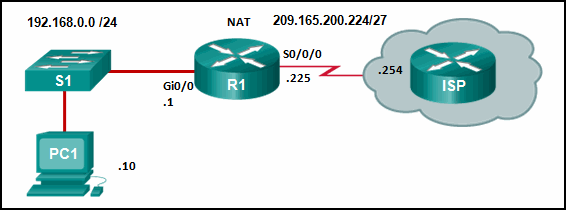
Explanation: Topic 6.1.4 – The inside global address is the public address of the NAT router's interface (209.165.200.225).
6. Refer to the exhibit. Given the commands as shown, how many hosts on the internal LAN off R1 can have simultaneous NAT translations on R1?
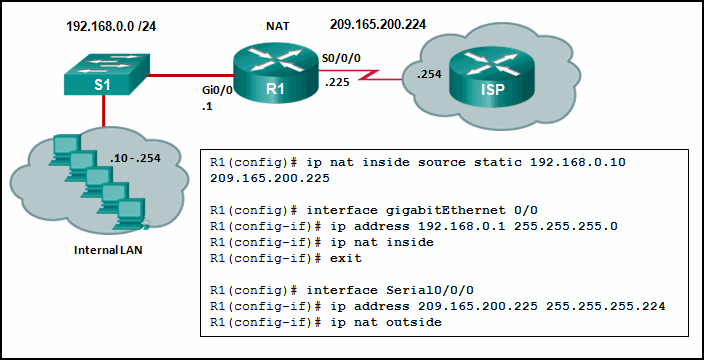
Explanation: Topic 6.2.1 – The NAT configuration on R1 is static NAT which translates a single inside IP address, 192.168.0.10 into a single public IP address, 209.165.200.255. If more hosts need translation, then a NAT pool of inside global address or overloading should be configured.
7. Refer to the exhibit. A network administrator has just configured address translation and is verifying the configuration. What three things can the administrator verify? (Choose three.)
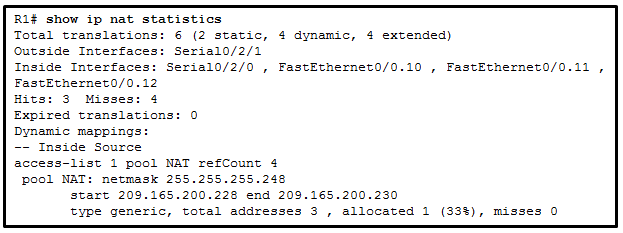
Explanation: Topic 6.5.5 – The show ip nat statistics, show ip nat translations, and debug ip nat commands are useful in determining if NAT is working and and also useful in troubleshooting problems that are associated with NAT. NAT is working, as shown by the hits and misses count. Because there are four misses, a problem might be evident. The standard access list numbered 1 is being used and the translation pool is named NAT as evidenced by the last line of the output. Both static NAT and NAT overload are used as seen in the Total translations line.
8. Refer to the exhibit. NAT is configured on RT1 and RT2. The PC is sending a request to the web server. What IPv4 address is the source IP address in the packet between RT2 and the web server?
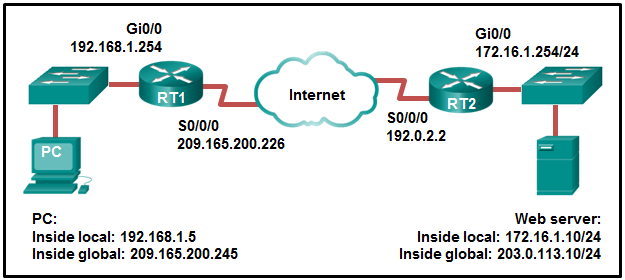
Explanation: Topic 6.1.4 – Because the packet is between RT2 and the web server, the source IP address is the inside global address of PC, 209.165.200.245.
9. Refer to the exhibit. Based on the output that is shown, what type of NAT has been implemented?

Explanation: Topic 6.6.6 – The output shows that there are two inside global addresses that are the same but that have different port numbers. The only time port numbers are displayed is when PAT is being used. The same output would be indicative of PAT that uses an address pool. PAT with an address pool is appropriate when more than 4,000 simultaneous translations are needed by the company.
10. Refer to the exhibit. From the perspective of users behind the NAT router, what type of NAT address is 209.165.201.1?
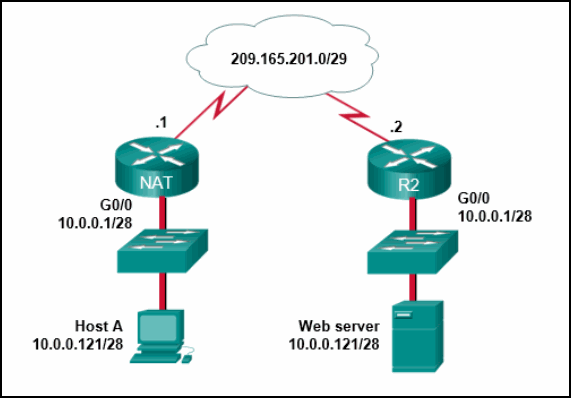
Explanation: Topic 6.1.4 – From the perspective of users behind NAT, inside global addresses are used by external users to reach internal hosts. Inside local addresses are the addresses assigned to internal hosts. Outside global addresses are the addresses of destinations on the external network. Outside local addresses are the actual private addresses of destination hosts behind other NAT devices.
11. Refer to the exhibit. Static NAT is being configured to allow PC 1 access to the web server on the internal network. What two addresses are needed in place of A and B to complete the static NAT configuration? (Choose two.)
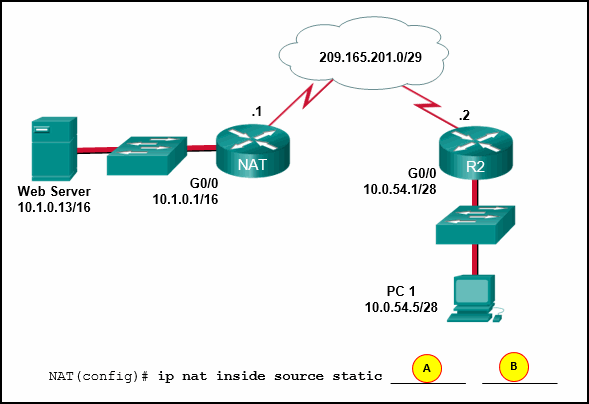
Explanation: Topic 6.4.2 – Static NAT is a one-to-one mapping between an inside local address and an inside global address. By using static NAT, external devices can initiate connections to internal devices by using the inside global addresses. The NAT devices will translate the inside global address to the inside local address of the target host.
12. What is the purpose of the overload keyword in the ip nat inside source list 1 pool NAT_POOL overload command?
Explanation: Topic 6.2.3 – Dynamic NAT uses a pool of inside global addresses that are assigned to outgoing sessions. If there are more internal hosts than public addresses in the pool, then an administrator can enable port address translation with the addition of the overload keyword. With port address translation, many internal hosts can share a single inside global address because the NAT device will track the individual sessions by Layer 4 port number.
13. Refer to the exhibit. Which source address is being used by router R1 for packets being forwarded to the Internet?

Explanation: Topic 6.1.4 – The source address for packets forwarded by the router to the Internet will be the inside global address of 209.165.200.225. This is the address that the internal addresses from the 10.6.15.0 network will be translated to by NAT.
14. Refer to the exhibit. The NAT configuration applied to the router is as follows:
ERtr(config)# access-list 1 permit 10.0.0.0 0.255.255.255
ERtr(config)# ip nat pool corp 209.165.201.6 209.165.201.30 netmask 255.255.255.224
ERtr(config)# ip nat inside source list 1 pool corp overload
ERtr(config)# ip nat inside source static 10.10.10.55 209.165.201.4
ERtr(config)# interface gigabitethernet 0/0
ERtr(config-if)# ip nat inside
ERtr(config-if)# interface serial 0/0/0
ERtr(config-if)# ip nat outside
Based on the configuration and the output shown, what can be determined about the NAT status within the organization?
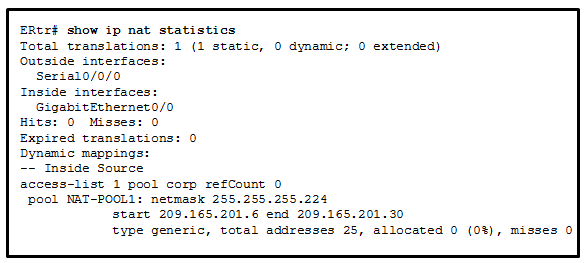
Explanation: Topic 6.5.5 – There is not enough information given because the router might not be attached to the network yet, the interfaces might not have IP addresses assigned yet, or the command could have been issued in the middle of the night. The output does match the given configuration, so no typographical errors were made when the NAT commands were entered.
15. Which situation describes data transmissions over a WAN connection?
Explanation: Topic 7.1.1 – When two offices across a city are communicating , it is most likely that the data transmissions are over some type of WAN connection. Data communications within a campus are typically over LAN connections.
16. Which two technologies are categorized as private WAN infrastructures? (Choose two.)
Explanation: Topic 7.2.2 – Private WAN technologies include leased lines, dialup, ISDN, Frame Relay, ATM, Ethernet WAN (an example is MetroE), MPLS, and VSAT.
17. Which network scenario will require the use of a WAN?
Explanation: Topic 7.1.1 – When traveling employees need to connect to a corporate email server through a WAN connection, the VPN will create a secure tunnel between an employee laptop and the corporate network over the WAN connection. Obtaining dynamic IP addresses through DHCP is a function of LAN communication. Sharing files among separate buildings on a corporate campus is accomplished through the LAN infrastructure. A DMZ is a protected network inside the corporate LAN infrastructure.
18. What are two hashing algorithms used with IPsec AH to guarantee authenticity? (Choose two.)
Explanation: Topic 8.3.5 – The IPsec framework uses various protocols and algorithms to provide data confidentiality, data integrity, authentication, and secure key exchange. Two popular algorithms used to ensure that data is not intercepted and modified (data integrity and authenticity) are MD5 and SHA.
19. What two algorithms can be part of an IPsec policy to provide encryption and hashing to protect interesting traffic? (Choose two.)
Explanation: Topic 8.3.2 – The IPsec framework uses various protocols and algorithms to provide data confidentiality, data integrity, authentication, and secure key exchange. Two popular algorithms used to ensure that data is not intercepted and modified (data integrity and authenticity) are MD5 and SHA.
20. Which VPN solution allows the use of a web browser to establish a secure, remote-access VPN tunnel to the ASA?
Explanation: Topic 8.2.1 – When a web browser is used to securely access the corporate network, the browser must use a secure version of HTTP to provide SSL encryption. A VPN client is not required to be installed on the remote host, so a clientless SSL connection is used.
21. Which IPsec security function provides assurance that the data received via a VPN has not been modified in transit?
Explanation: Topic 8.3.5 – Integrity is a function of IPsec and ensures data arrives unchanged at the destination through the use of a hash algorithm. Confidentiality is a function of IPsec and utilizes encryption to protect data transfers with a key. Authentication is a function of IPsec and provides specific access to users and devices with valid authentication factors. Secure key exchange is a function of IPsec and allows two peers to maintain their private key confidentiality while sharing their public key.
22. Which two types of VPNs are examples of enterprise-managed remote access VPNs? (Choose two.)
Explanation: Topic 8.1.4 – Remote access VPNs include client-based IPsec and clientless SSL.
23. Which is a requirement of a site-to-site VPN?
Explanation: Topic 8.2.3 – Site-to-site VPNs are static and are used to connect entire networks. Hosts have no knowledge of the VPN and send TCP/IP traffic to VPN gateways. The VPN gateway is responsible for encapsulating the traffic and forwarding it through the VPN tunnel to a peer gateway at the other end which decapsulates the traffic.
24. What is the function of the Diffie-Hellman algorithm within the IPsec framework?
Explanation: Topic 8.3.7 – Site-to-site VPNs are static and are used to connect entire networks. Hosts have no knowledge of the VPN and send TCP/IP traffic to VPN gateways. The VPN gateway is responsible for encapsulating the traffic and forwarding it through the VPN tunnel to a peer gateway at the other end which decapsulates the traffic.
25. What does NAT overloading use to track multiple internal hosts that use one inside global address?
Explanation: Topic 6.2.3 – NAT overloading, also known as Port Address Translation (PAT), uses port numbers to differentiate between multiple internal hosts.
26. What type of address is 192.168.7.98?
Explanation: Topic 6.1.1 – 192.168.0.0/16 is a private address range.
27. Refer to the exhibit. R1 is configured for static NAT. What IP address will Internet hosts use to reach PC1?
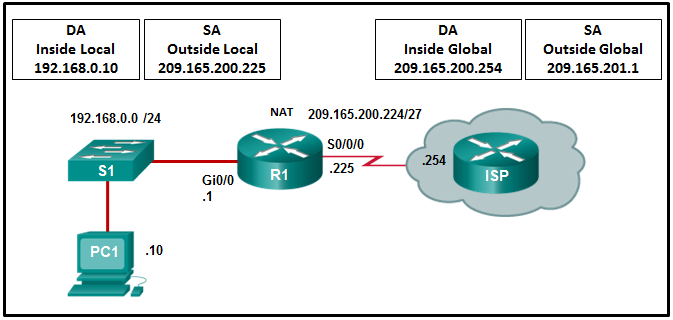
Explanation: Topic 6.1.4 – In static NAT a single inside local address, in this case 192.168.0.10, will be mapped to a single inside global address, in this case 209.165.200.225. Internet hosts will send packets to PC1 and use as a destination address the inside global address 209.165.200.225.
28. Which type of VPN uses the public key infrastructure and digital certificates?
Explanation: Topic 8.2.2 – SSL VPNs use PKI and digital certificates.
29. Which two WAN infrastructure services are examples of private connections? (Choose two.)
Explanation: Topic 7.3.1 – Private WANs can use T1/E1, T3/E3, PSTN, ISDN, Metro Ethernet, MPLS, Frame Relay, ATM, or VSAT technology.
30. Which two statements about the relationship between LANs and WANs are true? (Choose two.)
Explanation: Topic 7.1.1 – Private WANs can use T1/E1, T3/E3, PSTN, ISDN, Metro Ethernet, MPLS, Frame Relay, ATM, or VSAT technology.
31. Which statement describes an important characteristic of a site-to-site VPN?
Explanation: Topic 8.1.3 – A site-to-site VPN is created between the network devices of two separate networks. The VPN is static and stays established. The internal hosts of the two networks have no knowledge of the VPN.
32. How is "tunneling" accomplished in a VPN?
Explanation: Topic 8.2.4 – A site-to-site VPN is created between the network devices of two separate networks. The VPN is static and stays established. The internal hosts of the two networks have no knowledge of the VPN.
33. Which statement describes a VPN?
Explanation: Topic 8.1.1 – A site-to-site VPN is created between the network devices of two separate networks. The VPN is static and stays established. The internal hosts of the two networks have no knowledge of the VPN.
34. Open the PT Activity. Perform the tasks in the activity instructions and then answer the question. What problem is causing PC-A to be unable to communicate with the Internet?
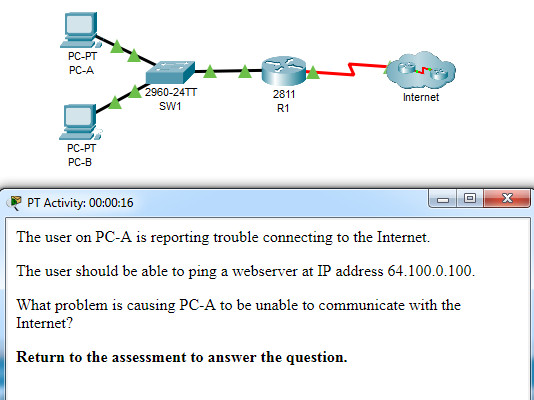

Explanation: Topic 6.5.5 – A site-to-site VPN is created between the network devices of two separate networks. The VPN is static and stays established. The internal hosts of the two networks have no knowledge of the VPN.
35. What type of address is 64.100.190.189?
Explanation: Topic 6.1.1 – A site-to-site VPN is created between the network devices of two separate networks. The VPN is static and stays established. The internal hosts of the two networks have no knowledge of the VPN.
36. Which type of VPN routes packets through virtual tunnel interfaces for encryption and forwarding?
Explanation: Topic 8.2.6 – The output of show ip nat statistics shows that the inside interface is FastEthernet0/0 but that no interface has been designated as the outside interface. This can be fixed by adding the command ip nat outside to interface Serial0/0/0.
37. Match the scenario to the WAN solution. (Not all options are used.)
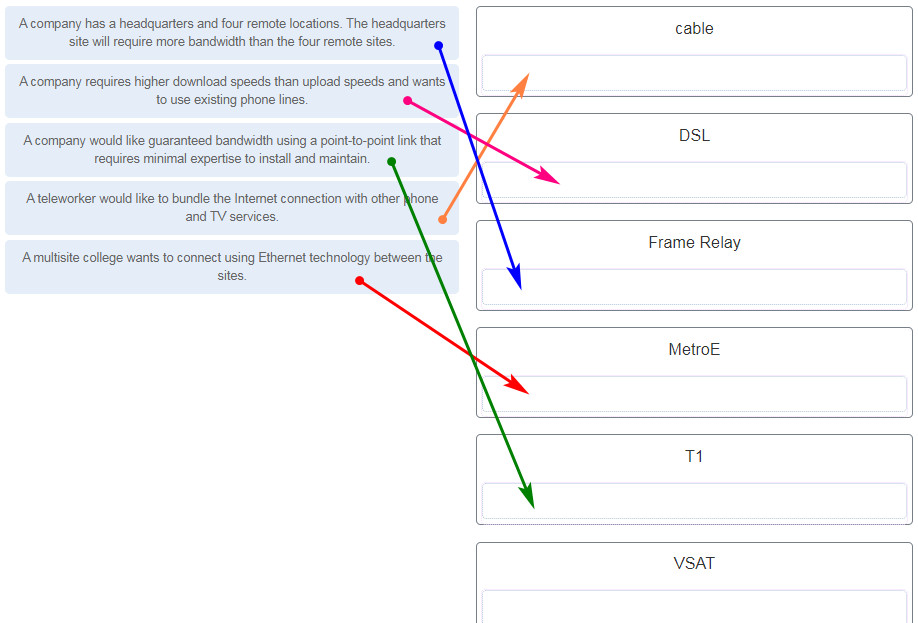
Explanation: Topic 7.3.2 – Match scenarios to appropriate WAN solutions.
38. Refer to the exhibit. The PC is sending a packet to the Server on the remote network. Router R1 is performing NAT overload. From the perspective of the PC, match the NAT address type with the correct IP address. (Not all options are used.)
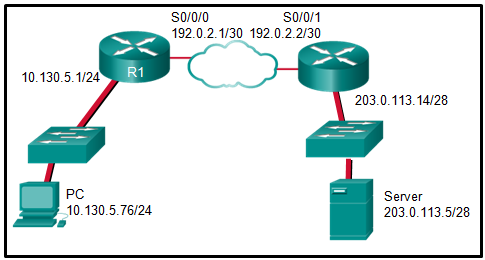

Explanation: Topic 6.1.4 – The inside local address is the private IP address of the source or the PC in this instance. The inside global address is the translated address of the source or the address as seen by the outside device. Since the PC is using the outside address of the R1 router, the inside global address is 192.0.2.1. The outside addressing is simply the address of the server or 203.0.113.5.
39. Refer to the exhibit. What has to be done in order to complete the static NAT configuration on R1?
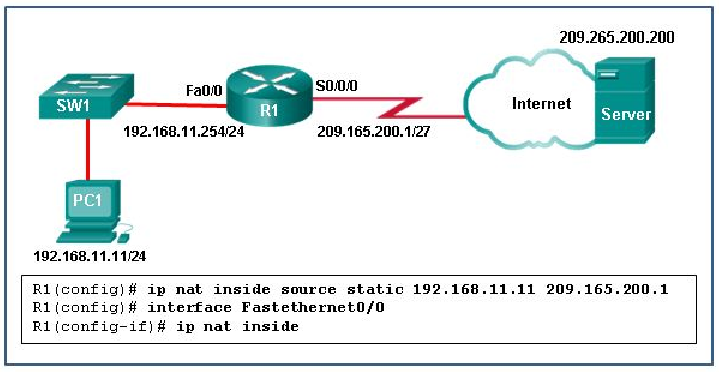
Explanation: Topic 6.4.2 – In order for NAT translations to work properly, both an inside and outside interface must be configured for NAT translation on the router.
40. In NAT terms, what address type refers to the globally routable IPv4 address of a destination host on the Internet?
Explanation: Topic 6.1.4 – In order for NAT translations to work properly, both an inside and outside interface must be configured for NAT translation on the router.
41. Refer to the exhibit. Which two statements are correct based on the output as shown in the exhibit? (Choose two.)

Explanation: Topic 6.4.4 – The output displayed in the exhibit is the result of the show ip nat translations command. Static NAT entries are always present in the NAT table, while dynamic entries will eventually time out.
42. Which circumstance would result in an enterprise deciding to implement a corporate WAN?
Explanation: Topic 7.1.5 – WANs cover a greater geographic area than LANs do, so having employees distributed across many locations would require the implementation of WAN technologies to connect those locations. Customers will access corporate web services via a public WAN that is implemented by a service provider, not by the enterprise itself. When employee numbers grow, the LAN has to expand as well. A WAN is not required unless the employees are in remote locations. LAN security is not related to the decision to implement a WAN.
43. What is the function of the Hashed Message Authentication Code (HMAC) algorithm in setting up an IPsec VPN?
Explanation: Topic 8.3.5 – The IPsec framework uses various protocols and algorithms to provide data confidentiality, data integrity, authentication, and secure key exchange. The Hashed Message Authentication Code (HMAC) is a data integrity algorithm that uses a hash value to guarantee the integrity of a message.
44. What algorithm is used with IPsec to provide data confidentiality?
Explanation: Topic 8.3.4 – The IPsec framework uses various protocols and algorithms to provide data confidentiality, data integrity, authentication, and secure key exchange. Two popular algorithms that are used to ensure that data is not intercepted and modified (data integrity) are MD5 and SHA. AES is an encryption protocol and provides data confidentiality. DH (Diffie-Hellman) is an algorithm that is used for key exchange. RSA is an algorithm that is used for authentication.
45. Which two technologies provide enterprise-managed VPN solutions? (Choose two.)
Explanation: Topic 8.1.4 – Enterprise-managed VPNs include site-to-site and remote access VPNs.
46. Which two end points can be on the other side of an ASA site-to-site VPN? (Choose two.)
Explanation: Topic 8.1.1 – In a site-to-site VPN, end hosts send and receive normal unencrypted TCP/IP traffic through a VPN terminating device, typically called a VPN gateway. A VPN gateway device could be a router or a firewall. A Cisco Adaptive Security Appliance (ASA) is a standalone firewall device that combines firewall, VPN concentrator, and intrusion prevention functionality into one software image.
47. Refer to the exhibit. A network administrator is viewing the output from the command show ip nat translations. Which statement correctly describes the NAT translation that is occurring on router RT2?
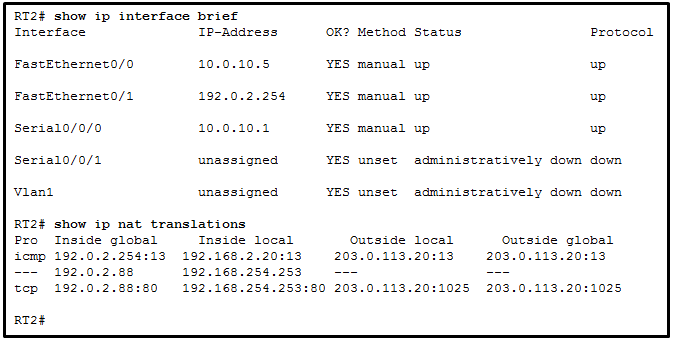
Explanation: Topic 6.4.4 – Because no outside local or outside global address is referenced, the traffic from a source IPv4 address of 192.168.254.253 is being translated to 192.0.2.88 by using static NAT. In the output from the command show ip nat translations, the inside local IP address of 192.168.2.20 is being translated into an outside IP address of 192.0.2.254 so that the traffic can cross the public network. A public IPv4 device can connect to the private IPv4 device 192.168.254.253 by targeting the destination IPv4 address of 192.0.2.88.
48. What type of address is 10.100.126.126?
Explanation: Topic 6.1.1 – 10.0.0.0/8 is a private address range.
49. Which type of VPN connects using the Transport Layer Security (TLS) feature?
Explanation: Topic 8.2.2 – When a client negotiates an SSL VPN connection with the VPN gateway, it connects using Transport Layer Security (TLS). TLS is the newer version of SSL and is sometimes expressed as SSL/TLS. The two terms are often used interchangeably.
50. Which two end points can be on the other side of an ASA site-to-site VPN configured using ASDM? (Choose two.)
Explanation: Topic 8.2.3 – ASDM supports creating an ASA site-to-site VPN between two ASAs or between an ASA and an ISR router.
51. Which protocol creates a virtual point-to-point connection to tunnel unencrypted traffic between Cisco routers from a variety of protocols?
Explanation: Topic 8.2.4 – ASDM supports creating an ASA site-to-site VPN between two ASAs or between an ASA and an ISR router.
52. What is a disadvantage when both sides of a communication use PAT?
Explanation: Topic 6.3.2 – With the use of NAT, especially PAT, end-to-end traceability is lost. This is because the host IP address in the packets during a communication is translated when it leaves and enters the network. With the use of NAT/PAT, both the flexibility of connections to the Internet and security are actually enhanced. Host IPv4 addressing is provided by DHCP and not related to NAT/PAT.
53. What two addresses are specified in a static NAT configuration?
Explanation: Topic 6.4.2 – Static NAT maps inside local to inside global.
54. A company is considering updating the campus WAN connection. Which two WAN options are examples of the private WAN architecture? (Choose two.)
Explanation: Topic 7.4.2 – Leased lines and Ethernet WAN are private WAN options.
55. What type of address is 128.107.240.239?
Explanation: Topic 6.1.1 – 128.107.240.239 is a public address.
56. Which type of VPN has both Layer 2 and Layer 3 implementations?
Explanation: Topic 8.2.7 – MPLS VPN has both Layer 2 and Layer 3 implementations.
57. Refer to the exhibit. A network administrator has configured R2 for PAT. Why is the configuration incorrect?
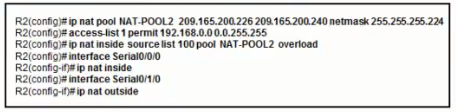
Explanation: Topic 6.5.2 – In the exhibit, NAT-POOL 2 is bound to ACL 100, but it should be bound to the configured ACL 1. This will cause PAT to fail. 100, but it should be bound to the configured ACL 1. This will cause PAT to fail.
58. Match each component of a WAN connection to its description. (Not all options are used.)

Explanation: Topic 7.2.3 – Match WAN components to their descriptions.
59. Which type of VPN allows multicast and broadcast traffic over a secure site-to-site VPN?
Explanation: Topic 8.2.4 – GRE over IPsec supports multicast and broadcast traffic.
60. Match the steps with the actions that are involved when an internal host with IP address 192.168.10.10 attempts to send a packet to and external server at the IP address 209.165.200.254 across a router R1 that running dynamic NAT. (Not all options are used.)
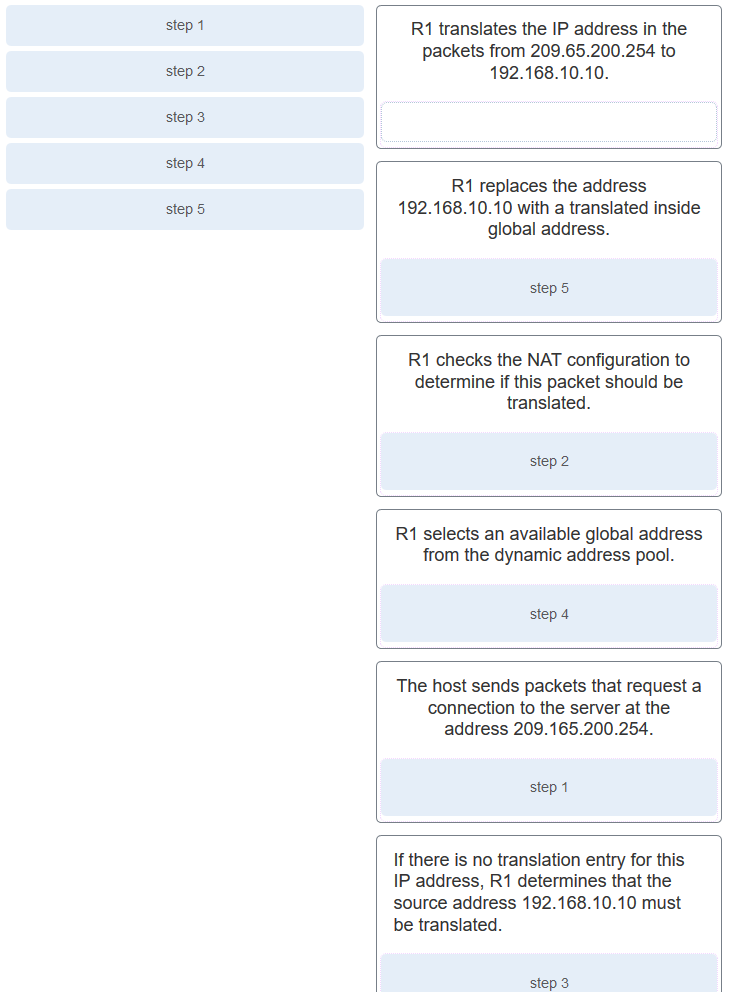
Explanation: Topic 6.5.3 – The correct order: Host sends packet → R1 checks NAT config → R1 determines translation needed → R1 selects global address → R1 replaces source address. The translation of the IP addresses from 209.65.200.254 to 192.168.10.10 will take place when the reply comes back from the server.
61. Which type of VPN involves passenger, carrier, and transport protocols?
Explanation: Topic 8.2.4 – The translation of the IP addresses from 209.65.200.254 to 192.168.10.10 will take place when the reply comes back from the server.
64. What type of address is 10.131.48.7?
Explanation: Topic 6.1.1 – 10.0.0.0/8 is private.
65. Which type of VPN supports multiple sites by applying configurations to virtual interfaces instead of physical interfaces?
Explanation: Topic 8.2.6 – An IPsec VTI is a newer IPsec VPN technology that simplifies the configuration required to support multiple sites and remote access. IPsec VTI configurations use virtual interfaces to send and receive IP unicast and multicast encrypted traffic. Therefore, routing protocols are automatically supported without requiring configuration of GRE tunnels.
66. Which type of VPN involves a nonsecure tunneling protocol being encapsulated by IPsec?
Explanation: Topic 8.2.4 – GRE (nonsecure) is encapsulated by IPsec.
67. What type of address is 10.19.6.7?
Explanation: Topic 6.1.1 – 10.0.0.0/8 is private.
68. What type of address is 64.101.198.197?
Explanation: Topic 6.1.1 – 64.101.198.197 is a public address.
69. What type of address is 64.101.198.107?
Explanation: Topic 6.1.1 – 64.101.198.107 is a public address.
70. What type of address is 10.100.34.34?
Explanation: Topic 6.1.1 – 10.0.0.0/8 is private.
71. What type of address is 192.168.7.126?
Explanation: Topic 6.1.1 – 192.168.0.0/16 is private.
72. What type of address is 198.133.219.148?
Explanation: Topic 6.1.1 – 198.133.219.148 is a public address.
🚀 Ace Your CCNA Exam - Complete Study Pack!
Get 500+ exam-realistic questions, Packet Tracer labs, and detailed explanations.
Understanding WAN Concepts (Modules 6-8)
Passing the CCNA 3 v7 Modules 6-8 exam requires a solid grasp of WAN technologies, NAT, VPNs, and IPsec. These modules cover WAN architectures, Network Address Translation (NAT), Virtual Private Networks (VPNs), IPsec protocols, and WAN connectivity options – essential knowledge for any network professional.
Why Modules 6-8 Matter for Your Networking Career
Modules 6-8 focus on connecting enterprise networks across wide geographic areas. You learn how NAT conserves IPv4 addresses, how VPNs secure data over public networks, and how IPsec provides confidentiality, integrity, and authentication. Employers expect CCNA-certified professionals to understand NAT terminology, VPN types, IPsec components, and WAN technologies. Mastering these topics prepares you for advanced network design and security roles.
Key Topics Covered in the Exam
Our verified answers address common exam questions on:
- NAT Concepts: Inside local/global, outside local/global, static NAT, dynamic NAT, PAT (overload).
- NAT Configuration:
ip nat inside source,ip nat outside, NAT pools, ACLs. - WAN Architectures: Private WAN (leased lines, Frame Relay, MetroE) vs. public WAN (DSL, cable).
- VPN Types: Site-to-site VPN, remote access VPN, client-based IPsec, clientless SSL.
- IPsec Components: AES, SHA, MD5, Diffie-Hellman, HMAC, IKE.
- VPN Protocols: GRE, IPsec, SSL/TLS, MPLS.
- Address Types: Public vs. private IPv4 addresses (RFC 1918).
Many questions present a network topology and ask you to identify NAT address types, correct VPN configuration, or troubleshooting steps. Understanding the encapsulation process and the role of each IPsec component is critical for success.
Common Pitfalls to Avoid
Students often confuse inside local and inside global addresses – inside local is the private address of the internal host, while inside global is the translated address seen on the outside network. Another common mistake is mixing up site-to-site and remote access VPNs – site-to-site connects entire networks, while remote access connects individual users. Also, remember that GRE does not encrypt traffic; it must be combined with IPsec for security.
When practicing with our answers, avoid memorizing letter choices (A, B, C, D). Cisco often reorders options. Focus on the concept behind each correct answer. For example, instead of remembering "option B is the correct NAT type", learn the difference between static NAT, dynamic NAT, and PAT.
Study Strategies That Work
To retain this material long-term, combine our exam answers with hands-on practice. Use Packet Tracer to configure static NAT, dynamic NAT, and PAT on routers. Set up a site-to-site VPN between two routers. Verify NAT translations and VPN tunnels with show commands. This practical approach cements the theory from Modules 6-8.
We also recommend creating flashcards for key terms: NAT, PAT, inside global, inside local, outside global, outside local, VPN, IPsec, AH, ESP, IKE, DH, SHA, MD5, AES, GRE, MPLS, Frame Relay, MetroE. Quiz yourself daily until you can define each term without hesitation.
How to Use This Answer Page Effectively
Our goal at CoursMooc.com is to provide accurate, up-to-date answers for the latest CCNA v7 curriculum. For each question, we include an explanation—not just the correct choice. Read those explanations carefully. If you find a concept unclear, refer to the official Cisco NetAcad course materials or our additional tutorials linked below.
We regularly update this page to match any changes in the exam. If you notice discrepancies, please let us know through the comments. Your feedback helps other learners succeed.
What's Next After Modules 6-8?
After mastering WAN concepts, Modules 9-12 cover network optimization, monitoring, and troubleshooting. Modules 13-14 focus on emerging network technologies. Each step builds on the fundamentals you solidify here. By completing all CCNA 3 v7 exams (Modules 1-2, 3-5, 6-8, 9-12, 13-14), you earn the official "Enterprise Networking, Security, and Automation" badge – a stepping stone to the full CCNA certification.
Final Tips for Exam Day
Before starting the real exam:
- Get a good night's sleep – fatigue leads to misreading questions.
- Read each question twice. Some ask "Which two statements are correct?" – don't just pick one answer.
- Manage your time. You typically have 50-60 minutes for 40-50 questions. Skip difficult ones and return later.
- Look for keywords like "not", "except", or "only". One word changes the entire meaning.
- Trust your first instinct unless you find clear evidence you misread.
Remember: The CCNA v7 curriculum emphasizes practical troubleshooting. If you can explain why a NAT translation fails or why a VPN tunnel won't establish, you're ready. Use our answers to verify your thinking, then reinforce with simulation tools. Good luck on your exam – and on your journey to networking expertise.