CCNA 3 v7 Modules 9-12: Optimize, Monitor, and Troubleshoot Networks Exam Answers
Checkpoint Exam: Optimize, Monitor, and Troubleshoot Networks. This comprehensive study guide covers Modules 9-12 of the CCNA3 Enterprise Networking, Security, and Automation v7.0 (ENSA), including QoS, network monitoring, troubleshooting, and network design.
1. What is the term used to indicate a variation of delay?
Explanation: Topic 9.1.3 – Jitter is a phenomenon caused by a variation in delay. Delay (or latency) is the time it takes for the packet to arrive at its destination. Jitter describes how the voice packets arrive at the destination at varying intervals (not in a steady, consistent stream).
2. A network engineer performs a ping test and receives a value that shows the time it takes for a packet to travel from a source to a destination device and return. Which term describes the value?
Explanation: Topic 9.1.3 – Latency is the round-trip time.
3. What role do network devices play in the IntServ QoS model?
Explanation: Topic 9.4.4 – IntServ reserves resources before traffic is sent.
4. Which device would be classified as a trusted endpoint?
Explanation: Trusted endpoints include IP phones, wireless access points, videoconferencing systems, etc.
5. What is the benefit of deploying Layer 3 QoS marking across an enterprise network?
Explanation: Layer 3 marking travels end-to-end.
6. What is the function of a QoS trust boundary?
Explanation: Network traffic is classified and marked as close to the source device as possible. The trust boundary is the location where the QoS markings on a packet are trusted as they enter an enterprise network.
7. What are two approaches to prevent packet loss due to congestion on an interface? (Choose two.)
Explanation: Increase capacity or drop lower-priority packets to prevent congestion.
8. What configuration scenario would offer the most protection to SNMP get and set messages?
Explanation: SNMPv3 supports authentication and encryption with the auth and priv security levels. SNMPv1 and SNMPv2 do not support authentication or encryption. Using a default community string is not secure because the default string of “public” is well known and would allow anyone with SNMP systems to read device MIBs.
9. Refer to the exhibit. The network administrator enters these commands into the R1 router:
 R1# copy running-config tftp
 Address or name of remote host [ ]?
When the router prompts for an address or remote host name, what IP address should the administrator enter at the prompt?
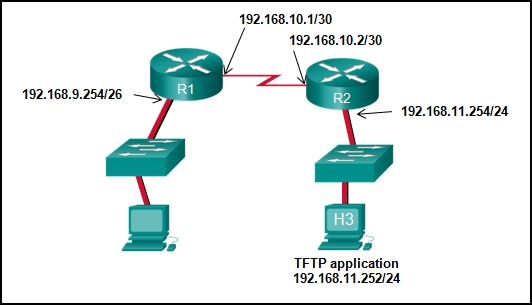
Explanation: The requested address is the address of the TFTP server. A TFTP server is an application that can run on a multitude of network devices including a router, server, or even a networked PC.
10. The command ntp server 10.1.1.1 is issued on a router. What impact does this command have?
Explanation: The ntp server ip-address global configuration command configures the NTP server for IOS devices.
11. As the network administrator you have been asked to implement EtherChannel on the corporate network. What does this configuration consist of?
Explanation: EtherChannel is utilized on a network to increase speed capabilities by grouping multiple physical ports into one or more logical EtherChannel links between two switches. STP is used to provide redundant links that dynamically block or forward traffic between switches. FHRPs are used to group physical devices to provide traffic flow in the event of failure.
12. What is a definition of a two-tier LAN network design?
Explanation: Maintaining three separate network tiers is not always required or cost-efficient. All network designs require an access layer, but a two-tier design can collapse the distribution and core layers into one layer to serve the needs of a small location with few users.
13. What are two reasons to create a network baseline? (Choose two.)
Explanation: A network baseline is created to provide a comparison point, at the time that the network is performing optimally, to whatever changes are implemented in the infrastructure. A baseline helps to keep track of the performance, to track the traffic patterns, and to monitor network behavior.
14. A computer can access devices on the same network but cannot access devices on other networks. What is the probable cause of this problem?
Explanation: The default gateway is the address of the device a host uses to access the Internet or another network. If the default gateway is missing or incorrect, that host will not be able to communicate outside the local network. Because the host can access other hosts on the local network, the network cable and the other parts of the IP configuration are working.
15. In which step of gathering symptoms does the network engineer determine if the problem is at the core, distribution, or access layer of the network?
Explanation: In the “narrow the scope” step of gathering symptoms, a network engineer will determine if the network problem is at the core, distribution, or access layer of the network. Once this step is complete and the layer is identified, the network engineer can determine which pieces of equipment are the most likely cause.
16. A network administrator is deploying QoS with the ability to provide a special queue for voice traffic so that voice traffic is forwarded before network traffic in other queues. Which queuing method would be the best choice?
Explanation: Low latency queuing (LLQ) allows delay-sensitive data, such as voice traffic, to be defined in a strict priority queue (PQ) and to always be sent first before any packets in any other queue are forwarded.
17. What are two characteristics of voice traffic? (Choose two.)
Explanation: Voice traffic does not consume a lot of network resources, such as bandwidth. However, it is very sensitive to delay and dropped packets cannot be retransmitted. For good voice quality, the amount of latency should always be less than 150 milliseconds.
18. Which type of network traffic cannot be managed using congestion avoidance tools?
Explanation: Queuing and compression techniques can help to reduce and prevent UDP packet loss, but there is no congestion avoidance for User Datagram Protocol (UDP) based traffic.
19. When QoS is implemented in a converged network, which two factors can be controlled to improve network performance for real-time traffic? (Choose two.)
Explanation: Delay is the latency between a sending and receiving device. Jitter is the variation in the delay of the received packets. Both delay and jitter need to be controlled in order to support real-time voice and video traffic.
20. An administrator wants to replace the configuration file on a Cisco router by loading a new configuration file from a TFTP server. What two things does the administrator need to know before performing this task? (Choose two.)
Explanation: In order to identify the exact location of the desired configuration file, the IP address of the TFTP server and the name of the configuration file are essential information. Because the file is a new configuration, the name of the current configuration file is not necessary.
21. Refer to the exhibit. Which of the three Cisco IOS images shown will load into RAM?
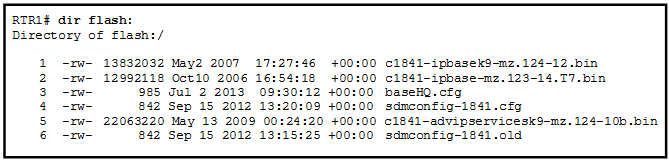
Explanation: When performing an upgrade or testing different IOS versions, the boot system command is used to select which image is used to boot the Cisco device.
22. Refer to the exhibit. What two types of devices are connected to R1? (Choose two.)
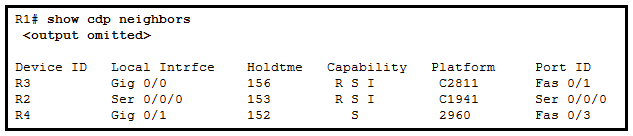
Explanation: The capabilities of the devices displayed by the output show them to be a Cisco 2811 series router, Cisco 1941 series router, and a Cisco 2960 switch.
23. What are three functions provided by the syslog service? (Choose three.)
Explanation: Syslog provides logging, selection, and destination specification.
24. What is the function of the MIB element as part of a network management system?
Explanation: The Management Information Base (MIB) resides on a networking device and stores operational data about the device. The SNMP manager can collect information from SNMP agents. The SNMP agent provides access to the information.
25. What network design would contain the scope of disruptions on a network should a failure occur?
Explanation: One way to contain the impact of a failure on the network is to implement redundancy. One way this is accomplished is by deploying redundant distribution layer switches and dividing the access layer switch connections between the redundant distribution layer switches. This creates what is called a switch block. Failures in a switch block are contained to that block and do not bring down the whole network.
26. Which action should be taken when planning for redundancy on a hierarchical network design?
Explanation: One method of implementing redundancy is path redundancy, installing alternate physical paths for data to traverse the network. Redundant links in a switched network supports high availability and can be used for load balancing, reducing congestion on the network.
27. What are two benefits of extending access layer connectivity to users through a wireless medium? (Choose two.)
Explanation: Wireless connectivity at the access layer provides increased flexibility, reduced costs, and the ability to grow and adapt to changing business requirements. Utilizing wireless routers and access points can provide an increase in the number of central points of failure. Wireless routers and access points will not provide an increase in bandwidth availability.
28. What is a basic function of the Cisco Borderless Architecture access layer?
Explanation: A function of the Cisco Borderless Architecture access layer is providing network access to the users. Layer 2 broadcast domain aggregation, Layer 3 routing boundaries aggregation, and high availability are distribution layer functions. The core layer provides fault isolation and high-speed backbone connectivity.
29. Which characteristic would most influence a network design engineer to select a multilayer switch over a Layer 2 switch?
Explanation: Multilayer switches, also known as Layer 3 switches, can route and build a routing table. This capability is required in a multi-VLAN network and would influence the network designer to select a multilayer switch. The other options are features also available on Layer 2 switches, so they would not influence the decision to select a multilayer switch.
30. Refer to the exhibit. Why are routers R1 and R2 not able to establish an OSPF adjacency?
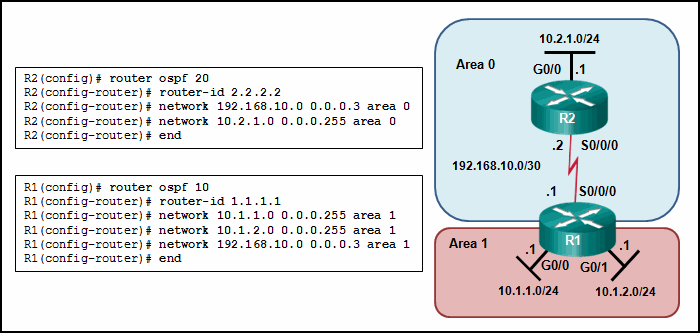
Explanation: On router R1, the network 192.168.10.0/30 is defined in the wrong area (area 1). It has to be defined in area 0 in order to establish adjacency with router R2, which has the network 192.168.10.0/30 defined in area 0.
31. When is the most appropriate time to measure network operations to establish a network performance baseline?
Explanation: The purpose of establishing a network performance baseline is to provide a reference of normal or average network use to enable data traffic anomalies to be detected and then investigated. Network operations that are not average, or are not normal, cannot be used to establish a network performance baseline.
32. Refer to the exhibit. A user has configured a NIC on the PC as shown but finds that the PC is unable to access the Internet. What is the problem?
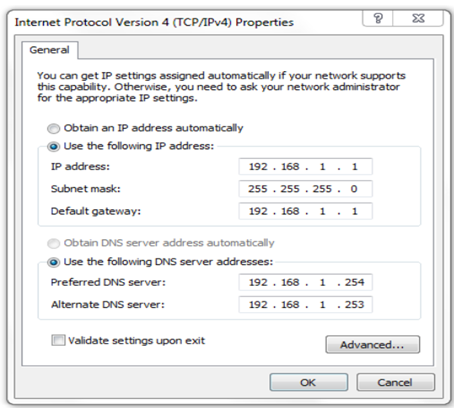
Explanation: In order for a computer to communicate outside its network, it must have a valid default gateway configured.This address cannot be the same as the IP address of the computer.
33. Refer to the exhibit. A network engineer configured an ACL preventing Telnet and HTTP access to the HQ web server from guest users in the Branch LAN. ... After implementing the ACL, no one can access any of the HQ servers. What is the problem?
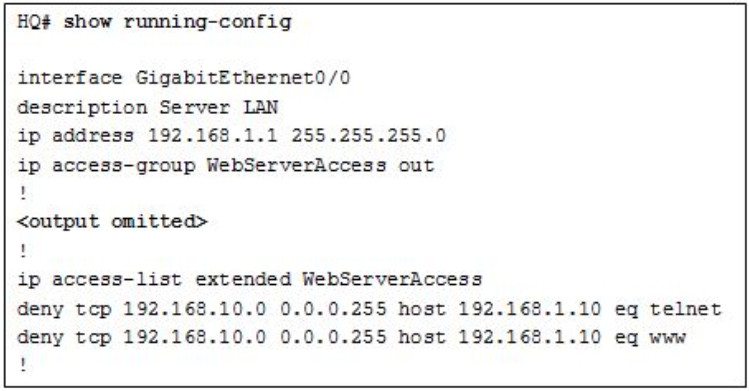
Explanation: Both named and numbered ACLs have an implicit deny ACE at the end of the list. This implicit deny blocks all traffic.
34. Refer to the exhibit. A network administrator has configured OSPFv2 on the two Cisco routers as shown. PC1 is unable to connect to PC2. What should the administrator do first when troubleshooting the OSPFv2 implementation?
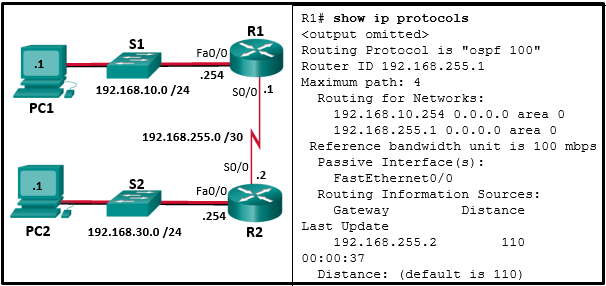
Explanation: A prerequisite for OSPFv2 neighbor relationships to form between two routers is Layer 3 connectivity. A successful ping confirms that a router interface is active and may be able to form an OSPF neighbor adjacency.
35. What type of traffic is described as requiring latency to be no more than 150 milliseconds (ms)?
Explanation: Voice traffic requires latency ≤ 150 ms.
36. A network manager wants to add a time to log messages so that there is record of when the message was generated. What command should the administrator use on a Cisco router?
Explanation: service timestamps log datetime adds timestamps to log messages.
37. Match the functions to the corresponding layers. (Not all options are used.)
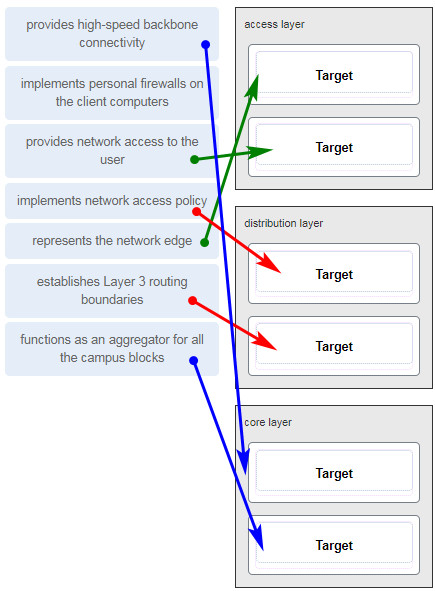
Explanation: Topic 11.1.2
| Function | Layer |
|---|---|
| represents the network edge | access layer |
| provides network access to the user | access layer |
| implements network access policy | distribution layer |
| establishes Layer 3 routing boundaries | distribution layer |
| provides high-speed backbone connectivity | core layer |
| functions as an aggregator for all the campus blocks | core layer |
38. Match the borderless switched network guideline description to the principle. (Not all options are used.)

Explanation: Topic 11.1.1
| Description | Principle |
|---|---|
| facilitates understanding the role of each device at every tier, simplifies deployment, operation, management, and reduces fault domains at every tier | hierarchical |
| satisfies user expectations for keeping the network always on | resiliency |
| allows seamless network expansion and integrated service enablement on an on-demand basis | modularity |
| allows intelligent traffic load sharing by using all network resources | flexibility |
39. What are two characteristics of the best-effort QoS model? (Choose two.)
Explanation: The best-effort QoS model provides no guarantees and it is commonly used on the Internet. The best-effort QoS model treats all network packets in the same way.
40. Why is QoS an important issue in a converged network that combines voice, video, and data communications?
Explanation: Without any QoS mechanisms in place, time-sensitive packets, such as voice and video, will be dropped with the same frequency as email and web browsing traffic.
41. A network administrator configures a router with the command sequence:
R1(config)# boot system tftp://c1900-universalk9-mz.SPA.152-4.M3.bin
R1(config)# boot system rom
What is the effect of the command sequence?
Explanation: The boot system command is a global configuration command that allows the user to specify the source for the Cisco IOS Software image to load. In this case, the router is configured to boot from the IOS image that is stored on the TFTP server and will use the ROMmon imagethat is located in the ROM if it fails to locate the TFTP server or fails to load a valid image from the TFTP server.
42. Which statement describes SNMP operation?
Explanation: An SNMP agent that resides on a managed device collects and stores information about the device and its operation. This information is stored by the agent locally in the MIB. An NMS periodically polls the SNMP agents that are residing on managed devices by using the get request to query the devices for data.
43. Refer to the exhibit. A network administrator issues the show lldp neighbors command on a switch. What are two conclusions that can be drawn? (Choose two.)
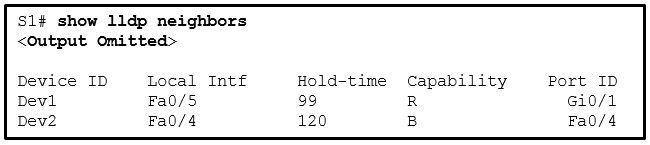
Explanation: In the output from the show lldp command, under Capability, R indicates a router and B indicates a bridge (switch). Nothing indicates that Dev1 and Dev2 are connected to one another.
44. What are the three layers of the switch hierarchical design model? (Choose three.)
Explanation: In the output from the show lldp command, under Capability, R indicates a router and B indicates a bridge (switch). Nothing indicates that Dev1 and Dev2 are connected to one another.
45. Refer to the exhibit. Which devices exist in the failure domain when switch S3 loses power?
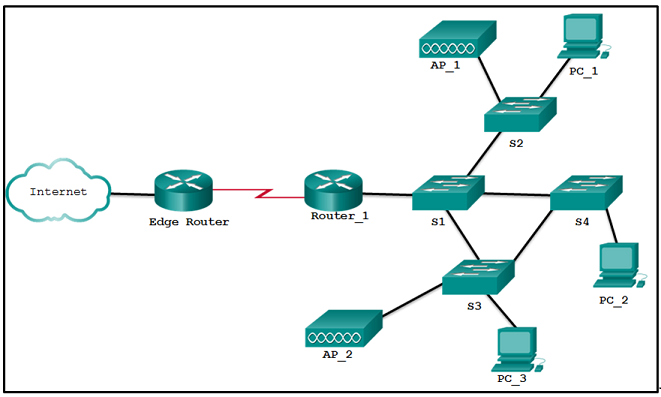
Explanation: A failure domain is the area of a network that is impacted when a critical device such as switch S3 has a failure or experiences problems.
46. A network designer is considering whether to implement a switch block on the company network. What is the primary advantage of deploying a switch block?
Explanation: The configuration of a switch block provides redundancy so that the failure of a single network device generally has little or no effect on end users.
47. Which troubleshooting tool would a network administrator use to check the Layer 2 header of frames that are leaving a particular host?
Explanation: A protocol analyzer such as Wireshark is capable of displaying the headers of data at any OSI Layer.
48. Refer to the exhibit. R1 and R3 are connected to each other via the local serial 0/0/0 interface. Why are they not forming an adjacency?
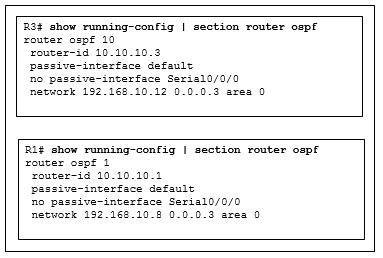
Explanation: The routers need to be in the same subnet in order to form an adjacency. The routing processes can be different on each router. The router IDs must be different for routers that participate in the same routing domain. The interfaces are not passive.
49. What type of traffic is described as not resilient to loss?
Explanation: Video traffic tends to be unpredictable, inconsistent, and bursty compared to voice traffic. Compared to voice, video is less resilient to loss and has a higher volume of data per packet.
50. A network manager wants lists the contents of flash. What command should the administrator use on a Cisco router?
Explanation: The dir command lists the contents of flash.
51. Voice packets are being received in a continuous stream by an IP phone, but because of network congestion the delay between each packet varies and is causing broken conversations. What term describes the cause of this condition?
Explanation: Jitter is the variation in the latency or delay of received packets. When data is sent, packets are sent in a continuous stream and are spaced evenly apart. Because of network congestion, the delay between each packet can vary instead of remaining constant.
52. A user is unable to reach the website when typing http://www.cisco.com in a web browser, but can reach the same site by typing http://72.163.4.161. What is the issue?
Explanation: Domain Name Service (DNS) is used to translate a web address to an IP address. The address of the DNS server is provided via DHCP to host computers.
53. What type of traffic is described as tending to be unpredictable, inconsistent, and bursty?
Explanation: Video traffic is bursty and unpredictable.
54. A network manager wants to determine the size of the Cisco IOS image file on the networking device. What command should the administrator use on a Cisco router?
Explanation: show flash:0 displays details of the IOS image file.
55. What is the principle that is applied when a network technician is troubleshooting a network fault by using the divide-and-conquer method?
Explanation: The nature of the OSI and TCP/IP layered models is that upper layers are dependent on lower layers. So when troubleshooting, if a particular layer is found to be working correctly then it can be assumed that all layers below it are also functioning correctly.
56. Which queuing algorithm has only a single queue and treats all packets equally?
Explanation: FIFO uses a single queue and treats all packets equally.
57. What type of traffic is described as traffic that requires at least 30 Kbps of bandwidth?
Explanation: Voice traffic typically requires at least 30 Kbps.
58. What type of traffic is described as being able to tolerate a certain amount of latency, jitter, and loss without any noticeable effects?
Explanation: Voice can tolerate some latency, jitter, and loss.
59. A network manager wants to view the amount of available and free memory, the type of file system, and its permissions. What command should the administrator use on a Cisco router?
Explanation: show file systems displays file system information.
60. What type of traffic is described as requiring latency to be no more than 400 milliseconds (ms)?
Explanation: Video traffic can tolerate up to 400 ms latency.
61. What type of traffic is described as consisting of traffic that requires a higher priority if interactive?
Explanation: Interactive data traffic needs higher priority.
62. A network manager wants to configure the router to load a new image from flash during bootup. What command should the administrator use on a Cisco router?
Explanation: The boot system command specifies the image to load.
63. What type of traffic is described as predictable and smooth?
Explanation: Voice traffic is predictable and smooth.
64. A network manager wants to ensure that the device will ignore the startup config file during startup and bypass the required passwords. What command should the administrator use on a Cisco router?
Explanation: confreg 0x2142 ignores the startup config.
65. What type of traffic is described as having a high volume of data per packet?
Explanation: Video packets have high data volume.
66. A network manager wants to backup the running configuration to a file server. What command should the administrator use on a Cisco router?
Explanation: copy running-config tftp backs up the running config to a TFTP server.
67. What type of traffic is described as consisting of traffic that gets a lower priority if it is not mission-critical?
Explanation: Data traffic can be deprioritized if not mission-critical.
🚀 Ace Your CCNA Exam - Complete Study Pack!
Get 500+ exam-realistic questions, Packet Tracer labs, and detailed explanations.
Understanding Optimize, Monitor, and Troubleshoot Networks (Modules 9-12)
Passing the CCNA 3 v7 Modules 9-12 exam requires a solid grasp of QoS, network monitoring, troubleshooting methodologies, and hierarchical network design. These modules cover Quality of Service (QoS), network management (SNMP, Syslog, NTP), network troubleshooting, and campus network design principles – essential knowledge for any network professional.
Why Modules 9-12 Matter for Your Networking Career
Modules 9-12 focus on optimizing network performance, monitoring network health, and troubleshooting network issues. You learn how QoS manages delay and jitter, how SNMP and Syslog help monitor devices, how to structure a network for redundancy and scalability, and how to systematically troubleshoot problems. Employers expect CCNA-certified professionals to understand QoS models, SNMP operations, hierarchical design, and troubleshooting methodologies. Mastering these topics prepares you for advanced network management and design roles.
Key Topics Covered in the Exam
Our verified answers address common exam questions on:
- QoS Concepts: Jitter, latency, bandwidth, trust boundaries, IntServ, DiffServ.
- Queuing Algorithms: FIFO, WFQ, CBWFQ, LLQ.
- Network Monitoring: SNMP (agents, MIB, NMS), Syslog (levels, destinations), NTP.
- Hierarchical Design: Access, distribution, core layers; switch blocks; two-tier vs three-tier.
- Troubleshooting: Divide-and-conquer, gather symptoms, narrow scope, common issues (default gateway, DNS, ACLs).
- Traffic Types: Voice, video, data characteristics (latency, jitter, loss, bandwidth).
- IOS File Management:
boot system,copy,show flash, configuration register.
Many questions present a scenario and ask you to identify the correct QoS mechanism, monitoring tool, or troubleshooting step. Understanding the purpose of each technology is critical for success.
Common Pitfalls to Avoid
Students often confuse jitter and latency – latency is the delay, jitter is the variation in delay. Another common mistake is mixing up SNMP versions – SNMPv3 provides security, while v1/v2 do not. Also, remember that LLQ provides a strict priority queue for voice, while CBWFQ provides bandwidth guarantees for multiple classes.
When practicing with our answers, avoid memorizing letter choices (A, B, C, D). Cisco often reorders options. Focus on the concept behind each correct answer. For example, instead of remembering "option B is the correct queuing method", learn when to use LLQ vs. CBWFQ.
Study Strategies That Work
To retain this material long-term, combine our exam answers with hands-on practice. Use Packet Tracer to configure QoS (class maps, policy maps), SNMP, Syslog, and NTP. Practice troubleshooting scenarios by introducing errors and using the divide-and-conquer method. This practical approach cements the theory from Modules 9-12.
We also recommend creating flashcards for key terms: jitter, latency, QoS, IntServ, DiffServ, FIFO, WFQ, CBWFQ, LLQ, SNMP, MIB, Syslog, NTP, access layer, distribution layer, core layer, switch block, default gateway, DNS, ACL implicit deny. Quiz yourself daily until you can define each term without hesitation.
How to Use This Answer Page Effectively
Our goal at CoursMooc.com is to provide accurate, up-to-date answers for the latest CCNA v7 curriculum. For each question, we include an explanation—not just the correct choice. Read those explanations carefully. If you find a concept unclear, refer to the official Cisco NetAcad course materials or our additional tutorials linked below.
We regularly update this page to match any changes in the exam. If you notice discrepancies, please let us know through the comments. Your feedback helps other learners succeed.
What's Next After Modules 9-12?
After mastering optimization, monitoring, and troubleshooting, Modules 13-14 cover emerging network technologies. The final checkpoint exam will test your knowledge of these topics. By completing all CCNA 3 v7 exams (Modules 1-2, 3-5, 6-8, 9-12, 13-14), you earn the official "Enterprise Networking, Security, and Automation" badge – a stepping stone to the full CCNA certification.
Final Tips for Exam Day
Before starting the real exam:
- Get a good night's sleep – fatigue leads to misreading questions.
- Read each question twice. Some ask "Which two statements are correct?" – don't just pick one answer.
- Manage your time. You typically have 50-60 minutes for 40-50 questions. Skip difficult ones and return later.
- Look for keywords like "not", "except", or "only". One word changes the entire meaning.
- Trust your first instinct unless you find clear evidence you misread.
Remember: The CCNA v7 curriculum emphasizes practical troubleshooting. If you can explain why a QoS policy fails or why a network issue occurs, you're ready. Use our answers to verify your thinking, then reinforce with simulation tools. Good luck on your exam – and on your journey to networking expertise.