CCNA 3 v7 Modules 13-14: Emerging Network Technologies Exam Answers
Checkpoint Exam: Emerging Network Technologies. This comprehensive study guide covers Modules 13-14 of the CCNA3 Enterprise Networking, Security, and Automation v7.0 (ENSA), including cloud computing, virtualization, SDN, network automation, and APIs.
1. A company uses a cloud-based payroll system. Which cloud computing technology is this company using?
Explanation: Curriculum Reference: Module 7.2 This item is based on information contained in the presentation. There is no such thing as BaaS. Infrastructure as a service (IaaS) is when key network devices such as routers and firewalls are leased from a provider. Wireless as a service (WaaS) is when a provider provides wireless connectivity at a fixed monthly cost.
2. For a data center, what is the difference in the server virtualization data traffic compared with the traditional client-server model?
Explanation: Virtual servers communicate with each other heavily.
3. Which component in a traditional infrastructure device provides Layer 2 and Layer 3 functions to create data paths within a network?
Explanation: The control plane maintains Layer 2 and Layer 3 forwarding mechanisms.
4. Which network traffic management technology is a basic element in SDN implementations?
Explanation: OpenFlow was developed at Stanford University to manage traffic between routers, switches, and wireless access points and a controller. It is the original and widely implemented southbound API for SDN. OpenStack is a virtualization and orchestration platform available to build scalable cloud environments and provide an infrastructure as a service (IaaS) solution. It is often used with Cisco ACI. IEEE 802.1aq is a replacement to the Spanning Tree Protocol (STP) that allows all paths to be active with multiple equal cost paths. Interface to the Routing System uses a fast path protocol to populate the network device routing table.
5. Which type of hypervisor would most likely be used in a data center?
Explanation: The two type of hypervisors are Type 1 and Type 2. Type 1 hypervisors are usually used on enterprise servers. Enterprise servers rather than virtualized PCs are more likely to be in a data center.
6. Which is a characteristic of a Type 1 hypervisor?
Explanation: Type 1 hypervisors are installed directly on a server and are known as “bare metal” solutions giving direct access to hardware resources. They also require a management console and are best suited for enterprise environments.
7. Which two layers of the OSI model are associated with SDN network control plane functions that make forwarding decisions? (Choose two.)
Explanation: The SDN control plane uses the Layer 2 ARP table and the Layer 3 routing table to make decisions about forwarding traffic.
8. What pre-populates the FIB on Cisco devices that use CEF to process packets?
Explanation: CEF uses the FIB and adjacency table to make fast forwarding decisions without control plane processing. The adjacency table is pre-populated by the ARP table and the FIB is pre-populated by the routing table.
9. What is a function of the data plane of a network device?
Explanation: Networking devices operate in two planes; the data plane and the control plane. The control plane maintains Layer 2 and Layer 3 forwarding mechanisms using the CPU. The data plane forwards traffic flows.
10. Which statement describes the concept of cloud computing?
Explanation: Cloud computing is used to separate the application or service from hardware. Virtualization separates the operating system from the hardware.
11. Which cloud model provides services for a specific organization or entity?
Explanation: Private clouds are used to provide services and applications to a specific organization and may be set up within the private network of the organization or managed by an outside organization.
12. What two benefits are gained when an organization adopts cloud computing and virtualization? (Choose two.)
Explanation: Organizations can use virtualization to consolidate the number of required servers by running many virtual servers on a single physical server. Cloud computing allows organizations to scale their solutions as required and to pay only for the resources they require.
13. Which type of Hypervisor is implemented when a user with a laptop running the Mac OS installs a Windows virtual OS instance?
Explanation: Type 2 hypervisors, also know as hosted hypervisors, are installed on top of an existing operating system, such as Mac OS, Windows, or Linux.
14. A small company is considering moving many of its data center functions to the cloud. What are three advantages of this plan? (Choose three.)
Explanation: Cloud computing offers many advantages to the company. Since the cloud data storage and processing facilities are owned by third-parties, the company does not need to be concerned about how it will handle increasing data storage and processing demands with its own data center equipment. The company can easily increase or decrease processing power and storage capacity based on need. Also, cloud services are billed by usage, so the company does not have the costs of supporting its own expensive data center that is not always used to maximum capacity.
15. How does virtualization help with disaster recovery within a data center?
Explanation: Live migration allows moving of one virtual server to another virtual server that could be in a different location that is some distance from the original data center.
16. What technology allows users to access data anywhere and at any time?
Explanation: Cloud computing allows organizations to eliminate the need for on-site IT equipment, maintenance, and management. Cloud computing allows organizations to expand their services or capabilities while avoiding the increased costs of energy and space.
17. Which action takes place in the assurance element of the IBN model?
Explanation: The assurance element of the IBN model is concerned with end-to-end verification of network-wide behavior.
18. Refer to the exhibit. Which data format is used to represent the data for network automation applications?
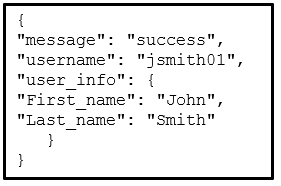
Explanation: JSON is a common data format for network automation APIs.
19. What is the function of the key contained in most RESTful APIs?
Explanation: Many RESTful APIs, including public APIs, require a key. The key is used to identify the source of the request through authentication.
20. Which two configuration management tools are developed using Ruby? (Choose two.)
Explanation: Chef and Puppet are configuration management tools developed using Ruby. Ansible and SaltStack are configuration management tools developed using Python. Ruby is typically considered a more difficult language to learn than Python. RESTCONF is a network management protocol.
21. Which term is used to describe a set of instructions for execution by the configuration management tool Puppet?
Explanation: Puppet uses Manifests for instructions.
22. Which term is used to describe a set of instructions for execution by the configuration management tool SaltStack?
Explanation: SaltStack uses Pillar for instructions.
23. Which scenario describes the use of a public API?
Explanation: Public, or open, APIs have no restrictions and are available to the public. Some API providers do require a user to obtain a free key or token prior to using the API in order to control the volume of API requests received and processed.
24. What is YAML?
Explanation: Like JSON, YAML Ain’t Markup Language (YAML) is a data format used by applications to store and transport data. YAML is considered a superset of JSON.
25. Which RESTFul operation corresponds to the HTTP GET method?
Explanation: GET corresponds to Read operation.
26. Which technology virtualizes the network control plane and moves it to a centralized controller?
Explanation: Networking devices operate in two planes: the data plane and the control plane. The control plane maintains Layer 2 and Layer 3 forwarding mechanisms using the CPU. The data plane forwards traffic flows. SDN virtualizes the control plane and moves it to a centralized network controller.
27. What are two functions of hypervisors? (Choose two.)
Explanation: The hypervisor does not protect the hosting OS from malware. Neither does it allow sharing software across virtual machines. The hard drive of the supporting computer does not need to be partitioned to run virtual machines. The hypervisor creates and manages virtual machines on a host computer and allocates physical system resources to them.
28. What is a difference between the functions of Cloud computing and virtualization?
Explanation: Cloud computing separates the application from the hardware. Virtualization separates the OS from the underlying hardware. Virtualization is a typical component within cloud computing. Virtualization is also widely used in data centers. Although the implementation of virtualization facilitates an easy server fault tolerance setup, it is not a fault tolerance technology by design. The Internet connection from a data center or service provider needs redundant physical WAN connections to ISPs.
29. How is the YAML data format structure different from JSON?
Explanation: YAML uses indentation for structure instead of brackets/commas.
30. What is the most widely used API for web services?
Explanation: REST accounts for more than 80% of all API types used for web services, making it the most widely used web service API.
31. What is REST?
Explanation: REST is not a protocol or service, but rather a style of software architecture for designing web service applications.
32. What is a difference between the XML and HTML data formats?
Explanation: XML is a human readable data structure used to store, transfer, and read data by applications. Like HTML, XML uses a related set of tags to enclose data. However, unlike HTML, XML uses no predefined tags or document structure.
33. To avoid purchasing new hardware, a company wants to take advantage of idle system resources and consolidate the number of servers while allowing for multiple operating systems on a single hardware platform. What service or technology would support this requirement?
Explanation: Virtualization allows multiple OSs on one physical server.
34. Match the term to the RESTful API request http://www.mapquestapi.com/directions/v2/route?outFormat=json&key=KEY&from=San+Jose,Ca&to=Monterey,Ca component. (Not all options are used.)

Explanation: Match components:
| Component | Value |
|---|---|
| resources | directions/v2/route |
| parameters | from=San+Jose,Ca&to=Monterey,Ca |
| query | outFormat=json&key=KEY&from=San+Jose,Ca&to=Monterey,Ca |
| API server | http://www.mapquestapi.com |
| format | outFormat=json |
| key | key=KEY |
35. Which cloud computing opportunity would provide the use of network hardware such as routers and switches for a particular company?
Explanation: This item is based on information contained in the presentation. Routers, switches, and firewalls are infrastructure devices that can be provided in the cloud.
36. What component is considered the brains of the ACI architecture and translates application policies?
Explanation: The ACI architecture consists of three core components: the Application Network Profile, the Application Policy Infrastructure Controller, which serves as the brains of the ACI architecture, and the Cisco Nexus 9000 switch.
38. In which situation would a partner API be appropriate?
Explanation: Partner API programs incorporate collaboration with other business. They facilitate communication and integration of software between a company and its business partners.
39. Because of enormous growth in web traffic, a company has planned to purchase additional servers to help handle the web traffic. What service or technology would support this requirement?
Explanation: Purchasing additional servers is using dedicated servers.
40. ABCTech is investigating the use of automation for some of its products. In order to control and test these products, the programmers require Windows, Linux, and MAC OS on their computers. What service or technology would support this requirement?
Explanation: Virtualization allows running multiple OSs on one machine.
41. What are three components used in the query portion of a typical RESTful API request? (Choose three.)
Explanation: The query includes format, key, and parameters.
42. A company has recently become multinational. Employees are working remotely, in different time zones, and they need access to company services from any place at any time. What service or technology would support this requirement?
Explanation: Cloud services provide access from anywhere.
43. Following a multicontinent advertising campaign for a new product, a company finds its client database and volume of orders are overloading its on-site computer systems but the company does not have any room to expand. What service or technology would support this requirement?
Explanation: Cloud offers scalable resources without physical expansion.
44. A network administrator has been tasked with creating a disaster recovery plan. As part of this plan, the administrator is looking for a backup site for all of the data on the company servers. What service or technology would support this requirement?
Explanation: A data center can serve as a backup site.
45. Which is a requirement of a site-to-site VPN?
Explanation: Site-to-site VPNs are static and are used to connect entire networks. Hosts have no knowledge of the VPN and send TCP/IP traffic to VPN gateways. The VPN gateway is responsible for encapsulating the traffic and forwarding it through the VPN tunnel to a peer gateway at the other end which decapsulates the traffic.
46. Which statement describes an important characteristic of a site-to-site VPN?
Explanation: A site-to-site VPN is created between the network devices of two separate networks. The VPN is static and stays established. The internal hosts of the two networks have no knowledge of the VPN.
47. Which protocol is attacked when a cybercriminal provides an invalid gateway in order to create a man-in-the-middle attack?
Explanation: A rogue DHCP server can provide a wrong default gateway for MITM attacks.
48. In which TCP attack is the cybercriminal attempting to overwhelm a target host with half-open TCP connections?
Explanation: In a TCP SYN flood attack, the attacker sends to the target host a continuous flood of TCP SYN session requests with a spoofed source IP address. The target host responds with a TCP-SYN-ACK to each of the SYN session requests and waits for a TCP ACK that will never arrive. Eventually the target is overwhelmed with half-open TCP connections.
49. Which statement describes a VPN?
Explanation: A VPN is a private network that is created over a public network. Instead of using dedicated physical connections, a VPN uses virtual connections routed through a public network between two network devices.
🚀 Ace Your CCNA Exam - Complete Study Pack!
Get 500+ exam-realistic questions, Packet Tracer labs, and detailed explanations.
Understanding Emerging Network Technologies (Modules 13-14)
Passing the CCNA 3 v7 Modules 13-14 exam requires understanding cloud computing, virtualization, SDN, network automation, and APIs. These modules cover cloud service models, hypervisors, IBN, SDN, configuration management tools, and RESTful APIs – essential knowledge for modern network engineers.
Why Modules 13-14 Matter for Your Networking Career
These modules introduce the technologies that are transforming networking: cloud, virtualization, and automation. You learn how to leverage cloud services, virtualize servers, and automate network configurations. Employers expect CCNA-certified professionals to understand SDN, network programmability, and infrastructure as code. Mastering these topics prepares you for next-generation network roles.
Key Topics Covered in the Exam
Our verified answers address common exam questions on:
- Cloud Computing: SaaS, IaaS, PaaS, public/private/hybrid clouds.
- Virtualization: Type 1 vs Type 2 hypervisors, benefits of virtualization.
- SDN: Control plane vs data plane, OpenFlow, ACI.
- Network Automation: IBN model, configuration management tools (Puppet, Chef, Ansible, SaltStack).
- Data Formats: JSON, XML, YAML.
- RESTful APIs: CRUD operations, API key, query components.
- VPN and Security: Site-to-site VPN, DHCP attacks, SYN flood.
Many questions present a scenario and ask you to identify the appropriate technology or service. Understanding the differences between cloud models and virtualization is critical for success.
Common Pitfalls to Avoid
Students often confuse cloud computing and virtualization – cloud abstracts applications/services, while virtualization abstracts the OS from hardware. Another common mistake is mixing up type 1 and type 2 hypervisors – type 1 runs on bare metal, type 2 runs on an existing OS. Also, remember that YAML uses indentation whereas JSON uses brackets and commas.
When practicing with our answers, focus on the concept behind each correct answer. For example, instead of remembering "option B is the correct hypervisor type", learn the difference between Type 1 and Type 2.
Study Strategies That Work
To retain this material long-term, combine our exam answers with hands-on practice. Set up a virtual lab with VirtualBox or VMware to experiment with virtualization. Explore cloud platforms like AWS or Azure free tier. Try using REST APIs with tools like Postman. This practical approach cements the theory from Modules 13-14.
We also recommend creating flashcards for key terms: SaaS, IaaS, PaaS, Hypervisor, SDN, OpenFlow, REST, JSON, YAML, Puppet, Chef, Ansible, SaltStack. Quiz yourself daily until you can define each term without hesitation.
How to Use This Answer Page Effectively
Our goal at CoursMooc.com is to provide accurate, up-to-date answers for the latest CCNA v7 curriculum. For each question, we include an explanation—not just the correct choice. Read those explanations carefully. If you find a concept unclear, refer to the official Cisco NetAcad course materials or our additional tutorials linked below.
We regularly update this page to match any changes in the exam. If you notice discrepancies, please let us know through the comments. Your feedback helps other learners succeed.
What's Next After Modules 13-14?
After mastering emerging technologies, you will take the ENSA Practice Final Exam and then the Course Final Exam. Completing all CCNA 3 v7 exams earns you the official "Enterprise Networking, Security, and Automation" badge – a stepping stone to the full CCNA certification.
Final Tips for Exam Day
Before starting the real exam:
- Get a good night's sleep – fatigue leads to misreading questions.
- Read each question twice. Some ask "Which two statements are correct?" – don't just pick one answer.
- Manage your time. You typically have 50-60 minutes for 40-50 questions. Skip difficult ones and return later.
- Look for keywords like "not", "except", or "only". One word changes the entire meaning.
- Trust your first instinct unless you find clear evidence you misread.
Remember: The CCNA v7 curriculum emphasizes practical understanding. If you can explain why a certain cloud model or API is used, you're ready. Use our answers to verify your thinking, then reinforce with simulation tools. Good luck on your exam – and on your journey to networking expertise.