CCNA 2 v7 Modules 5-6: Redundant Networks Exam Answers
Checkpoint Exam: Redundant Networks. This comprehensive study guide covers Modules 5-6 of the CCNA2 Switching, Routing, and Wireless Essentials v7.0 (SRWE), including Spanning Tree Protocol (STP), RSTP, EtherChannel, PAgP, LACP, and redundant network design.
1. What additional information is contained in the 12-bit extended system ID of a BPDU?
Explanation: Topic 5.2.1 – The extended system ID carries the VLAN ID to distinguish BPDUs per VLAN.
2. During the implementation of Spanning Tree Protocol, all switches are rebooted by the network administrator. What is the first step of the spanning-tree election process?
Explanation: Topic 5.2.2 – Initially, all switches claim to be the root bridge and send BPDUs.
3. Which STP port role is adopted by a switch port if there is no other port with a lower cost to the root bridge?
Explanation: Topic 5.2.5 – The root port is the port with the lowest cost to reach the root bridge.
4. Which two concepts relate to a switch port that is intended to have only end devices attached and intended never to be used to connect to another switch? (Choose two.)
Explanation: Topic 5.3.4 – Edge ports and PortFast are configured on ports connected to end devices to speed up convergence.
5. Which three components are combined to form a bridge ID?
Explanation: Topic 5.2.1 – The bridge ID consists of bridge priority, extended system ID (VLAN ID), and MAC address.
6. Match the STP protocol with the correct description. (Not all options are used.)

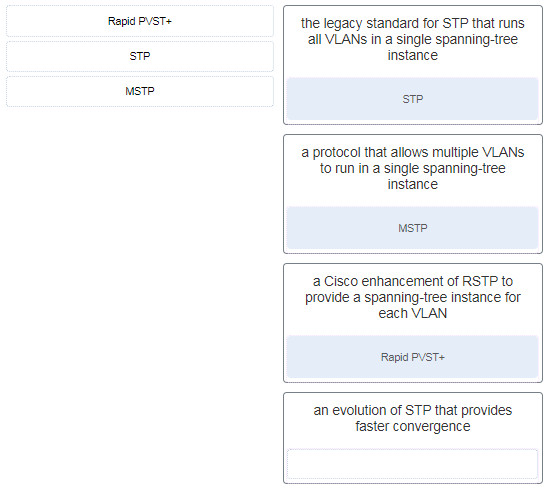
Explanation: Topic 5.3.1
| Protocol | Description |
|---|---|
| PVST | Cisco implementation of IEEE 802.1D |
| RSTP | Fast converging enhancement of IEEE 802.1D |
| MSTP | IEEE standard that reduces the number of STP instances |
| MST | Proprietary per VLAN implementation of IEEE 802.1w |
| Rapid PVST+ | an evolution of STP that provides faster convergence |
7. In which two port states does a switch learn MAC addresses and process BPDUs in a PVST network? (Choose two.)
Explanation: Topic 5.2.9 – Switches learn MAC addresses at the learning and forwarding port states. They receive and process BPDUs at the blocking, listening, learning, and forwarding port states.
8. If no bridge priority is configured in PVST, which criteria is considered when electing the root bridge?
Explanation: Topic 5.2.3 – Only one switch can be the root bridge for a VLAN. The root bridge is the switch with the lowest BID. The BID is determined by priority and the MAC address. If no priority is configured then all switches use the default priority and the election of the root bridge will be based on the lowest MAC address.
9. Match the spanning-tree feature with the protocol type. (Not all options are used.)

Explanation: Topic 5.3.1
| Feature | Protocol |
|---|---|
| Cisco implementation of IEEE 802.1D | PVST |
| Fast converging enhancement of IEEE 802.1D | RSTP |
| IEEE standard that reduces the number of STP instances | MSTP |
| Proprietary per VLAN implementation of IEEE 802.1w | MST |
| an evolution of STP that provides faster convergence | Rapid PVST+ |
10. When the show spanning-tree vlan 33 command is issued on a switch, three ports are shown in the forwarding state. In which two port roles could these interfaces function while in the forwarding state? (Choose two.)
Explanation: Topic 5.2.9 – The role of each of the three ports will be either designated port or root port. Ports in the disabled state are administratively disabled. Ports in the blocking state are alternate ports.
11. What is the function of STP in a scalable network?
Explanation: Topic 5.1.2 – STP is an important component in a scalable network because it allows redundant physical connections between Layer 2 devices to be implemented without creating Layer 2 loops. STP prevents Layer 2 loops from forming by disabling interfaces on Layer 2 devices when they would create a loop.
12. What is a characteristic of spanning tree?
Explanation: Topic 5.3.1 – Spanning tree does work at Layer 2 on Ethernet-based networks and is enabled by default, but it does not have a TTL mechanism. Spanning tree exists because Layer 2 frames do not have a TTL mechanism. Layer 2 frames are still broadcast when spanning tree is enabled, but the frames can only be transmitted through a single path through the Layer 2 network that was created by spanning tree. Cisco Discovery Protocol (CDP) is used to discover information about an adjacent Cisco device.
13. Which spanning tree standard supports only one root bridge so that traffic from all VLANs flows over the same path?
Explanation: Topic 5.3.1 – MST is the Cisco implementation of MSTP, an IEEE standard protocol that provides up to 16 instances of RSTP. PVST+ provides a separate 802.1D spanning-tree instance for each VLAN that is configured in the network. 802.1D is the original STP standard defined by the IEEE and allows for only one root bridge for all VLANs. 802.1w, or RSTP, provides faster convergence but still uses only one STP instance for all VLANs.
14. What is the purpose of the Spanning Tree Protocol (STP)?
Explanation: Topic 5.1.2 – The Spanning-Tree Protocol (STP) creates one path through a switch network in order to prevent Layer 2 loops.
15. What is the value used to determine which port on a non-root bridge will become a root port in a STP network?
Explanation: Topic 5.2.5 – STP establishes one root port on each non-root bridge. The root port is the lowest-cost path from the non-root bridge to the root bridge, indicating the direction of the best path to the root bridge. This is primarily based on the path cost to the root bridge.
16. Refer to the exhibit. Which switch will be the root bridge after the election process is complete?
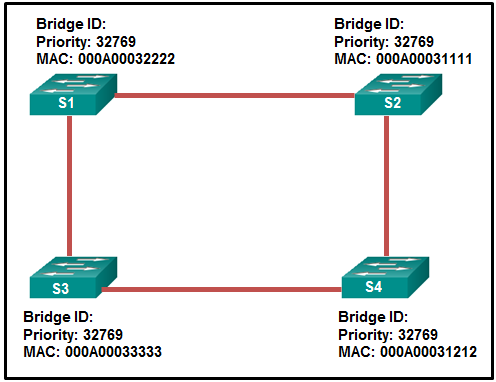
Explanation: Topic 5.2.2 – The root bridge is determined by the lowest bridge ID, which consists of the priority value and the MAC address. Because the priority values of all of the switches are identical, the MAC address is used to determine the root bridge. Because S2 has the lowest MAC address, S2 becomes the root bridge.
17. What are two drawbacks to turning spanning tree off and having multiple paths through the Layer 2 switch network? (Choose two.)
Explanation: Topic 5.1.4 – Spanning tree should never be disabled. Without it, the MAC address table becomes unstable, broadcast storms can render network clients and the switches unusable, and multiple copies of unicast frames can be delivered to the end devices.
18. A small company network has six interconnected Layer 2 switches. Currently all switches are using the default bridge priority value. Which value can be used to configure the bridge priority of one of the switches to ensure that it becomes the root bridge in this design?
Explanation: Topic 5.2.1 – The default bridge priority value for all Cisco switches is 32768. The range is 0 to 61440 in increments of 4096. Thus, the values 1 and 34816 are invalid. Configuring one switch with the lower value of 28672 (and leaving the bridge priority value of all other switches unchanged) will make the switch become the root bridge.
19. Refer to the exhibit. The administrator tried to create an EtherChannel between S1 and the other two switches via the commands that are shown, but was unsuccessful. What is the problem?
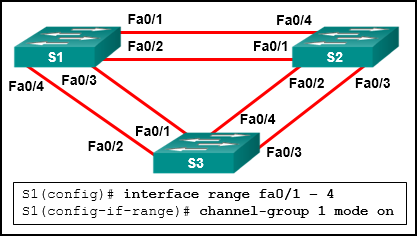
Explanation: Topic 6.1.4 – An EtherChannel link can only connect two devices; it cannot be split to two different switches.
20. Which statement is true regarding the use of PAgP to create EtherChannels?
Explanation: Topic 6.1.6 – PAgP is used to automatically aggregate multiple ports into an EtherChannel bundle, but it only works between Cisco devices. LACP can be used for the same purpose between Cisco and non-Cisco devices. PAgP must have the same duplex mode at both ends and can use two ports or more. The number of ports depends on the switch platform or module. An EtherChannel aggregated link is seen as one port by the spanning-tree algorithm.
21. What are two requirements to be able to configure an EtherChannel between two switches? (Choose two.)
Explanation: Topic 6.2.1 – All interfaces in the EtherChannel bundle must be assigned to the same VLAN or be configured as a trunk. If the allowed range of VLANs is not the same, the interfaces do not form an EtherChannel even when set to auto or desirable mode.
22. Refer to the exhibit. On the basis of the output that is shown, what can be determined about the EtherChannel bundle?
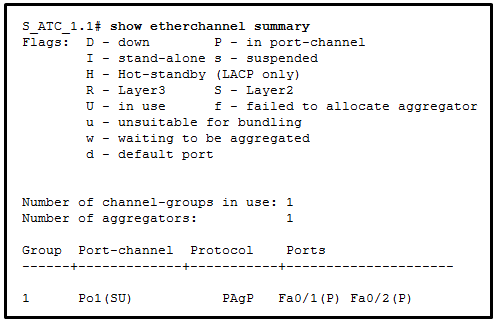
Explanation: Topic 6.1.6 – Two protocols can be used to send negotiation frames that are used to try to establish an EtherChannel link: PAgP and LACP. PAgP is Cisco proprietary, and LACP adheres to the industry standard.
23. Which two parameters must match on the ports of two switches to create a PAgP EtherChannel between the switches? (Choose two.)
Explanation: Topic 6.1.6 – For an EtherChannel to be created, the ports that are concerned on the two switches must match in terms of the speed, duplex, and VLAN information. The PAgP mode must be compatible but not necessarily equal. The port ID and the MAC addresses do not have to match.
24. Refer to the exhibit. A network administrator is configuring an EtherChannel link between two switches, SW1 and SW2. Which statement describes the effect after the commands are issued on SW1 and SW2?
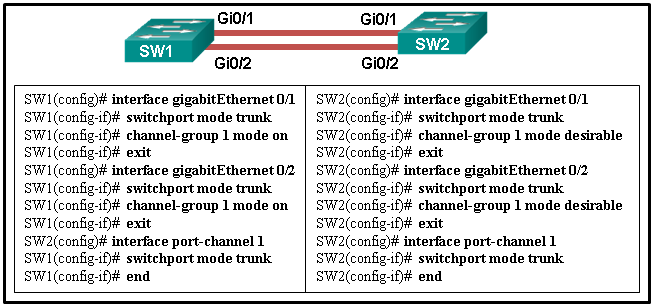
Explanation: Topic 6.1.7 – The interfaces GigabitEthernet 0/1 and GigabitEthernet 0/2 are configured “on” for the EtherChannel link. This mode forces the interface to channel without PAgP or LACP. The EtherChannel will be established only if the other side is also set to “on”. However, the mode on SW2 side is set to PAgP desirable. Thus the EtherChannel link will not be established.
25. Refer to the exhibit. A network administrator is configuring an EtherChannel link between two switches, SW1 and SW2. However, the EtherChannel link fails to establish. What change in configuration would correct the problem?
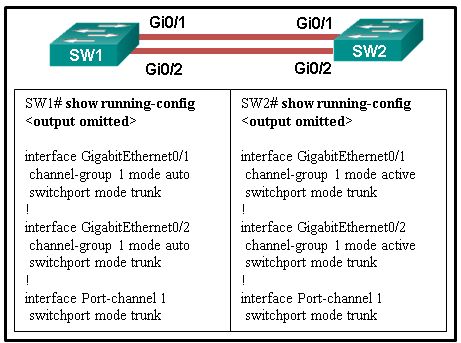
Explanation: Topic 6.1.7 – The EtherChannel mode must be compatible on each side for the link to work. The three modes from PAgP protocol are on, desirable, and auto. The three modes from LACP protocol are on, active, and passive. The compatible modes include on-on, auto-desirable, desirable-desirable, active-passive, and active-active. Any other combinations will not form an EtherChannel link.
26. A network administrator configured an EtherChannel link with three interfaces between two switches. What is the result if one of the three interfaces is down?
Explanation: Topic 6.1.3 – EtherChannel creates an aggregation that is seen as one logical link. It provides redundancy because the overall link is one logical connection. The loss of one physical link within the channel does not create a change in the topology; the EtherChannel remains functional.
27. A network administrator is configuring an EtherChannel link between switches SW1 and SW2 by using the command SW1(config-if-range)# channel-group 1 mode auto. Which command must be used on SW2 to enable this EtherChannel?
Explanation: Topic 6.1.6 – The possible combinations to establish an EtherChannel between SW1 and SW2 using LACP or PAgP are as follows:
PAgP
on on
auto desirable
desirable desirable
LACP
on on
active active
passive active
The EtherChannel mode chosen on each side of the EtherChannel must be compatible in order to enable it.
28. Which technology is an open protocol standard that allows switches to automatically bundle physical ports into a single logical link?
Explanation: Topic 6.1.8 – LACP, or Link Aggregation Control Protocol, is defined by IEEE 802.3ad and is an open standard protocol. LACP allows switches to automatically bundle switch ports into a single logical link to increase bandwidth. PAgP, or Port Aggregation Protocol, performs a similar function, but it is a Cisco proprietary protocol. DTP is Dynamic Trunking Protocol and is used to automatically and dynamically build trunks between switches. Multilink PPP is used to load-balance PPP traffic across multiple serial interfaces.
29. What is a requirement to configure a trunking EtherChannel between two switches?
Explanation: Topic 6.2.1 – To enable a trunking EtherChannel successfully, the range of VLANs allowed on all the interfaces must match; otherwise, the EtherChannel cannot be formed. The interfaces involved in an EtherChannel do not have to be physically contiguous, or on the same module. Because the EtherChannel is a trunking one, participating interfaces are configured as trunk mode, not access mode.
30. What are two advantages of using LACP? (Choose two.)
Explanation: Topic 6.1.8 – The Link Aggregation Control Protocol (LACP) allows directly connected multivendor switches to negotiate an EtherChannel link. LACP helps create the EtherChannel link by detecting the configuration of each side and making sure that they are compatible so that the EtherChannel link can be enabled when needed.
31. A switch is configured to run STP. What term describes a non-root port that is permitted to forward traffic on the network?
Explanation: Topic 5.2.6 – A designated port forwards traffic on a segment.
32. What are two advantages of EtherChannel? (Choose two.)
Explanation: Topic 6.1.3 – EtherChannel configuration of one logical interface ensures configuration consistency across the physical links in the EtherChannel. The EtherChannel provides increased bandwidth using existing switch ports without requiring any upgrades to the physical interfaces. Load balancing methods are implemented between links that are part of the same Etherchannel. Because EtherChannel views the bundled physical links as one logical connection, spanning tree recalculation is not required if one of the bundled physical links fail. If a physical interface fails, STP cannot transition the failed interface into a forwarding state.
33. Refer to the exhibit. What are the possible port roles for ports A, B, C, and D in this RSTP-enabled network?
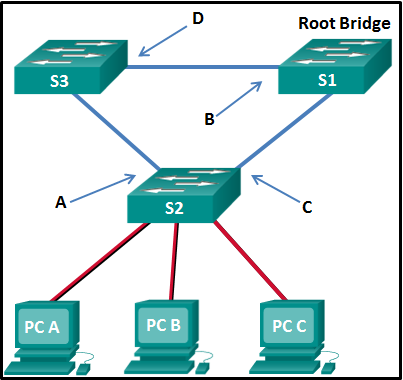
Explanation: Topic 5.2.1 – Because S1 is the root bridge, B is a designated port, and C and D root ports. RSTP supports a new port type, alternate port in discarding state, that can be port A in this scenario.
34. Refer to the exhibit. Which switching technology would allow each access layer switch link to be aggregated to provide more bandwidth between each Layer 2 switch and the Layer 3 switch?
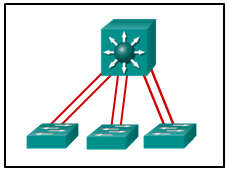
Explanation: Topic 6.1.1 – PortFast is used to reduce the amount of time that a port spends going through the spanning-tree algorithm, so that devices can start sending data sooner. Trunking can be implemented in conjunction with EtherChannel, but trunking alone does not aggregate switch links. HSRP is used to load-balance traffic across two different connections to Layer 3 devices for default gateway redundancy. HSRP does not aggregate links at either Layer 2 or Layer 3 as EtherChannel does.
35. Refer to the exhibit. An administrator wants to form an EtherChannel between the two switches by using the Port Aggregation Protocol. If switch S1 is configured to be in auto mode, which mode should be configured on S2 to form the EtherChannel?
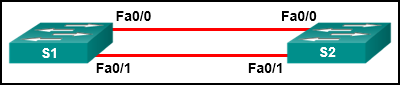
Explanation: Topic 6.1.6 – An EtherChannel will be formed via PAgP when both switches are in on mode or when one of them is in auto or desirable mode and the other is in desirable mode.
36. Open the PT Activity. Perform the tasks in the activity instructions and then answer the question. Which set of configuration commands issued on SW1 will successfully complete the EtherChannel link between SW1 and SW2?

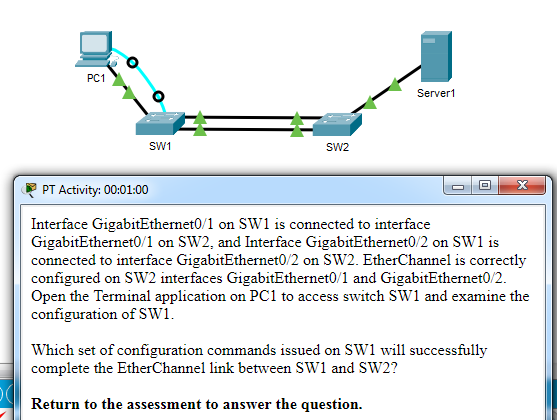
Explanation: Topic 6.2.2 – Issuing the show running-configuration command on SW1 shows that interface GigabitEthernet0/1 is missing the channel-group 1 mode desirable command which will compete the EtherChannel configuration for interface GigabitEthernet0/1 and interface GigabitEthernet0/2.
37. A set of switches is being connected in a LAN topology. Which STP bridge priority value will make it least likely for the switch to be selected as the root?
Explanation: Topic 5.2.1 – The STP bridge priority is a two byte number, but it can only be customized in increments of 4096. The smaller number is preferred, but the largest usable priority value is 61440.
38. In which two PVST+ port states are MAC addresses learned? (Choose two.)
Explanation: Topic 5.2.10 – The two PVST+ port states during which MAC addresses are learned and populate the MAC address table are the learning and the forwarding states.
39. Which port role is assigned to the switch port that has the lowest cost to reach the root bridge?
Explanation: Topic 5.2.5 – The root port is the port with the lowest cost to the root bridge.
40. A switch is configured to run STP. What term describes the switch port closest, in terms of overall cost, to the root bridge?
Explanation: Topic 5.2.5 – The root port is the closest port to the root bridge in terms of cost.
42. A switch is configured to run STP. What term describes a field used to specify a VLAN ID?
Explanation: Topic 5.2.1 – The extended system ID field contains the VLAN ID.
43. A switch is configured to run STP. What term describes the reference point for all path calculations?
Explanation: Topic 5.2.2 – The root bridge is the reference point for all STP calculations.
44. A switch is configured to run STP. What term describes a field that has a default value of 32,768 and is the initial deciding factor when electing a root bridge?
Explanation: Topic 5.2.1 – Bridge priority has a default value of 32768 and is the primary factor in root bridge election.
45. Which statement describes an EtherChannel implementation?
Explanation: Topic 6.2.1 – Up to 16 links can be grouped in an EtherChannel by using the the PAgP or LACP protocol. EtherChannel can be configured as a Layer 2 bundle or a Layer 3 bundle. Configuring a Layer 3 bundle is beyond the scope of this course. If a trunked port is a part of the EtherChannel bundle, all ports in the bundle need to be trunk ports and the native VLAN must be the same on all of these ports. A best practice is to apply the configuration to the port channel interface. The configuration is then automatically applied to the individual ports.
46. Refer to the exhibit. A network administrator issued the show etherchannel summary command on the switch S1. What conclusion can be drawn?
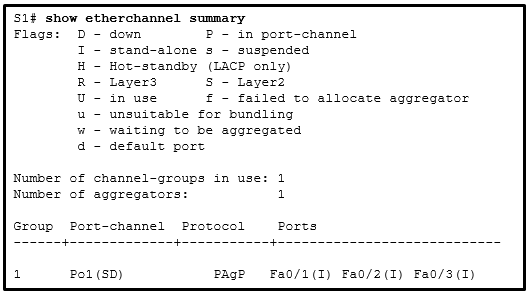
Explanation: Topic 6.3.3 – The EtherChannel status shows as (SD), which means it is a Layer 2 EtherChannel with a status of D or down. Because the EtherChannel is down, the status of the interfaces in the channel group is stand-alone. PAgP is configured on S1, but there is no indication whether it is configured correctly on S1. The problem might also be the adjacent switch EtherChannel configuration.
47. Which statement describes a characteristic of EtherChannel?
Explanation: Topic 6.1.1 – An EtherChannel is formed by combining multiple (same type) Ethernet physical links so they are seen and configured as one logical link. It provides an aggregated link between two switches. Currently each EtherChannel can consist of up to eight compatibly configured Ethernet ports.
48. Which two channel group modes would place an interface in a negotiating state using PAgP? (Choose two.)
Explanation: Topic 6.1.6 – There are three modes available when configuring an interface for PAgP: on, desirable, and auto. Only desirable and auto place the interface in a negotiating state. The active and passive states are used to configure LACP and not PAgP.
49. Which mode configuration setting would allow formation of an EtherChannel link between switches SW1 and SW2 without sending negotiation traffic?
Explanation: Topic 6.1.6 – The auto channel-group keyword enables PAgP only if a PAgP device is detected on the opposite side of the link. If the auto keyword is used, the only way to form an EtherChannel link is if the opposite connected device is configured with the desirable keyword. PortFast and trunking technologies are irrelevant to forming an EtherChannel link. Even though an EtherChannel can be formed if both sides are configured in desirable mode, PAgP is active and PAgP messages are being sent constantly across the link, decreasing the amount of bandwidth available for user traffic.
50. Refer to the exhibit. An EtherChannel was configured between switches S1 and S2, but the interfaces do not form an EtherChannel. What is the problem?
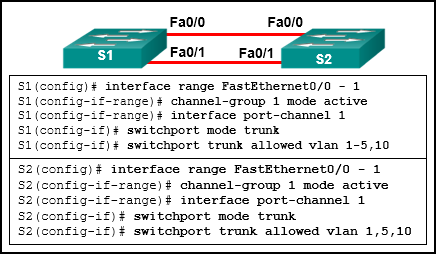
Explanation: Topic 6.2.1 – Mismatched VLAN allowed ranges prevent EtherChannel formation.
51. When EtherChannel is configured, which mode will force an interface into a port channel without exchanging aggregation protocol packets?
Explanation: Topic 6.1.6 – For both LACP and PAgP, the “on” mode will force an interface into an EtherChannel without exchanging protocol packets.
52. What are two load-balancing methods in the EtherChannel technology? (Choose two.)
Explanation: Topic 6.1.3 – Depending on the hardware platform, one or more load-balancing methods can be implemented. These methods include source MAC to destination MAC load balancing or source IP to destination IP load balancing, across the physical links.
53. Which protocol provides up to 16 instances of RSTP, combines many VLANs with the same physical and logical topology into a common RSTP instance, and provides support for PortFast, BPDU guard, BPDU filter, root guard, and loop guard?
Explanation: Topic 5.3.1 – MST is the Cisco implementation of MSTP, an IEEE standard protocol that provides up to 16 instances of RSTP and combines many VLANs with the same physical and logical topology into a common RSTP instance. Each instance supports PortFast, BPDU guard, BPDU filter, root guard, and loop guard. STP and RSTP assume only one spanning-tree instance for the entire bridged network, regardless of the number of VLANs. PVST+ provides a separate 802.1D spanning-tree instance for each VLAN that is configured in the network.
54. What is the outcome of a Layer 2 broadcast storm?
Explanation: Topic 5.1.6 – When the network is saturated with broadcast traffic that is looping between switches, new traffic is discarded by each switch because it is unable to be processed.
55. Which two network design features require Spanning Tree Protocol (STP) to ensure correct network operation? (Choose two.)
Explanation: Topic 5.1.1 – Spanning Tree Protocol (STP) is required to ensure correct network operation when designing a network with multiple interconnected Layer 2 switches or using redundant links to eliminate single points of failure between Layer 2 switches. Routing is a Layer 3 function and does not relate to STP. VLANs do reduce the number of broadcast domains but relate to Layer 3 subnets, not STP.
56. A network administrator has configured an EtherChannel between two switches that are connected via four trunk links. If the physical interface for one of the trunk links changes to a down state, what happens to the EtherChannel?
Explanation: Topic 6.1.3 – EtherChannel offers redundancy by bundling multiple trunk links into one logical connection. Failure of one physical link within the EtherChannel will not create a change in the topology and therefore a recalculation by Spanning Tree is unnecessary. Just one physical link must remain operational for the EtherChannel to continue to function.
🚀 Ace Your CCNA Exam - Complete Study Pack!
Get 500+ exam-realistic questions, Packet Tracer labs, and detailed explanations.
Understanding Redundant Networks (Modules 5-6)
Passing the CCNA 2 v7 Modules 5-6 exam requires a solid grasp of how to design and implement redundant Layer 2 networks while avoiding loops. These modules cover Spanning Tree Protocol (STP), Rapid STP (RSTP), EtherChannel, PAgP, and LACP – essential knowledge for any network engineer building resilient switched networks.
Why Modules 5-6 Matter for Your Networking Career
Redundancy is critical in modern networks to ensure high availability. STP prevents loops in redundant topologies, while EtherChannel increases bandwidth and provides fault tolerance. Employers expect CCNA-certified professionals to understand bridge IDs, root bridge election, port roles, EtherChannel configuration, and load-balancing methods. Mastering these topics prepares you for more advanced network design and troubleshooting later in the curriculum.
Key Topics Covered in the Exam
Our verified answers address common exam questions on:
- STP Concepts: Bridge ID, root bridge, port roles (root, designated, alternate), BPDU, convergence.
- STP Variants: PVST, PVST+, RSTP, Rapid PVST+, MST.
- EtherChannel: Aggregation of multiple links, PAgP (Cisco proprietary), LACP (open standard).
- EtherChannel Configuration: Modes (on, auto, desirable, active, passive), load-balancing methods.
- Redundancy and Broadcast Storms: Causes and effects of Layer 2 loops.
- Troubleshooting: Interpreting
show spanning-tree,show etherchannel summary.
Many questions present a topology and ask you to identify the root bridge, port roles, or configure an EtherChannel. Understanding the election process and compatibility requirements is critical for success.
Common Pitfalls to Avoid
Students often confuse STP port roles – a root port is the best path to the root bridge, while a designated port forwards on a segment. Another common mistake is mixing up PAgP and LACP modes – PAgP uses auto/desirable, while LACP uses active/passive. Also, remember that EtherChannel interfaces must share speed, duplex, and VLAN configuration; otherwise, the bundle fails.
When practicing with our answers, avoid memorizing letter choices (A, B, C, D). Cisco often reorders options. Focus on the concept behind each correct answer. For example, instead of remembering "option B is the bridge priority", learn how priority and MAC address together determine the root bridge.
Study Strategies That Work
To retain this material long-term, combine our exam answers with hands-on practice. Download Cisco Packet Tracer and build a switched network with redundant links. Observe STP convergence by enabling and disabling ports. Configure an EtherChannel between two switches using both PAgP and LACP. Experiment with load-balancing methods. This practical approach cements the theory from Modules 5-6.
We also recommend creating flashcards for key terms: bridge ID, root bridge, BPDU, root port, designated port, alternate port, EtherChannel, PAgP, LACP, load-balancing, broadcast storm. Quiz yourself daily until you can define each term without hesitation.
How to Use This Answer Page Effectively
Our goal at CoursMooc.com is to provide accurate, up-to-date answers for the latest CCNA v7 curriculum. For each question, we include an explanation—not just the correct choice. Read those explanations carefully. If you find a concept unclear, refer to the official Cisco NetAcad course materials or our additional tutorials linked below.
We regularly update this page to match any changes in the exam. If you notice discrepancies, please let us know through the comments. Your feedback helps other learners succeed.
What's Next After Modules 5-6?
After mastering redundant networks, Modules 7-9 cover available and reliable networks (including DHCP, FHRP, and QoS). Modules 10-13 dive into L2 security and WLANs. Modules 14-16 cover routing concepts and configuration. Each step builds on the fundamentals you solidify here. By completing all three CCNA 2 v7 exams (Modules 1-4, 5-6, 7-9, 10-13, 14-16), you earn the official "Switching, Routing, and Wireless Essentials" badge – a stepping stone to the full CCNA certification.
Final Tips for Exam Day
Before starting the real exam:
- Get a good night's sleep – fatigue leads to misreading questions.
- Read each question twice. Some ask "Which two statements are correct?" – don't just pick one answer.
- Manage your time. You typically have 50-60 minutes for 40-50 questions. Skip difficult ones and return later.
- Look for keywords like "not", "except", or "only". One word changes the entire meaning.
- Trust your first instinct unless you find clear evidence you misread.
Remember: The CCNA v7 curriculum emphasizes practical troubleshooting. If you can explain why a root bridge is elected or why an EtherChannel fails, you're ready. Use our answers to verify your thinking, then reinforce with simulation tools. Good luck on your exam – and on your journey to networking expertise.