CCNA 3 v7 Modules 1-2: OSPF Concepts and Configuration Exam Answers
Checkpoint Exam: OSPF Concepts and Configuration. This comprehensive study guide covers Modules 1-2 of the CCNA3 Enterprise Networking, Security, and Automation v7.0 (ENSA), including OSPF concepts, configuration, and verification.
1. What is a function of OSPF hello packets?
Explanation: Topic 1.2.4 – Hello packets are used to discover neighbors and establish adjacencies.
2. Which OSPF packet contains the different types of link-state advertisements?
Explanation: Topic 1.2.3 – Link-State Update (LSU) packets contain LSAs.
3. Which three statements describe features of the OSPF topology table? (Choose three.)
Explanation: Topic 1.1.2 – The topology table on an OSPF router is a link-state database (LSDB) that lists information about all other routers in the network, and represents the network topology. All routers within an area have identical link-state databases, and the table can be viewed using the show ip ospf database command. The EIGRP topology table contains feasible successor routes. This concept is not used by OSPF. The SPF algorithm uses the LSDB to produce the unique routing table for each router which contains the lowest cost route entries for known networks.
4. What does an OSPF area contain?
Explanation: Topic 1.1.4 – An OSPF area contains one set of link-state information, although each router within the area will process that information individually to form its own SPF tree. OSPF process IDs are locally significant and are created by the administrator. Router IDs uniquely identify each router.
5. What is used to facilitate hierarchical routing in OSPF?
Explanation: Topic 1.1.4 – OSPF supports the concept of areas to prevent larger routing tables, excessive SPF calculations, and large LSDBs. Only routers within an area share link-state information. This allows OSPF to scale in a hierarchical fashion with all areas that connect to a backbone area.
6. Which OSPF data structure is identical on all OSPF routers that share the same area?
Explanation: Topic 1.1.2 – Regardless of which OSPF area a router resides in, the adjacency database, routing table, and forwarding database are unique for each router. The link-state database lists information about all other routers within an area and is identical across all OSPF routers participating in that area.
7. Which step does an OSPF-enabled router take immediately after establishing an adjacency with another router?
Explanation: Topic 1.1.3 – After adjacency, routers exchange LSAs.
8. A network engineer has manually configured the hello interval to 15 seconds on an interface of a router that is running OSPFv2. By default, how will the dead interval on the interface be affected?
Explanation: Topic 2.4.9 – Cisco IOS automatically modifies the dead interval to four times the hello interval.
9. Refer to the exhibit. A network administrator has configured the OSPF timers to the values that are shown in the graphic. What is the result of having those manually configured timers?
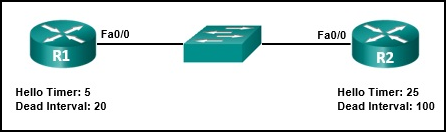
Explanation: Topic 2.4.9 – R1's dead timer (20s) expires before next hello from R2 (25s).
10. To establish a neighbor adjacency two OSPF routers will exchange hello packets. Which two values in the hello packets must match on both routers? (Choose two.)
Explanation: Topic 1.2.4 – Hello and dead intervals must match.
11. What is the default router priority value for all Cisco OSPF routers?
Explanation: Topic 1.2.4 – The router priority value is used in a DR/BDR election. The default priority for all OSPF routers is 1 but it can be manually altered to any value 0 to 255.
12. Which type of OSPFv2 packet contains an abbreviated list of the LSDB of a sending router and is used by receiving routers to check against the local LSDB?
Explanation: Topic 1.2.2 – The database description (DBD) packet contains an abbreviated list of the LSDB sent by a neighboring router and is used by receiving routers to check against the local LSDB.
13. In an OSPF network when are DR and BDR elections required?
Explanation: Topic 1.3.3 – When the routers are interconnected over a common Ethernet network, then a designated router (DR) and a backup DR (BDR) must be elected.
14. When an OSPF network is converged and no network topology change has been detected by a router, how often will LSU packets be sent to neighboring routers?
Explanation: Topic 1.3.4 – LSUs are sent every 30 minutes even when converged.
15. What will an OSPF router prefer to use first as a router ID?
Explanation: Topic 2.1.4 – When the routers are interconnected over a common Ethernet network, then a designated router (DR) and a backup DR (BDR) must be elected.
16. What are the two purposes of an OSPF router ID? (Choose two.)
Explanation: Topic 2.1.3 – OSPF router ID does not contribute to SPF algorithm calculations, nor does it facilitate the transition of the OSPF neighbor state to Full. Although the router ID is contained within OSPF messages when router adjacencies are being established, it has no bearing on the actual convergence process.
17. Refer to the exhibit. If no router ID was manually configured, what would router Branch1 use as its OSPF router ID?
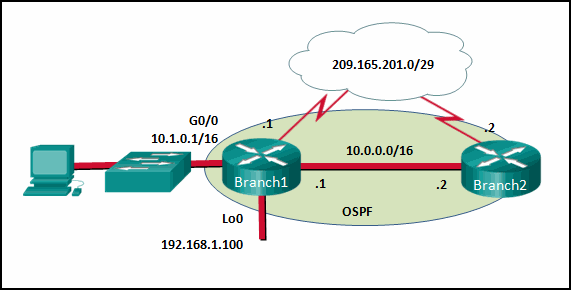
Explanation: Topic 2.1.4 – In OSPFv2, a Cisco router uses a three-tier method to derive its router ID. The first choice is the manually configured router ID with the router-id command. If the router ID is not manually configured, the router will choose the highest IPv4 address of the configured loopback interfaces. Finally if no loopback interfaces are configured, the router chooses the highest active IPv4 address of its physical interfaces.
18. A network technician issues the following commands when configuring a router:
R1(config)# router ospf 11
R1(config-router)# network 10.10.10.0 0.0.0.255 area 0
What does the number 11 represent?
Explanation: Topic 2.1.2 – There is no autonomous system number to configure on OSPF. The area number is located at the end of the network statement. The cost of a link can be modified in the interface configuration mode. The process ID is local to the router.
19. An OSPF router has three directly connected networks; 172.16.0.0/16, 172.16.1.0/16, and 172.16.2.0/16. Which OSPF network command would advertise only the 172.16.1.0 network to neighbors?
Explanation: Topic 2.2.4 – To advertise only the 172.16.1.0/16 network the wildcard mask used in the network command must match the first 16-bits exactly. To match bits exactly, a wildcard mask uses a binary zero. This means that the first 16-bits of the wildcard mask must be zero. The low order 16-bits can all be set to 1.
20. Refer to the exhibit. Which three statements describe the results of the OSPF election process of the topology that is shown in the exhibit? (Choose three.)
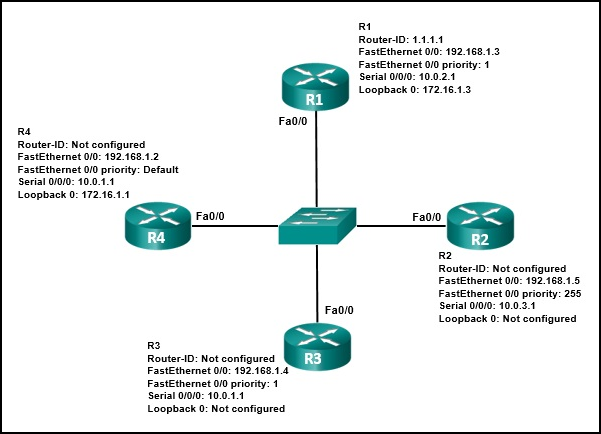
Explanation: Topic 2.3.6 – R2 will be elected DR because it has the highest priority of 255, all of the others have a priority of 1. R3 will be elected BDR because it has the numerically highest router-ID of 192.168.1.4. The R4 router-ID is 172.16.1.1 because it is the IPv4 address attached to the loopback 0 interface.
21. Refer to the exhibit. If the switch reboots and all routers have to re-establish OSPF adjacencies, which routers will become the new DR and BDR?
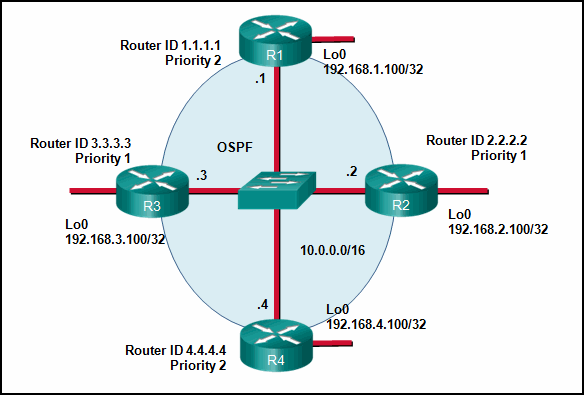
Explanation: Topic 2.3.6 – R4 has highest priority, R1 has second highest router ID.
22. By default, what is the OSPF cost for any link with a bandwidth of 100 Mb/s or greater?
Explanation: Topic 2.4.1 – OSPF uses the formula: Cost = 100,000,000 / bandwidth. Because OSPF will only use integers as cost, any bandwidth of 100 Mb/s or greater will all equal a cost of 1.
23. Refer to the exhibit. What is the OSPF cost to reach the router A LAN 172.16.1.0/24 from B?
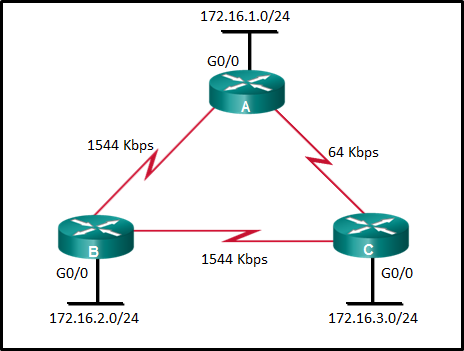
Explanation: Topic 2.4.3 – The formula used to calculate the OSPF cost is as follows: Cost = reference bandwidth / interface bandwidth The default reference bandwidth is 10^8 (100,000,000); therefore, the formula is Cost = 100,000,000 bps / interface bandwidth in bps Thus the cost to reach the A LAN 172.16.1.0/24 from B is as follows: Serial link (1544 Kbps) from B to A cost => 100,000,000 / 1,544,000 = 64 Gigabit Ethernet link on A cost => 100,000,000 / 1,000,000,000 = 1 Total cost to reach 172.16.1.0/24 = 64 + 1 = 65
24. Refer to the exhibit. On which router or routers would a default route be statically configured in a corporate environment that uses single area OSPF as the routing protocol?
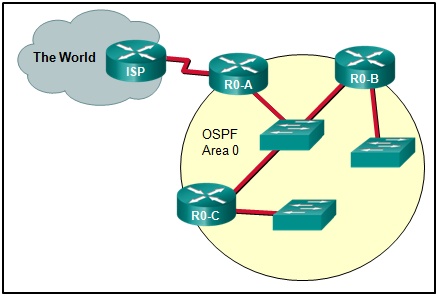
Explanation: Topic 2.5.1 – Default route is configured on the router connected to the Internet (R0-A).
25. What command would be used to determine if a routing protocol-initiated relationship had been made with an adjacent router?
Explanation: Topic 2.6.1 – While the show ip interface brief and ping commands can be used to determine if Layer 1, 2, and 3 connectivity exists, neither command can be used to determine if a particular OSPF or EIGRP-initiated relationship has been made. The show ip protocols command is useful in determining the routing parameters such as timers, router ID, and metric information associated with a specific routing protocol. The show ip ospf neighbor command shows if two adjacent routers have exchanged OSPF messages in order to form a neighbor relationship.
26. Refer to the exhibit. Which command did an administrator issue to produce this output?
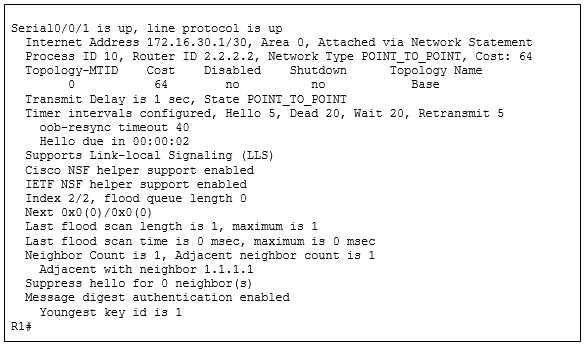
Explanation: Topic 2.6.4 – Output shows OSPF interface details.
27. Which command is used to verify that OSPF is enabled and also provides a list of the networks that are being advertised by the network?
Explanation: Topic 2.6.2 – The command show ip ospf interface verifies the active OSPF interfaces. The command show ip interface brief is used to check that the interfaces are operational. The command show ip route ospf displays the entries that are learned via OSPF in the routing table. The command show ip protocols checks that OSPF is enabled and lists the networks that are advertised.
28. Refer to the exhibit. A network administrator has configured OSPFv2 on the two Cisco routers but PC1 is unable to connect to PC2. What is the most likely problem?
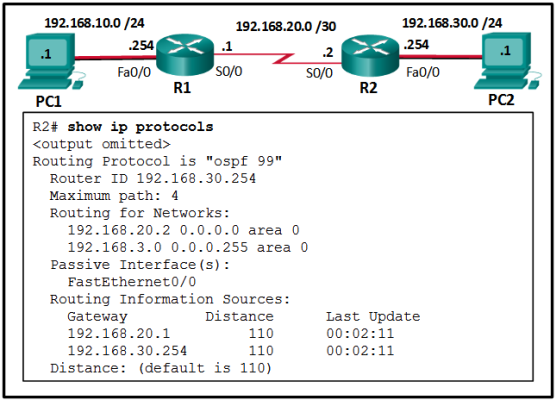
Explanation: Topic 2.2.4 – If a LAN network is not advertised using OSPFv2, a remote network will not be reachable. The output displays a successful neighbor adjacency between router R1 and R2 on the interface S0/0 of both routers.
29. What is the recommended Cisco best practice for configuring an OSPF-enabled router so that each router can be easily identified when troubleshooting routing issues?
Explanation: Topic 2.1.4 – A Cisco router is assigned a router ID to uniquely identify it. It can be automatically assigned and take the value of the highest configured IP address on any interface, the value of a specifically-configured loopback address, or the value assigned (which is in the exact form of an IP address) using the router-id command. Cisco recommends using the router-id command.
30. Which step in the link-state routing process is described by a router running an algorithm to determine the best path to each destination?
Explanation: Topic 1.1.3 – SPF algorithm computes best paths.
31. An administrator is configuring single-area OSPF on a router. One of the networks that must be advertised is 192.168.223.0 255.255.254.0. What wildcard mask would the administrator use in the OSPF network statement?
Explanation: Topic 2.2.2 – Wildcard = inverse of subnet mask (255.255.254.0 => 0.0.1.255).
32. What is the format of the router ID on an OSPF-enabled router?
Explanation: Topic 2.1.3 – A router ID is a 32-bit number formatted like an IPv4 address and assigned in order to uniquely identify a router among OSPF peers.
33. Question as presented: DUAL is the algorithm used by EIGRP. In multiarea OSPF, OSPF is implemented using multiple areas, and all of them must be connected to the backbone area.
Explanation: Topic 1.1.4 – Multiarea OSPF requires connection to backbone area 0.
34. After modifying the router ID on an OSPF router, what is the preferred method to make the new router ID effective?
Explanation: Topic 2.1.7 – To modify a router-id on an OSPF-enabled router, it is necessary to reset the OSPF routing process by entering either the clear ip ospf process command or the reload command.
35. In an OSPFv2 configuration, what is the effect of entering the command network 192.168.1.1 0.0.0.0 area 0 ?
Explanation: Topic 2.2.4 – Entering the command network 192.168.1.1 0.0.0.0 area 0 will turn on only the interface with that IP address for OSPF routing. It does not change the router ID. Instead, OSPF will use the network that is configured on that interface.
36. What is the reason for a network engineer to alter the default reference bandwidth parameter when configuring OSPF?
Explanation: Topic 2.4.2 – Default reference bandwidth causes all fast links to have cost 1; adjusting allows finer granularity.
37. Open the PT Activity. Perform the tasks in the activity instructions and then answer the question. Which task has to be performed on Router 1 for it to establish an OSPF adjacency with Router 2?
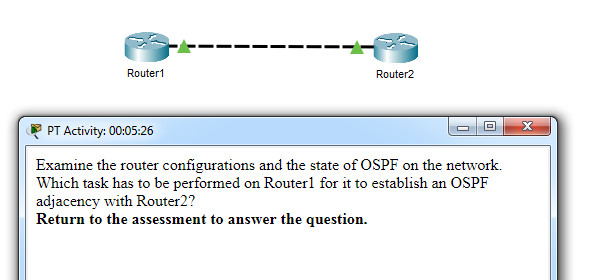

Explanation: Topic 2.6.1 – Each interface on the link connecting the OSPF routers must be in the same subnet for an adjacency to be established. The IP address subnet mask on FastEthernet interface 0/0 must be changed to 255.255.255.0. The FastEthernet interface 0/0 is not passive. The 10.0.1.0/24 network is only connected to Router2 so should not be advertised by Router1. The clear ip ospf process command will start the OPSF process on Router1 but will not cause an adjacency to be established if the subnet mask mismatch on the connecting interfaces still exists.
38. Match the description to the term. (Not all options are used.)

Explanation: Topic 1.1.2 - DUAL is the algorithm used by EIGRP. In multiarea OSPF, OSPF is implemented using multiple areas, and all of them must be connected to the backbone area.
| Description | Term |
|---|---|
| This is the algorithm used by OSPF. | Shortest Path First |
| This is where the details of the neighboring routers can be found. | Adjacency database |
| All the routers are in the backbone area. | Single-area OSPF |
| This is where you can find the topology table. | Link-state database |
39. What is a benefit of multiarea OSPF routing?
Explanation: Topic 1.1.5 – With multiarea OSPF, only routers within an area share the same link-state database. Changes to the network topology in one area do not impact other areas, which reduces the number of SPF algorithm calculations and the of link-state databases.
40. Match the OSPF state with the order in which it occurs. (Not all options are used.)

Explanation: Topic 1.3.2 – Order: Down, Init, Two-way, Exstart, Exchange, Loading, Full.
| Order | State |
|---|---|
| first | Down |
| second | Init |
| third | Two-way |
| fourth | Exstart |
| fifth | Exchange |
| sixth | Loading |
| seventh | Full |
41. What indicates to a link-state router that a neighbor is unreachable?
Explanation: Topic 2.4.7 – OSPF routers send hello packets to monitor the state of a neighbor. When a router stops receiving hello packets from a neighbor, that neighbor is considered unreachable and the adjacency is broken.
42. Which three OSPF states are involved when two routers are forming an adjacency? (Choose three.)
Explanation: Topic 1.3.4 – OSPF operation progresses through 7 states for establishing neighboring router adjacency, exchanging routing information, calculating the best routes, and reaching convergence. The Down, Init, and Two-way states are involved in the phase of neighboring router adjacency establishment.
43. Refer to the exhibit. Suppose that routers B, C, and D have a default priority, and router A has a priority 0. Which conclusion can be drawn from the DR/BDR election process?
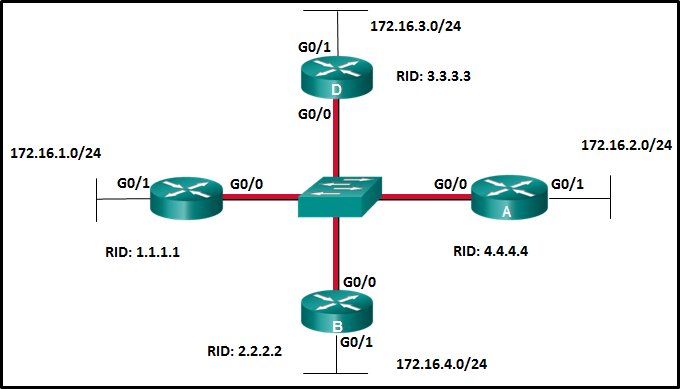
Explanation: Topic 2.3.7 – If the priority is set to 0, the router is not capable of becoming the DR, so router A cannot be the DR. OSPF DR and BDR elections are not preemptive. If a new router with a higher priority or higher router ID is added to the network after the DR and BDR election, the newly added router does not take over the DR or the BDR role.
44. An administrator is configuring single-area OSPF on a router. One of the networks that must be advertised is 64.102.0.0 255.255.255.128. What wildcard mask would the administrator use in the OSPF network statement?
Explanation: Topic 2.2.2 – Inverse of /25 is 0.0.0.127.
45. Which command will a network engineer issue to verify the configured hello and dead timer intervals on a point-to-point WAN link between two routers that are running OSPFv2?
Explanation: Topic 2.4.8 – The show ip ospf interface serial 0/0/0 command will display the configured hello and dead timer intervals on a point-to-point serial WAN link between two OSPFv2 routers. The show ipv6 ospf interface serial 0/0/0 command will display the configured hello and dead timer intervals on a point-to-point serial link between two OSPFv3 routers. The show ip ospf interface fastethernet 0/1 command will display the configured hello and dead timer intervals on a multiaccess link between two (or more) OSPFv2 routers. The show ip ospf neighbor command will display the dead interval elapsed time since the last hello message was received, but does not show the configured value of the timer.
46. An administrator is configuring single-area OSPF on a router. One of the networks that must be advertised is 128.107.0.0 255.255.255.192. What wildcard mask would the administrator use in the OSPF network statement?
Explanation: Topic 2.2.2 – Inverse of /26 is 0.0.0.63.
47. Match each OSPF packet type to how it is used by a router. (Not all options are used.)

Explanation: Topic 1.2.2
| Packet Type | Usage |
|---|---|
| link-state request packet | query another router for additional information |
| hello packet | establish and maintain adjacencies |
| database description packet | compare local topology to that sent by another router |
| link-state update packet | advertise new information |
48. An administrator is configuring single-area OSPF on a router. One of the networks that must be advertised is 192.168.181.0 255.255.254.0. What wildcard mask would the administrator use in the OSPF network statement?
Explanation: Topic 2.2.2 – Inverse of /23 is 0.0.1.255.
49. An administrator is configuring single-area OSPF on a router. One of the networks that must be advertised is 198.19.0.0 255.255.252.0. What wildcard mask would the administrator use in the OSPF network statement?
Explanation: Topic 2.2.2 – Inverse of /22 is 0.0.3.255.
50. An administrator is configuring single-area OSPF on a router. One of the networks that must be advertised is 128.107.0.0 255.255.252.0. What wildcard mask would the administrator use in the OSPF network statement?
Explanation: Topic 2.2.2 – Inverse of /22 is 0.0.3.255.
51. Which step in the link-state routing process is described by a router flooding link-state and cost information about each directly connected link?
Explanation: Topic 1.1.3 – Flooding LSAs is part of exchanging link-state info.
52. Which step in the link-state routing process is described by a router sending Hello packets out all of the OSPF-enabled interfaces?
Explanation: Topic 1.1.3 – Hello packets are used to establish adjacencies.
53. An administrator is configuring single-area OSPF on a router. One of the networks that must be advertised is 64.100.0.0 255.255.255.0. What wildcard mask would the administrator use in the OSPF network statement?
Explanation: Topic 2.2.2 – Inverse of /24 is 0.0.0.255.
54. Which step in the link-state routing process is described by a router inserting best paths into the routing table?
Explanation: Topic 1.1.3 – After SPF, the best routes are inserted into the routing table.
55. What type of address is 64.101.198.197?
Explanation: Topic 2.5.1 – Not in private ranges (10.0.0.0/8, 172.16.0.0/12, 192.168.0.0/16), so public.
56. An OSPF router has three directly connected networks; 172.16.0.0/24, 172.16.1.0/24, and 172.16.2.0/24. Which OSPF network command would advertise only the 172.16.1.0 network to neighbors?
Explanation: Topic 2.2.4 – To advertise only the 172.16.1.0/24 network the wildcard mask used in the network command must match the first 24-bits exactly. To match bits exactly, a wildcard mask uses a binary zero. This means that the first 24-bits of the wildcard mask must be zero. The low order 8-bits can all be set to 1.
57. Which step in the link-state routing process is described by a router building a link-state database based on received LSAs?
Explanation: Topic 1.1.3 – Building topology table is constructing the LSDB.
🚀 Ace Your CCNA Exam - Complete Study Pack!
Get 500+ exam-realistic questions, Packet Tracer labs, and detailed explanations.
Understanding OSPF Concepts and Configuration (Modules 1-2)
Passing the CCNA 3 v7 Modules 1-2 exam requires a solid grasp of OSPF fundamentals. These modules cover link-state routing, OSPF operation, configuration, and verification – essential knowledge for any network engineer.
Why Modules 1-2 Matter for Your Networking Career
OSPF is one of the most widely used routing protocols in enterprise networks. Understanding how OSPF builds adjacencies, exchanges LSAs, and calculates best paths is critical. Employers expect CCNA-certified professionals to understand OSPF areas, DR/BDR election, cost calculation, and troubleshooting. Mastering these topics prepares you for real-world network administration.
Key Topics Covered in the Exam
Our verified answers address common exam questions on:
- OSPF Operation: Hello packets, neighbor states, LSDB, SPF algorithm.
- OSPF Areas: Single-area vs multi-area, backbone area.
- OSPF Configuration: Router ID, network statements, wildcard masks, passive interfaces.
- DR/BDR Election: Priority, router ID, election process.
- OSPF Cost: Reference bandwidth, cost calculation.
- Verification Commands: show ip ospf neighbor, show ip ospf interface, show ip protocols.
Many questions present a topology and ask you to identify the correct configuration or election outcome. Understanding the OSPF state machine and the purpose of each packet type is critical.
Common Pitfalls to Avoid
Students often confuse OSPF process ID and area ID – process ID is locally significant, area ID must match. Another common mistake is misunderstanding wildcard masks – remember they are the inverse of the subnet mask. Also, DR/BDR elections are not preemptive; changing priority after election does not affect current DR/BDR.
When practicing, focus on the concept behind each answer rather than memorizing letters. For example, learn how OSPF cost is derived from bandwidth and why adjusting reference bandwidth is sometimes needed.
Study Strategies That Work
Combine our exam answers with hands-on practice. Use Packet Tracer to configure OSPF on multiple routers, observe adjacency formation, and verify routes. Experiment with different areas, DR/BDR priorities, and cost settings. This practical approach cements the theory.
Create flashcards for key terms: OSPF neighbor states (Down, Init, Two-way, Exstart, Exchange, Loading, Full), LSA types, DR/BDR, cost, reference bandwidth, and the five OSPF packet types (Hello, DBD, LSR, LSU, LSAck).
How to Use This Answer Page Effectively
Our goal at CoursMooc.com is to provide accurate, up-to-date answers. Read each explanation carefully. If a concept is unclear, refer to Cisco NetAcad materials or our additional tutorials.
We regularly update this page to match exam changes. If you notice discrepancies, please comment below.
What's Next After Modules 1-2?
After OSPF, Modules 3-5 cover network security, Modules 6-8 WAN concepts, and Modules 9-12 optimization and troubleshooting. Each step builds on your knowledge. Completing all CCNA 3 exams earns the "Enterprise Networking, Security, and Automation" badge.
Final Tips for Exam Day
- Get enough sleep – fatigue leads to misreading.
- Read each question twice. Watch for "not", "except", or "only".
- Manage time; skip difficult ones and return later.
- Trust your first instinct unless you find clear evidence otherwise.
Remember: The CCNA v7 curriculum emphasizes practical troubleshooting. If you can explain why a route is not installed or why a neighbor is not forming, you're ready. Good luck!