CCNA 2 (Version 7.00) SRWE Practice Final Exam Answers
Practice Final Exam – SRWE. This comprehensive study guide covers the CCNA2 Switching, Routing, and Wireless Essentials (SRWE) practice final exam, including VLANs, STP, EtherChannel, DHCP, routing, and wireless concepts.
1. A network administrator is using the router-on-a-stick method to configure inter-VLAN routing. Switch port Gi1/1 is used to connect to the router. Which command should be entered to prepare this port for the task?
Explanation: Topic 4.2.2 – With the router-on-a-stick method, the switch port that connects to the router must be configured as trunk mode. This can be done with the command Switch(config-if)# switchport mode trunk. The other options do not put the switch port into trunk mode.
2. Refer to the exhibit. The configuration shows commands entered by a network administrator for inter-VLAN routing. However, host H1 cannot communicate with H2. Which part of the inter-VLAN configuration causes the problem?
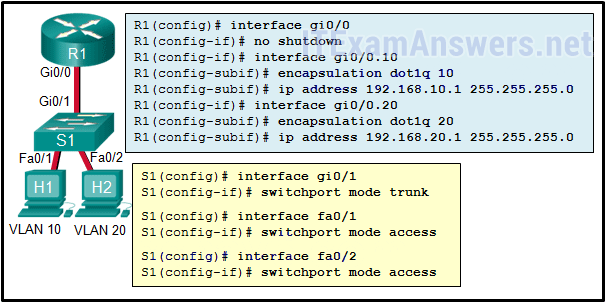
Explanation: Topic 4.4.5 – All Cisco switch ports are assigned to VLAN 1 by default. For VLAN implementation, ports Fa0/1 and Fa0/2 should be assigned to VLAN 10 and VLAN 20, respectively. The missing commands on S1 are as follows: switchport access vlan 10 and switchport access vlan 20 .
3. Refer to the exhibit. Inter-VLAN communication between VLAN 10, VLAN 20, and VLAN 30 is not successful. What is the problem?
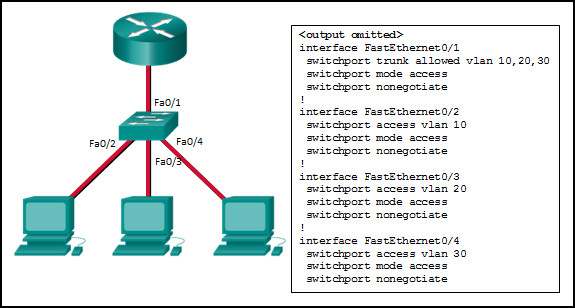
Explanation: Topic 4.4.4 – To forward all VLANs to the router, the switch interface Fa0/1 must be configured as a trunk interface with the switchport mode trunk command.
4. An employee connects wirelessly to the company network using a cell phone. The employee then configures the cell phone to act as a wireless access point that will allow new employees to connect to the company network. Which type of security threat best describes this situation?
Explanation: Topic 12.6.4 – Configuring the cell phone to act as a wireless access point means that the cell phone is now a rogue access point. The employee unknowingly breached the security of the company network by allowing a user to access the network without connecting through the company access point. Cracking is the process of obtaining passwords from data stored or transmitted on a network. Denial of service attacks refer to sending large amounts of data to a networked device, such as a server, to prevent legitimate access to the server. Spoofing refers to access gained to a network or data by an attacker appearing to be a legitimate network device or user.
5. Which combination of WLAN authentication and encryption is recommended as a best practice for home users?
Explanation: Topic 12.7.4 – WPA2 is the Wi-Fi alliance version of 802.11i, the industry standard for authentication. Neither WEP nor WPA possess the level of authentication provided by WPA2. AES aligns with WPA2 as an encryption standard, and is stronger than TKIP or RC4. PSK refers to pre-shared passwords, an authentication method that can be used by either WPA or WPA2. EAP is intended for use with enterprise networks which use a RADIUS server.
6. What are the two methods that a wireless NIC can use to discover an AP? (Choose two.)
Explanation: Topic 12.3.7 – Two methods can be used by a wireless device to discover and register with an access point: passive mode and active mode. In passive mode, the AP sends a broadcast beacon frame that contains the SSID and other wireless settings. In active mode, the wireless device must be manually configured for the SSID, and then the device broadcasts a probe request.
7. What address and prefix length is used when configuring an IPv6 default static route?
Explanation: Topic 15.3.1 – The IPv6 address and prefix for a default static route is ::/0. This represents all zeros in the address and a prefix length of zero.
8. Refer to the exhibit. Match the description with the routing table entries. (Not all options are used.)
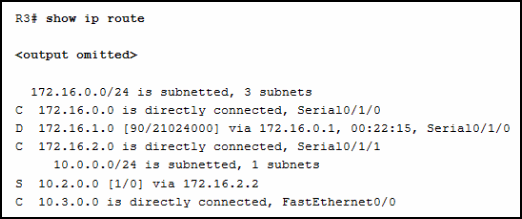
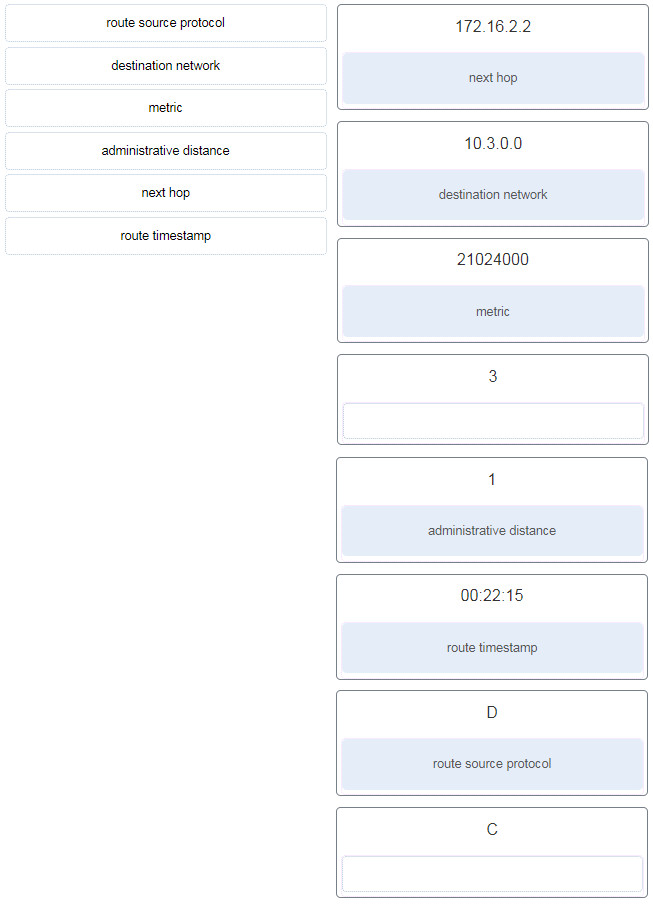
Explanation: Topic 14.4.3
- route source protocol = D (EIGRP)
- destination network = 10.3.0.0
- metric = 21024000
- administrative distance = 1
- next hop = 172.16.2.2
- route timestamp = 00:22:15
9. Refer to the exhibit. Which interface will be the exit interface to forward a data packet that has the destination IP address 172.18.109.152?
Gateway of last resort is not set.
172.18.109.0/26 is variously subnetted, 7 subnets, 3 masks
O 172.18.109.0/26 [110/10] via 172.18.32.1, 00:00:24, Serial0/0/0
O 172.18.109.64/26 [110/20] via 172.18.32.6, 00:00:56, Serial 0/0/1
O 172.18.109.128/26 [110/10] via 172.18.32.1, 00:00:24, Serial 0/0/0
C 172.18.109.192/27 is directly connected, GigabitEthernet0/0
L 172.18.109.193/27 is directly connected, GigabitEthernet0/0
C 172.18.109.224/27 is directly connected, GigabitEthernet0/1
L 172.18.109.225/27 is directly connected, GigabitEthernet0/1
172.18.32.0/24 is variably subnetted, 4 subnets, 2 masks
C 172.18.32.0/30 is directly connected, Serial0/0/0
L 172.18.32.2/32 is directly connected, Serial0/0/0
C 172.18.32.4/30 is directly connected, Serial0/0/1
L 172.18.32.5/32 is directly connected, Serial0/0/1
S 172.18.33.0/26 [1/0] via 172.18.32.1, 00:00:24, Serial0/0/0
R1#
Explanation: Topic 14.1.3 – The destination 172.18.109.152 falls in the 172.18.109.128/26 subnet, which is reachable via Serial0/0/0.
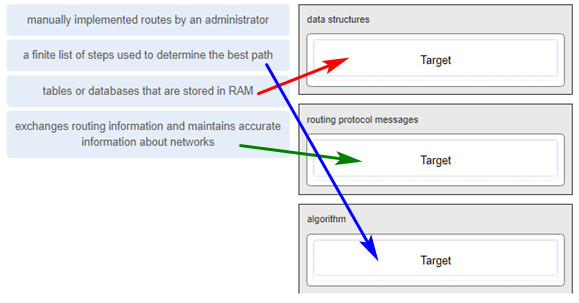
10. Match the dynamic routing protocol component to the characteristic. (Not all options are used.)
Explanation: Topic 14.5.3
- data structures – tables or databases that are stored in RAM
- routing protocol messages – exchanges routing information and maintains accurate information about networks
- algorithm – a finite list of steps used to determine the best path
11. Which statement describes the behavior of a switch when the MAC address table is full?
Explanation: Topic 10.4.2 – When the MAC address table is full, the switch treats the frame as an unknown unicast and begins to flood all incoming traffic to all ports only within the local VLAN.
12. Which term describes the role of a Cisco switch in the 802.1X port-based access control?
Explanation: Topic 10.2.6 – 802.1X port-based authentication defines specific roles for the devices in the network: Client (Supplicant) – The device that requests access to LAN and switch services Switch (Authenticator) – Controls physical access to the network based on the authentication status of the client Authentication server – Performs the actual authentication of the client
13. What is a result of connecting two or more switches together?
Explanation: Topic 2.2.2 – When two or more switches are connected together, the size of the broadcast domain is increased and so is the number of collision domains. The number of broadcast domains is increased only when routers are added.
14. A small publishing company has a network design such that when a broadcast is sent on the LAN, 200 devices receive the transmitted broadcast. How can the network administrator reduce the number of devices that receive broadcast traffic?
Explanation: Topic 2.2.2 – By dividing the one big network into two smaller network, the network administrator has created two smaller broadcast domains. When a broadcast is sent on the network now, the broadcast will only be sent to the devices on the same Ethernet LAN. The other LAN will not receive the broadcast.
15. Refer to the exhibit. How is a frame sent from PCA forwarded to PCC if the MAC address table on switch SW1 is empty?
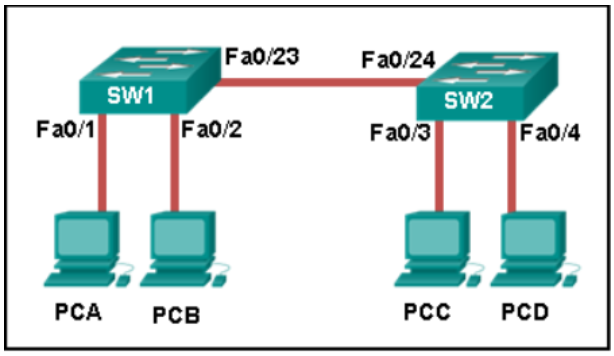
Explanation: Topic 2.1.3 – When a switch powers on, the MAC address table is empty. The switch builds the MAC address table by examining the source MAC address of incoming frames. The switch forwards based on the destination MAC address found in the frame header. If a switch has no entries in the MAC address table or if the destination MAC address is not in the switch table, the switch will forward the frame out all ports except the port that brought the frame into the switch.
16. What are two switch characteristics that could help alleviate network congestion? (Choose two.)
Explanation: Topic 2.2.3 – Switch characteristics that help alleviate network congestion include fast port speeds, fast internal switching, large frame buffers, and high port density.
17. A network engineer is configuring a LAN with a redundant first hop to make better use of the available network resources. Which protocol should the engineer implement?
Explanation: Topic 9.1.4 – Gateway Load Balancing Protocol (GLBP) provides load sharing between a group of redundant routers while also protecting data traffic from a failed router or circuit.
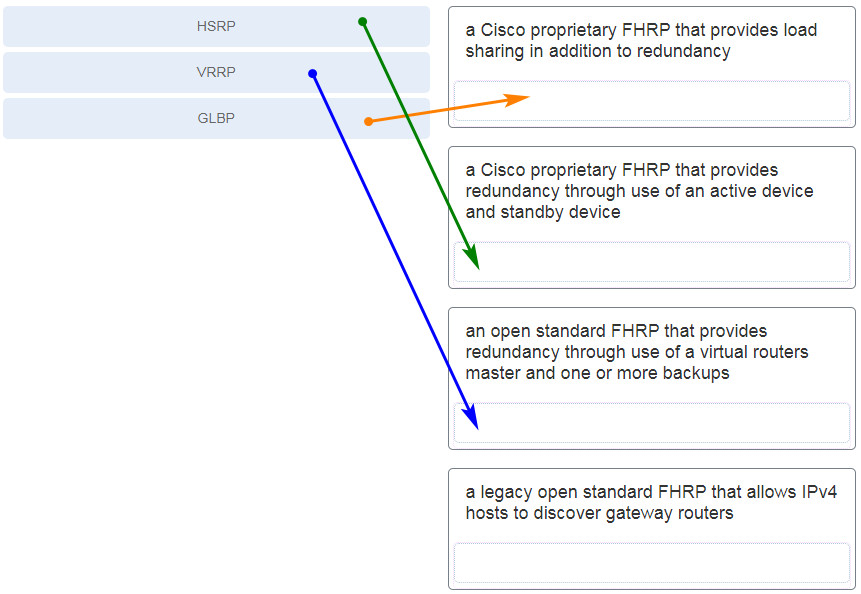
18. Match the FHRP protocols to the appropriate description. (Not all options are used.)
Explanation: Topic 9.1.4
| Protocol | Description |
|---|---|
| GLBP | a Cisco proprietary FHRP that provides load sharing in addition to redundancy |
| HSRP | a Cisco proprietary FHRP that provides redundancy through use of an active device and standby device |
| VRRP | an open standard FHRP that provides redundancy through use of a virtual routers master and one or more backups |
19. After sticky learning of MAC addresses is enabled, what action is needed to prevent dynamically learned MAC addresses from being lost in the event that an associated interface goes down?
Explanation: Topic 11.1.4 – When sticky learning is enabled, dynamically learned MAC addresses are stored in the running configuration in RAM and will be lost if the switch is rebooted or an interface goes down. To prevent the loss of learned MAC addresses, an administrator can save the running configuration into the startup configuration in NVRAM.
20. A small coffee shop is offering free Wi-Fi to customers. The network includes a wireless router and a DSL modem that is connected to the local phone company. What method is typically used to configure the connection to the phone company?
Explanation: Topic 7.3.3 – In a SOHO environment, a wireless router connects to an ISP via a DSL or cable modem. The IP address between the wireless router and ISP site is typically assigned by the ISP through DHCP. The DSL modem does not manage IP address allocation.
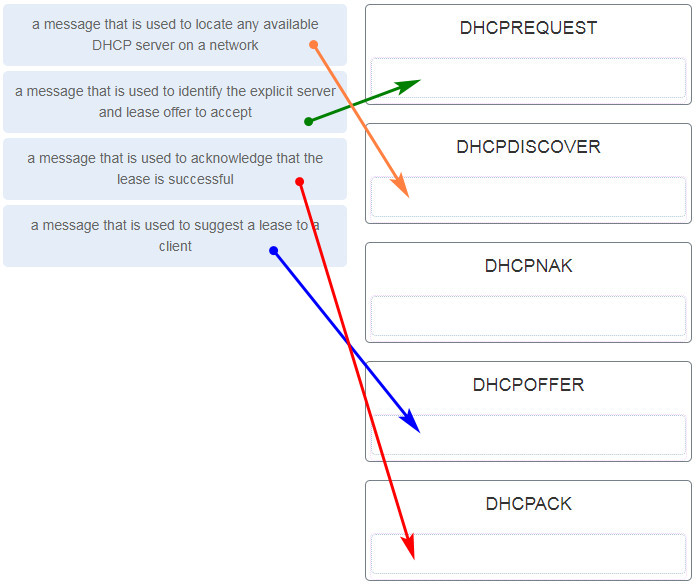
21. Match the purpose with its DHCP message type. (Not all options are used.)
Explanation: Topic 7.1.3
- DHCPDISCOVER – Locate any available DHCP server on a network
- DHCPOFFER – Suggest a lease to a client
- DHCPREQUEST – Identify the explicit server and lease offer to accept
- DHCPACK – Acknowledge that the lease is successful
- DHCPNAK – Used when an offered lease is no longer valid
22. Match the spanning-tree feature with the protocol type. (Not all options are used.)

Explanation: Topic 5.3.1
| Feature | Protocol |
|---|---|
| PVST | Cisco implementation of IEEE 802.1D |
| RSTP | Fast converging enhancement of IEEE 802.1D |
| MSTP | IEEE standard that reduces the number of STP instances |
| MST | Proprietary per VLAN implementation of IEEE 802.1w |
| Rapid PVST+ | an evolution of STP that provides faster convergence |
24. What is an advantage of PVST+?
Explanation: Topic 5.3.1 – PVST+ results in optimum load balancing. However, this is accomplished by manually configuring switches to be elected as root bridges for different VLANs on the network. The root bridges are not automatically selected. Furthermore, having spanning-tree instances for each VLAN actually consumes more bandwidth and it increases the CPU cycles for all the switches in the network.
25. Which problem is evident if the show ip interface command shows that the interface is down and the line protocol is down?
Explanation: Topic 1.2.6 – If an interface has not been brought up with the no shutdown command, the interface status shows administratively down. A duplicate IP address will not bring an interface down. An encapsulation error is normally found using the show interfaces command.
26. A technician is configuring a new Cisco 2960 switch. What is the effect of issuing the BranchSw(config)#interface VLAN88 command?
Explanation: Topic 1.1.6 – The command enters SVI configuration mode for VLAN 88.
27. In what situation would a Layer 2 switch have an IP address configured?
Explanation: Topic 1.1.5 – Layer 2 switches can be configured with an IP address so that they can be remotely managed by an administrator. Layer 3 switches can use an IP address on routed ports. Layer 2 switches do not need a configured IP address to forward user traffic or act as a default gateway.
28. Which command would create a valid IPv6 default route?
Explanation: Topic 15.3.1 – The correct prefix and prefix length for a default route is ::/0, which matches any address. ::/128 matches only the specific address of all zeros. When creating a static route that uses a link-local address as the next hop, an exit interface must also be specified for the route to be valid.
29. Refer to the exhibit. The routing table for R2 is as follows: [exhibit]. What will router R2 do with a packet destined for 192.168.10.129?
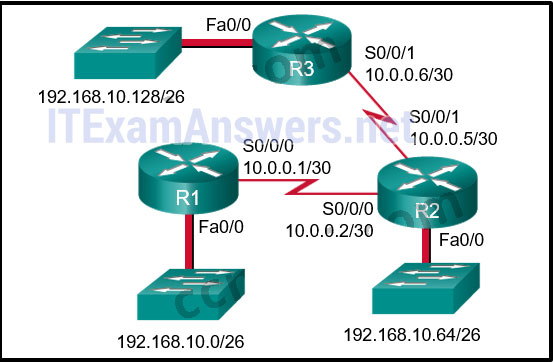
Gateway of last resort is not set
10.0.0.0/30 is subnetted, 2 subnets
C 10.0.0.0 is directly connected, Serial0/0/0
C 10.0.0.4 is directly connected, Serial0/0/1
192.168.10.0/26 is subnetted, 3 subnets
S 192.168.10.0 is directly connected, Serial0/0/0
C 192.168.10.64 is directly connected, FastEthernet0/0
S 192.168.10.128 [1/0] via 10.0.0.6
Explanation: Topic 14.4.3 – When a static route is configured with the next hop address (as in the case of the 192.168.10.128 network), the output of the show ip route command lists the route as “via” a particular IP address. The router has to look up that IP address to determine which interface to send the packet out. Because the IP address of 10.0.0.6 is part of network 10.0.0.4, the router sends the packet out interface Serial0/0/1.
30. Refer to the exhibit. Router R1 has an OSPF neighbor relationship with the ISP router over the 192.168.0.32 network. The 192.168.0.36 network link should serve as a backup when the OSPF link goes down. The floating static route command ip route 0.0.0.0 0.0.0.0 S0/0/1 100 was issued on R1 and now traffic is using the backup link even when the OSPF link is up and functioning. Which change should be made to the static route command so that traffic will only use the OSPF link when it is up?
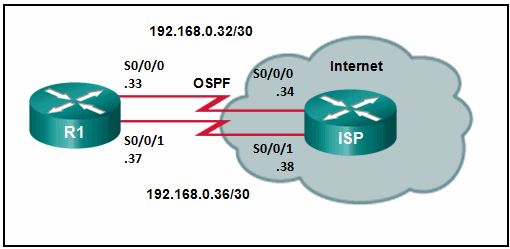
Explanation: Topic 15.4.1 – The problem with the current floating static route is that the administrative distance is set too low. The administrative distance will need to be higher than that of OSPF, which is 110, so that the router will only use the OSPF link when it is up.
31. A junior technician was adding a route to a LAN router. A traceroute to a device on the new network revealed a wrong path and unreachable status. What should be done or checked?
Explanation: Topic 16.2.2 – First verify that the static route is installed in the routing table.
32. Refer to the exhibit. When a packet arrives on interface Serial0/0/0 on R1, with a destination IP address of PC1, which two events occur? (Choose two)
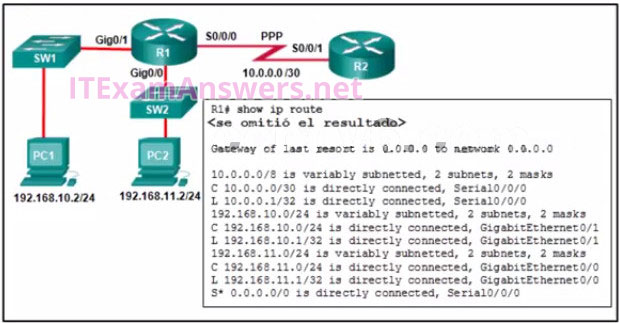
Explanation: Topic 14.2.1 – The router will forward out the exit interface (Gig0/1) and encapsulate in an Ethernet frame.
33. Refer to the exhibit. How was the host route 2001:DB8:CAFE:4::1/128 installed in the routing table?
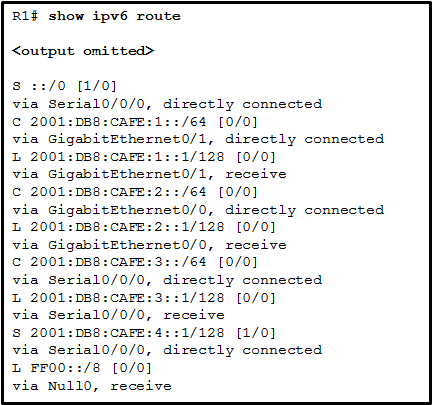
Explanation: Topic 15.5.3 – A host route is an IPv6 route with a 128-bit mask. A host route can be installed in a routing table automatically when an IP address is configured on a router interface or manually if a static route is created.
34. Which command will start the process to bundle two physical interfaces to create an EtherChannel group via LACP?
Explanation: Topic 6.2.2 – To specify the interfaces in an EtherChannel group, use the interface range interface global configuration command for the range of interfaces used. The interface range GigabitEthernet 0/4 – 5 command is the correct option because it specifies two interfaces for the EtherChannel group.
35. Refer to the exhibit. Based on the command output shown, what is the status of the EtherChannel?
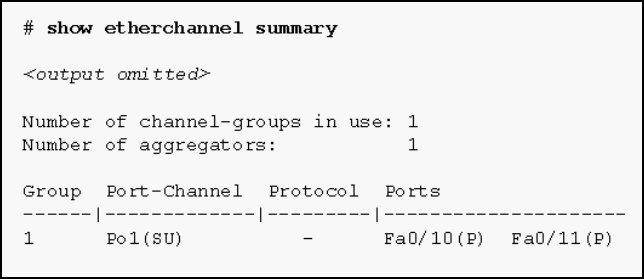
Explanation: Topic 6.3.1 – The command output shows the port channel as SU, which means Layer 2 and in use; and the FastEthernet 0/10 and 0/11 interfaces are bundled in port-channel as indicated by the P flag. Configuring the EtherChannel using the channel-group 1 mode on command will cause the Protocol field in the command output to be empty.
36. Refer to the exhibit. DLS1 is connected to another switch, DLS2, via a trunk link. A host that is connected to DLS1 is not able to communicate to a host that is connected to DLS2, even though they are both in VLAN 99. Which command should be added to Fa0/1 on DLS1 to correct the problem?
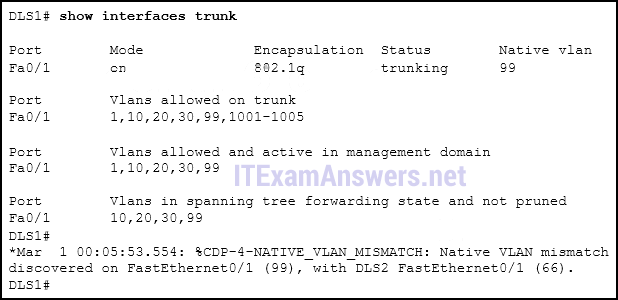
Explanation: Topic 3.4.2 – When configuring 802.1Q trunk links, the native VLAN must match on both sides of the link, or else CDP error messages will be generated, and traffic that is coming from or going to the native VLAN will not be handled correctly.
37. Which type of traffic is designed for a native VLAN?
Explanation: Topic 3.2.5 – A native VLAN carries untagged traffic, which is traffic that does not come from a VLAN. A data VLAN carries user-generated traffic. A management VLAN carries management traffic.
38. Refer to the exhibit. PC-A and PC-B are both in VLAN 60. PC-A is unable to communicate with PC-B. What is the problem?
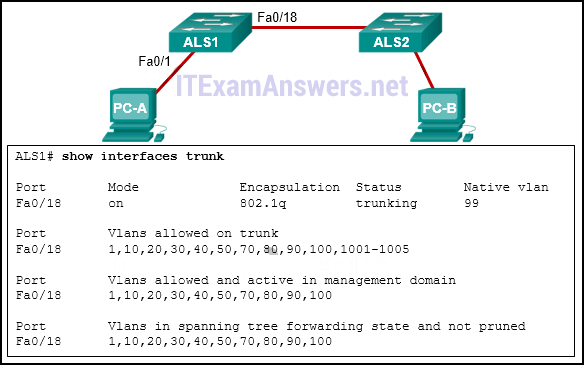
Explanation: Topic 3.4.1 – Because PC-A and PC-B are connected to different switches, traffic between them must flow over the trunk link. Trunks can be configured so that they only allow traffic for particular VLANs to cross the link. In this scenario, VLAN 60, the VLAN that is associated with PC-A and PC-B, has not been allowed across the link, as shown by the output of show interfaces trunk.
39. Question as presented: Match the DTP mode with its function. (Not all options are used.)
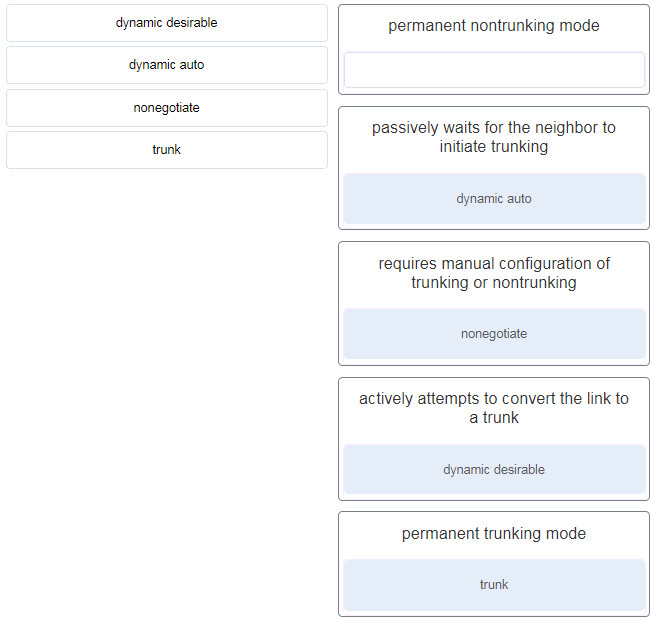
Explanation: Topic 3.5.2
- dynamic auto – makes the interface become a trunk if the neighbor is trunk or desirable
- dynamic desirable – actively attempts to convert the link to a trunk
- trunk – puts the interface into permanent trunking mode and negotiates
- nonegotiate – prevents the interface from generating DTP frames
40. What type of VLAN is configured specifically for network traffic such as SSH, Telnet, HTTPS, HTTP, and SNMP?
Explanation: Topic 3.1.3 – Management VLAN carries management traffic.
41. Refer to the exhibit. The users on the LAN network of R1 cannot receive an IPv6 address from the configured stateful DHCPv6 server. What is missing from the stateful DHCPv6 configuration on router R1?
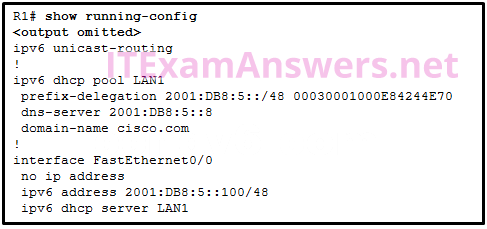
Explanation: Topic 8.3.5 – When configuring a router interface for stateful DHCPv6, the router must be able to inform the host PC’s to receive IPv6 addressing from a stateful DHCPv6 server. The interface command is ipv6 nd managed-config-flag
42. A network administrator is implementing DHCPv6 for the company. The administrator configures a router to send RA messages with M flag as 1 by using the interface command ipv6 nd managed-config-flag. What effect will this configuration have on the operation of the clients?
Explanation: Topic 8.3.4 – Under stateful DHCPv6 configuration, which is indicated by setting M flag as 1 (through the interface command ipv6 nd managed-config-flag ), the dynamic IPv6 address assignments are managed by the DHCPv6 server. Clients must obtain all configuration information from a DHCPv6 server.
43. Refer to the exhibit. A network administrator is troubleshooting a problem with EtherChannel. What command was used to produce the exhibited output?
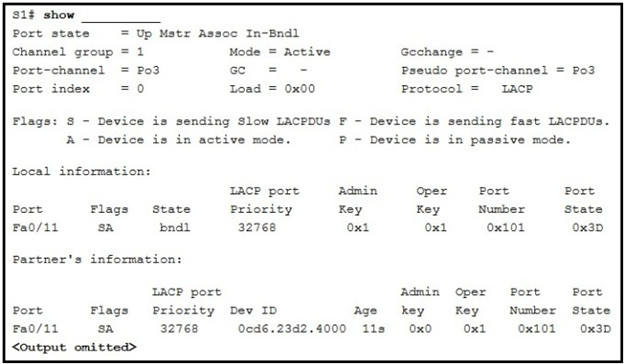
Explanation: Topic 6.3.1 – The show interfaces fastethernet 0/11 etherchannel command will show the EtherChannel information for the FastEthernet 0/11 interface. The displayed information includes the port channel it belongs to, the current mode, and the channel group, among other information.
44. Refer to the exhibit. The administrator wants to enable port security on an interface on switch S1, but the command was rejected. Which conclusion can be drawn?
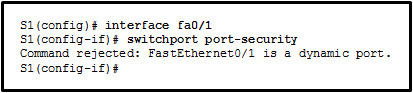
Explanation: Topic 11.1.3 – To enable port security, use the switchport port-security interface configuration command on an access port. By default, Layer 2 switch ports are set to dynamic auto (trunking on); therefore, the port must be initially configured as an access port before port security can be enabled.
45. On which port should Dynamic ARP Inspection (DAI) be configured on a switch?
Explanation: Topic 11.4.2 – DHCP snooping must be enabled on a port where DAI is configured, because DAI requires the DHCP snooping table to operate. Only a trusted interface, such as an uplink port between switches, is configured to implement DAI. All access ports are untrusted.
46. Refer to the exhibit. A network administrator is configuring DAI on switch SW1. What is the result of entering the exhibited commands?
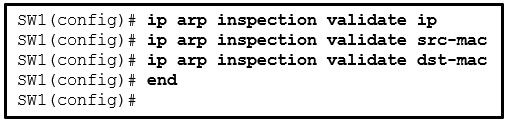
Explanation: Topic 11.4.3 – DAI can be configured to check for destination MAC, source MAC, and IP addresses. However, only one ip arp inspection validate command can be configured. Entering multiple ip arp inspection validate commands overwrites the previous command.
47. Which Cisco solution helps prevent ARP spoofing and ARP poisoning attacks?
Explanation: Topic 11.4.1 – DAI prevents ARP spoofing and poisoning.
48. What is the reason for disabling SSID broadcasting and changing the default SSID on a wireless access point?
Explanation: Topic 12.7.2 – The SSID is the name of the wireless network. Changing the default SSID forces device users to manually enter the SSID in order to gain access to the network. Broadcasting the SSID does not allow other devices to access the configuration, or to discover the MAC address of the device. SSID broadcasts do not affect radio frequency bandwidth.
49. What are two characteristics of Cisco Express Forwarding (CEF)? (Choose two.)
Explanation: Topic 14.2.3 – Cisco Express Forwarding (CEF) builds a forwarding information base (FIB) and an adjacency table to be able to route packets quicker than traditional packet forwarding methods can.
50. A network administrator of a college is configuring WLAN security with WPA2 Enterprise authentication. Which server is required when deploying this type of authentication?
Explanation: Topic 12.7.7 – WAP2 Enterprise provides stronger secure user authentication than WPA2 PSK does. Instead of using a pre-shared key for all users to access a WLAN, WPA2 Enterprise requires that users enter their own username and password credentials to be authenticated before they can access the WLAN. The RADIUS server is required for deploying WPA2 Enterprise authentication.
51. What is a potential issue when using the WLC to upgrade and deploy the latest firmware image to all APs?
Explanation: Topic 13.4.4 – When APs are performing a firmware upgrade, users will be disconnected from the WLAN and the internet until the upgrade finishes. The wireless router may need to reboot several times before normal network operations are restored.
52. A network administrator is configuring a WLC to provide WLAN access to users in an office building. When testing the newly created WLAN, the administrator does not see the SSID from a wireless device. What is a possible cause?
Explanation: Topic 13.2.6 – When APs are performing a firmware upgrade, users will be disconnected from the WLAN and the internet until the upgrade finishes. The wireless router may need to reboot several times before normal network operations are restored.
53. What is the best way to prevent a VLAN hopping attack?
Explanation: Topic 11.2.2 – VLAN hopping attacks rely on the attacker being able to create a trunk link with a switch. Disabling DTP and configuring user-facing ports as static access ports can help prevent these types of attacks. Disabling the Spanning Tree Protocol (STP) will not eliminate VLAN hopping attacks.
54. An administrator has configured a DHCPv4 relay router and issued these commands:
Router(config)# interface g0/0
Router(config-if)# ip address 10.0.1.1 255.255.255.0
Router(config-if)# no shutdown
Router(config-if)# exit
Router(config)# ip dhcp pool RELAY
Router(dhcp-config)# end
The clients are not receiving IP parameters from the DHCPv4 server. What is a possible cause?
Explanation: Topic 7.2.8 – This router should be configured with the ip helper-address command, followed with the IP address of the DHCPv4 server, because the router is meant to be used as a relay agent. The ip dhcp pool RELAY command just names the DHCPv4 pool, and it does not enable the relay function.
55. Consider the following command:
ip route 192.168.10.0 255.255.255.0 10.10.10.2 5
What does the 5 at the end of the command signify?
Explanation: Topic 15.4.2 – The 5 at the end of the command signifies administrative distance. This value is added to floating static routes or routes that only appear in the routing table when the preferred route has gone down. The 5 at the end of the command signifies administrative distance configured for the static route. This value indicates that the floating static route will appear in the routing table when the preferred route (with an administrative distance less than 5) is down.
56. Which three components are combined to form a bridge ID? (Choose three.)
Explanation: Topic 5.2.1 – The three components that are combined to form a bridge ID are bridge priority, extended system ID, and MAC address.
🚀 Ace Your CCNA Exam - Complete Study Pack!
Get 500+ exam-realistic questions, Packet Tracer labs, and detailed explanations.
Understanding the SRWE Practice Final Exam
Passing the CCNA 2 SRWE Practice Final Exam requires a solid grasp of switching, routing, and wireless concepts covered in the course. This practice final tests your knowledge on VLANs, inter-VLAN routing, STP, EtherChannel, DHCP, routing protocols, and wireless LANs – essential skills for any network administrator.
Why This Practice Exam Matters
This practice exam consolidates all the topics from the SRWE course. You'll be tested on your ability to configure and troubleshoot VLANs, implement spanning-tree, manage EtherChannel, configure DHCP and routing, and secure wireless networks. Employers expect CCNA-certified professionals to be proficient in these areas, as they form the foundation of enterprise networking.
Key Topics Covered
- VLANs and Inter-VLAN Routing: Router-on-a-stick, SVI, trunking, native VLAN.
- Spanning Tree Protocol: STP, RSTP, PVST+, MST, BPDU guard, PortFast.
- EtherChannel: LACP, PAgP, load balancing, configuration.
- DHCP: DHCPv4, DHCPv6, relay agents, stateful/stateless.
- Routing: Static routes, default routes, floating static routes, routing table components.
- Wireless LANs: WLAN standards, security (WPA2, AES), AP discovery, rogue APs.
- Layer 2 Security: Port security, DHCP snooping, Dynamic ARP Inspection, 802.1X.
- First Hop Redundancy: HSRP, VRRP, GLBP.
Many questions present a network topology and ask you to identify the correct configuration or troubleshooting step. Understanding the underlying protocols and their configuration is critical for success.
Common Pitfalls to Avoid
Students often confuse native VLAN and allowed VLAN lists – the native VLAN must match on both ends, and allowed VLANs must include all needed VLANs. Another common mistake is misunderstanding administrative distance – a floating static route must have a higher AD than the dynamic route it backs up. Also, remember the difference between stateful and stateless DHCPv6 – stateful uses M flag=1, stateless uses O flag=1.
When practicing, avoid memorizing letter choices. Focus on the concept behind each answer. For example, instead of remembering "option B is the correct violation mode", learn the difference between protect, restrict, and shutdown.
Study Strategies That Work
Combine our answers with hands-on practice in Packet Tracer. Build networks with VLANs, configure trunking, set up STP and EtherChannel, and test routing. This practical approach reinforces theory and prepares you for real-world scenarios.
We recommend creating flashcards for key terms: VLAN, trunk, native VLAN, STP, root bridge, BPDU guard, EtherChannel, LACP, DHCP snooping, DAI, 802.1X, HSRP, GLBP, AD, metric, and the three DHCPv6 flags.
How to Use This Answer Page Effectively
Our goal at CoursMooc.com is to provide accurate, up-to-date answers. Read the explanations carefully to understand the reasoning behind each correct choice. If a concept is unclear, refer to the official Cisco NetAcad materials or our additional tutorials.
We regularly update this page to match any changes in the exam. If you notice discrepancies, please let us know through the comments.
Final Tips for Exam Day
- Get a good night's sleep.
- Read each question twice, paying attention to keywords like "not", "except", or "only".
- Manage your time – skip difficult questions and return later.
- Trust your first instinct unless you find clear evidence you misread.
Remember: The CCNA v7 curriculum emphasizes practical troubleshooting. If you can explain why a configuration fails or why a protocol behaves a certain way, you're ready. Good luck on your exam!