CCNA 2 v7 Modules 10-13: L2 Security and WLANs Exam Answers
Checkpoint Exam: L2 Security and WLANs. This comprehensive study guide covers Modules 10-13 of the CCNA2 Switching, Routing, and Wireless Essentials v7.0 (SRWE), including Layer 2 security, port security, DHCP snooping, AAA, and wireless LAN concepts.
1. Which Layer 2 attack will result in legitimate users not getting valid IP addresses?
Explanation: Topic 10.5.5 – DHCP starvation exhausts the IP address pool before legitimate users can obtain addresses.
2. What mitigation plan is best for thwarting a DoS attack that is creating a MAC address table overflow?
Explanation: Topic 11.1.2 – A MAC address (CAM) table overflow attack, buffer overflow, and MAC address spoofing can all be mitigated by configuring port security. A network administrator would typically not want to disable STP because it prevents Layer 2 loops. DTP is disabled to prevent VLAN hopping. Placing unused ports in an unused VLAN prevents unauthorized wired connectivity.
3. Which three Cisco products focus on endpoint security solutions? (Choose three.)
Explanation: Topic 10.1.3 – A MAC address (CAM) table overflow attack, buffer overflow, and MAC address spoofing can all be mitigated by configuring port security. A network administrator would typically not want to disable STP because it prevents Layer 2 loops. DTP is disabled to prevent VLAN hopping. Placing unused ports in an unused VLAN prevents unauthorized wired connectivity.
4. True or False? In the 802.1X standard, the client attempting to access the network is referred to as the supplicant.
Explanation: Topic 10.2.6 – The client is the supplicant.
5. Which authentication method stores usernames and passwords in the router and is ideal for small networks?
Explanation: Topic 10.2.3 – In a small network with a few network devices, AAA authentication can be implemented with the local database and with usernames and passwords stored on the network devices. Authentication using the TACACS+ or RADIUS protocol will require dedicated ACS servers although this authentication solution scales well in a large network.
6. What represents a best practice concerning discovery protocols such as CDP and LLDP on network devices?
Explanation: Topic 10.5.10 – Both discovery protocols can provide hackers with sensitive network information. They should not be enabled on edge devices, and should be disabled globally or on a per-interface basis if not required. CDP is enabled by default.
7. Which protocol should be used to mitigate the vulnerability of using Telnet to remotely manage network devices?
Explanation: Topic 10.3.3 – Telnet uses plain text to communicate in a network. The username and password can be captured if the data transmission is intercepted. SSH encrypts data communications between two network devices. TFTP and SCP are used for file transfer over the network. SNMP is used in network management solutions.
8. Which statement describes the behavior of a switch when the MAC address table is full?
Explanation: Topic 10.4.2 – When the MAC address table is full, the switch treats the frame as an unknown unicast and begins to flood all incoming traffic to all ports only within the local VLAN.
9. What device is considered a supplicant during the 802.1X authentication process?
Explanation: Topic 10.2.6 – The supplicant is the client requesting network access.
10. Refer to the exhibit. Port Fa0/2 has already been configured appropriately. The IP phone and PC work properly. Which switch configuration would be most appropriate for port Fa0/2 if the network administrator has the following goals? No one is allowed to disconnect the IP phone or the PC and connect some other wired device. If a different device is connected, port Fa0/2 is shut down. The switch should automatically detect the MAC address of the IP phone and the PC and add those addresses to the running configuration.
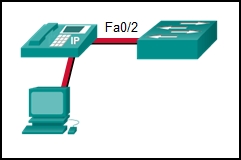
Explanation: Topic 11.1.4 – The default mode for a port security violation is to shut down the port so the switchport port-security violation command is not necessary. The switchport port-security command must be entered with no additional options to enable port security for the port. Then, additional port security options can be added.
11. Refer to the exhibit. Port security has been configured on the Fa 0/12 interface of switch S1. What action will occur when PC1 is attached to switch S1 with the applied configuration?
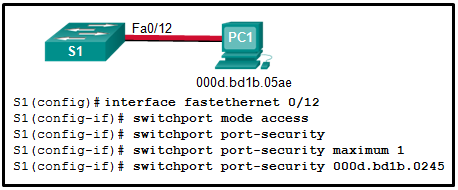
Explanation: Topic 11.1.6 – Manual configuration of the single allowed MAC address has been entered for port fa0/12. PC1 has a different MAC address and when attached will cause the port to shut down (the default action), a log message to be automatically created, and the violation counter to increment. The default action of shutdown is recommended because the restrict option might fail if an attack is underway.
12. Which type of VLAN-hopping attack may be prevented by designating an unused VLAN as the native VLAN?
Explanation: Topic 10.5.3 – Spoofing DTP messages forces a switch into trunking mode as part of a VLAN-hopping attack, but VLAN double tagging works even if trunk ports are disabled. Changing the native VLAN from the default to an unused VLAN reduces the possibility of this type of attack. DHCP spoofing and DHCP starvation exploit vulnerabilities in the DHCP message exchange.
13. A network administrator is configuring DAI on a switch with the command ip arp inspection validate src-mac. What is the purpose of this configuration command?
Explanation: Topic 11.4.3 – DAI validate src-mac checks the Ethernet source MAC against the ARP sender MAC.
14. Which two commands can be used to enable BPDU guard on a switch? (Choose two.)
Explanation: Topic 11.5.3 – BPDU guard can be enabled on all PortFast-enabled ports by using the spanning-tree portfast bpduguard default global configuration command. Alternatively, BPDU guard can be enabled on a PortFast-enabled port through the use of the spanning-tree bpduguard enable interface configuration command.
15. As part of the new security policy, all switches on the network are configured to automatically learn MAC addresses for each port. All running configurations are saved at the start and close of every business day. A severe thunderstorm causes an extended power outage several hours after the close of business. When the switches are brought back online, the dynamically learned MAC addresses are retained. Which port security configuration enabled this?
Explanation: Topic 11.1.4 – With sticky secure MAC addressing, the MAC addresses can be either dynamically learned or manually configured and then stored in the address table and added to the running configuration file. In contrast, dynamic secure MAC addressing provides for dynamically learned MAC addressing that is stored only in the address table.
16. Which type of management frame may regularly be broadcast by an AP?
Explanation: Topic 12.3.7 – Beacons are the only management frame that may regularly be broadcast by an AP. Probing, authentication, and association frames are used only during the association (or reassociation) process.
17. What are the two methods that are used by a wireless NIC to discover an AP? (Choose two.)
Explanation: Topic 12.3.7 – Two methods can be used by a wireless device to discover and register with an access point: passive mode and active mode. In passive mode, the AP sends a broadcast beacon frame that contains the SSID and other wireless settings. In active mode, the wireless device must be manually configured for the SSID, and then the device broadcasts a probe request.
18. A technician is configuring the channel on a wireless router to either 1, 6, or 11. What is the purpose of adjusting the channel?
Explanation: Topic 12.5.2 – Channels 1, 6, and 11 are selected because they are 5 channels apart. thus minimizing the interference with adjacent channels. A channel frequency can interfere with channels on either side of the main frequency. All wireless devices need to be used on nonadjacent channels.
19. While attending a conference, participants are using laptops for network connectivity. When a guest speaker attempts to connect to the network, the laptop fails to display any available wireless networks. The access point must be operating in which mode?
Explanation: Topic 12.3.7 – Active is a mode used to configure an access point so that clients must know the SSID to connect to the access point. APs and wireless routers can operate in a mixed mode meaning that that multiple wireless standards are supported. Open is an authentication mode for an access point that has no impact on the listing of available wireless networks for a client. When an access point is configured in passive mode, the SSID is broadcast so that the name of wireless network will appear in the listing of available networks for clients.
20. A network administrator is required to upgrade wireless access to end users in a building. To provide data rates up to 1.3 Gb/s and still be backward compatible with older devices, which wireless standard should be implemented?
Explanation: Topic 12.1.4 – 802.11ac provides data rates up to 1.3 Gb/s and is still backward compatible with 802.11a/b/g/n devices. 802.11g and 802.11n are older standards that cannot reach speeds over 1Gb/s. 802.11ad is a newer standard that can offer theoretical speeds of up to 7 Gb/s.
21. A technician is about to install and configure a wireless network at a small branch office. What is the first security measure the technician should apply immediately upon powering up the wireless router?
Explanation: Topic 13.1.3 – The first action a technician should do to secure a new wireless network is to change the default user-name and password of the wireless router. The next action would usually be to configure encryption. Then once the initial group of wireless hosts have connected to the network, MAC address filtering would be enabled and SSID broadcast disabled. This will prevent new unauthorized hosts from finding and connecting to the wireless network.
22. On a Cisco 3504 WLC dashboard, which option provides access to the full menu of features?
Explanation: Topic 13.2.5 – The Cisco 3504 WLC dashboard displays when a user logs into the WLC. It provides some basic settings and menus that users can quickly access to implement a variety of common configurations. By clicking the Advanced button, the user will access the advanced Summary page and access all the features of the WLC.
23. Which step is required before creating a new WLAN on a Cisco 3500 series WLC?
Explanation: Topic 13.3.7 – Each new WLAN configured on a Cisco 3500 series WLC needs its own VLAN interface. Thus it is required that a new VLAN interface to be created first before a new WLAN can be created.
24. A network engineer is troubleshooting a newly deployed wireless network that is using the latest 802.11 standards. When users access high bandwidth services such as streaming video, the wireless network performance is poor. To improve performance the network engineer decides to configure a 5 Ghz frequency band SSID and train users to use that SSID for streaming media services. Why might this solution improve the wireless network performance for that type of service?
Explanation: Topic 13.4.3 – Wireless range is determined by the access point antenna and output power, not the frequency band that is used. In this scenario it is stated that all users have wireless NICs that comply with the latest standard, and so all can access the 5 GHz band. Although some users may find it inconvenient to switch to the 5 Ghz band to access streaming services, it is the greater number of channels, not just fewer users, that will improve network performance.
25. A network administrator is configuring a RADIUS server connection on a Cisco 3500 series WLC. The configuration requires a shared secret password. What is the purpose for the shared secret password?
Explanation: Topic 13.3.4 – The RADIUS protocol uses security features to protect communications between the RADIUS server and clients. A shared secret is the password used between the WLC and the RADIUS server. It is not for end users.
26. Which three parameters would need to be changed if best practices are being implemented for a home wireless AP? (Choose three.)
Explanation: Topic 13.1.5 – As soon as an AP is taken out of a box, the default device password, SSID, and security parameters (wireless network password) should be set. The frequency of a wireless antenna can be adjusted, but doing so is not required. The beacon time is not normally configured. The wireless client operating system password is not affected by the configuration of a home wireless network.
27. Which access control component, implementation, or protocol is based upon usernames and passwords?
Explanation: Topic 10.2.3 – Authentication verifies identity using credentials.
28. Which type of wireless network is based on the 802.11 standard and a 2.4-GHz or 5-GHz radio frequency?
Explanation: Topic 12.1.4 – WLANs use 802.11 and 2.4/5 GHz frequencies.
29. Which two Cisco solutions help prevent DHCP starvation attacks? (Choose two.)
Explanation: Topic 10.3.3 – DHCP snooping and port security help prevent DHCP starvation.
30. What are three techniques for mitigating VLAN attacks? (Choose three.)
Explanation: Topic 11.2.2 – Mitigating a VLAN attack can be done by disabling Dynamic Trunking Protocol (DTP), manually setting ports to trunking mode, and by setting the native VLAN of trunk links to VLANs not in use.
31. Refer to the exhibit. What can be determined about port security from the information that is shown?
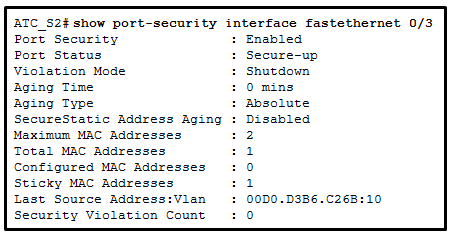
Explanation: Topic 11.1.6 – The Port Security line simply shows a state of Enabled if the switchport port-security command (with no options) has been entered for a particular switch port. If a port security violation had occurred, a different error message appears such as Secure-shutdown. The maximum number of MAC addresses supported is 50. The Maximum MAC Addresses line is used to show how many MAC addresses can be learned (2 in this case). The Sticky MAC Addresses line shows that only one device has been attached and learned automatically by the switch. This configuration could be used when a port is shared by two cubicle-sharing personnel who bring in separate laptops.
32. A network administrator of a college is configuring the WLAN user authentication process. Wireless users are required to enter username and password credentials that will be verified by a server. Which server would provide such service?
Explanation: Topic 13.3.2 – Remote Authentication Dial-In User Service (RADIUS) is a protocol and server software that provides user-based authentication for an organization. When a WLAN is configured to use a RADIUS server, users will enter username and password credentials that are verified by the RADIUS server before allowing to the WLAN.
33. A technician is troubleshooting a slow WLAN that consists of 802.11b and 802.11g devices. A new 802.11n/ac dual-band router has been deployed on the network to replace the old 802.11g router. What can the technician do to address the slow wireless speed?
Explanation: Topic 13.4.3 – Splitting the wireless traffic between the 802.11n 2.4 GHz band and the 5 GHz band will allow for the 802.11n to use the two bands as two separate wireless networks to help manage the traffic, thus improving wireless performance.
34. The company handbook states that employees cannot have microwave ovens in their offices. Instead, all employees must use the microwave ovens located in the employee cafeteria. What wireless security risk is the company trying to avoid?
Explanation: Topic 12.6.3 – Denial of service attacks can be the result of improperly configured devices which can disable the WLAN. Accidental interference from devices such as microwave ovens and cordless phones can impact both the security and performance of a WLAN. Man-in-the-middle attacks can allow an attacker to intercept data. Rogue access points can allow unauthorized users to access the wireless network.
35. What is the function provided by CAPWAP protocol in a corporate wireless network?
Explanation: Topic 12.4.2 – CAPWAP is an IEEE standard protocol that enables a WLC to manage multiple APs and WLANs. CAPWAP is also responsible for the encapsulation and forwarding of WLAN client traffic between an AP and a WLC.
36. Open the PT Activity. Perform the tasks in the activity instructions and then answer the question. Which event will take place if there is a port security violation on switch S1 interface Fa0/1?

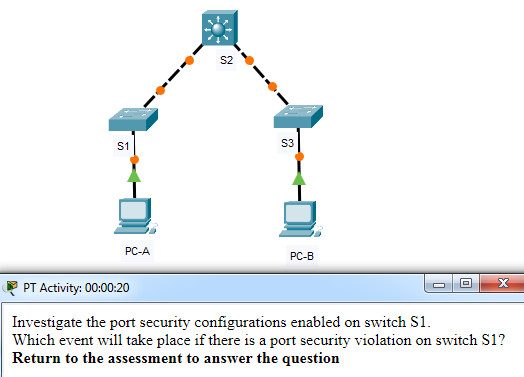
Explanation: Topic 11.1.6 – The violation mode can be viewed by issuing the show port-security interface
37. Match each functional component of AAA with its description.
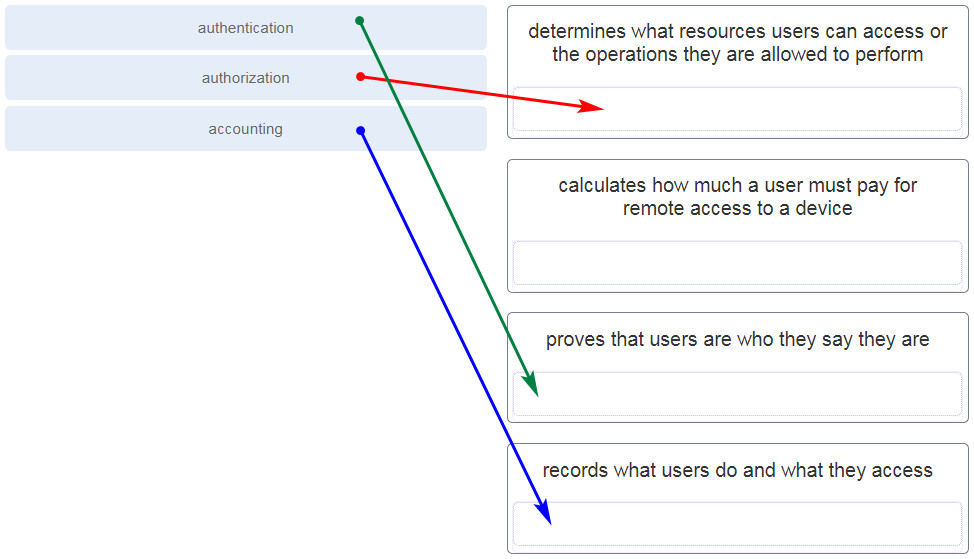
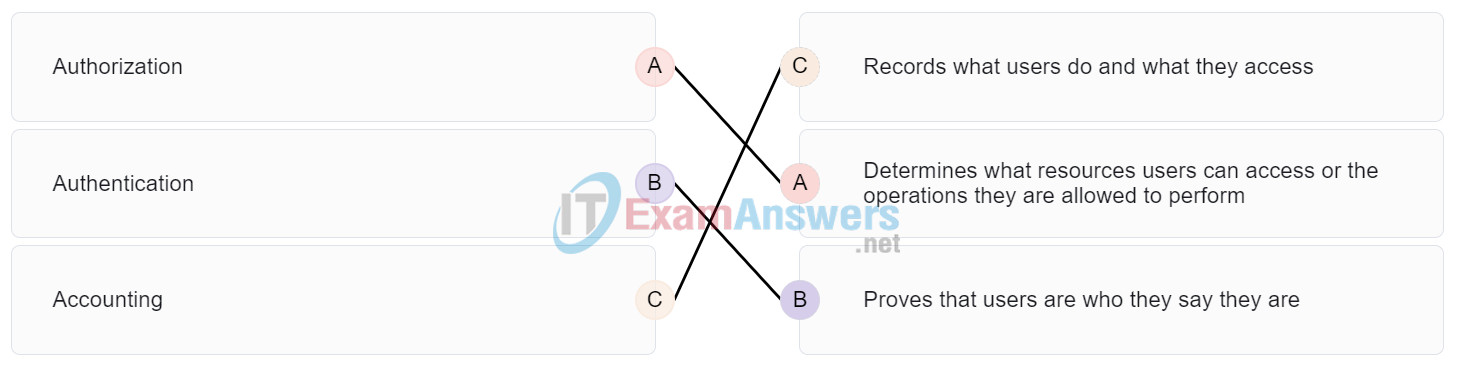
Explanation: Topic 10.2.2 – Authorization determines access, Authentication proves identity, Accounting records actions.
| Component | Description |
|---|---|
| Authorization | Determines what resources users can access or the operations they are allowed to perform |
| Authentication | Proves that users are who they say they are |
| Accounting | Records what users do and what they access |
38. What are two protocols that are used by AAA to authenticate users against a central database of usernames and password? (Choose two.)
Explanation: Topic 10.2.3 – By using TACACS+ or RADIUS, AAA can authenticate users from a database of usernames and passwords stored centrally on a server such as a Cisco ACS server.
39. What is the result of a DHCP starvation attack?
Explanation: Topic 10.5.5 – DCHP starvation attacks are launched by an attacker with the intent to create a DoS for DHCP clients. To accomplish this goal, the attacker uses a tool that sends many DHCPDISCOVER messages to lease the entire pool of available IP addresses, thus denying them to legitimate hosts.
40. Which feature or configuration on a switch makes it vulnerable to VLAN double-tagging attacks?
Explanation: Topic 10.5.3 – A double-tagging (or double-encapsulated) VLAN hopping attack takes advantage of the way that hardware on most switches operates. Most switches perform only one level of 802.1Q de-encapsulation, which allows an attacker to embed a hidden 802.1Q tag inside the frame. This tag allows the frame to be forwarded to a VLAN that the original 802.1Q tag did not specify. An important characteristic of the double-encapsulated VLAN hopping attack is that it works even if trunk ports are disabled, because a host typically sends a frame on a segment that is not a trunk link. This type of attack is unidirectional and works only when the attacker is connected to a port residing in the same VLAN as the native VLAN of the trunk port.
41. Which component of AAA allows an administrator to track individuals who access network resources and any changes that are made to those resources?
Explanation: Topic 10.2.5 – One of the components in AAA is accounting. After a user is authenticated through AAA, AAA servers keep a detailed log of exactly what actions the authenticated user takes on the device.
42. Refer to the exhibit. PC1 and PC2 should be able to obtain IP address assignments from the DHCP server. How many ports among switches should be assigned as trusted ports as part of the DHCP snooping configuration?
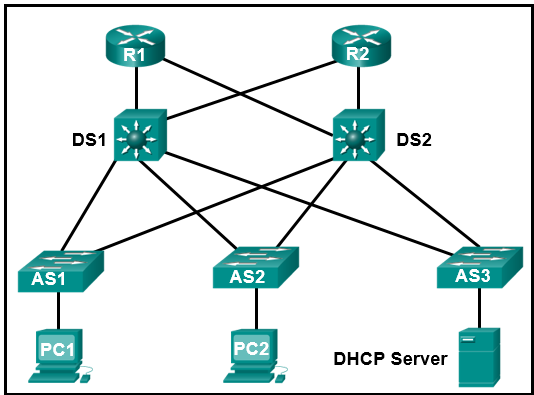
Explanation: Topic 11.3.2 – The DHCP snooping configuration includes building the DHCP Snooping Binding Database and assigning necessary trusted ports on switches. A trusted port points to the legitimate DHCP servers. In this network design, because the DHCP server is attached to AS3, seven switch ports should be assigned as trusted ports, one on AS3 toward the DHCP server, one on DS1 toward AS3, one on DS2 toward AS3, and two connections on both AS1 and AS2 (toward DS1 and DS2), for a total of seven.
43. An IT security specialist enables port security on a switch port of a Cisco switch. What is the default violation mode in use until the switch port is configured to use a different violation mode?
Explanation: Topic 11.1.6 – If no violation mode is specified when port security is enabled on a switch port, then the security violation mode defaults to shutdown.
44. A laptop cannot connect to a wireless access point. Which two troubleshooting steps should be taken first? (Choose two.)
Explanation: Topic 13.4.2 – A wireless laptop normally does not have an antenna attached unless a repair has recently been implemented. If the wireless NIC is enabled, the correct media, radio, will be used. When the NIC detects an access point, the correct frequency is automatically used.
45. What is an advantage of SSID cloaking?
Explanation: Topic 12.7.2 – SSID cloaking is a weak security feature that is performed by APs and some wireless routers by allowing the SSID beacon frame to be disabled. Although clients have to manually identify the SSID to be connected to the network, the SSID can be easily discovered. The best way to secure a wireless network is to use authentication and encryption systems. SSID cloaking does not provide free Internet access in public locations, but an open system authentication could be used in that situation.
46. What is a wireless security mode that requires a RADIUS server to authenticate wireless users?
Explanation: Topic 12.7.5 – WPA and WPA2 come in two types: personal and enterprise. Personal is used in home and small office networks. Shared key allows three different authentication techniques: (1) WEP, (2) WPA, and (3) 802.11i/WPA2. WEP is an encryption method.
47. A company has recently implemented an 802.11n wireless network. Some users are complaining that the wireless network is too slow. Which solution is the best method to enhance the performance of the wireless network?
Explanation: Topic 13.4.3 – Because some users are complaining about the network being too slow, the correct option would be to split the traffic so that there are two networks using different frequencies at the same time. Replacing the wireless NICs will not necessarily correct the network being slow and it could be expensive for the company. DHCP versus static addressing should have no impact of the network being slow and it would be a huge task to have all users assigned static addressing for their wireless connection. Upgrading the firmware on the wireless access point is always a good idea. However, if some of the users are experiencing a slow network connection, it is likely that this would not substantially improve network performance.
48. Which protocol can be used to monitor the network?
Explanation: Topic 13.3.2 – SNMP is used for network monitoring.
49. A network administrator deploys a wireless router in a small law firm. Employee laptops join the WLAN and receive IP addresses in the 10.0.10.0/24 network. Which service is used on the wireless router to allow the employee laptops to access the internet?
Explanation: Topic 13.1.7 – Any address with the 10 in the first octet is a private IPv4 address and cannot be routed on the internet. The wireless router will use a service called Network Address Translation (NAT) to convert private IPv4 addresses to internet-routable IPv4 addresses for wireless devices to gain access to the internet.
50. Which service can be used on a wireless router to prioritize network traffic among different types of applications so that voice and video data are prioritized over email and web data?
Explanation: Topic 13.1.8 – Many wireless routers have an option for configuring quality of service (QoS). By configuring QoS, certain time-sensitive traffic types, such as voice and video, are prioritized over traffic that is not as time-sensitive, such as email and web browsing.
51. Which access control component, implementation, or protocol is based on device roles of supplicant, authenticator, and authentication server?
Explanation: Topic 10.2.6 – 802.1X defines these three roles.
52. Which type of wireless network is suitable for national and global communications?
Explanation: Topic 12.1.2 – WWAN covers national and global areas.
53. Which feature on a switch makes it vulnerable to VLAN hopping attacks?
Explanation: Topic 10.5.2 – A VLAN hopping attack enables traffic from one VLAN to be seen by another VLAN without routing. In a basic VLAN hopping attack, the attacker takes advantage of the automatic trunking port feature enabled by default on most switch ports.
54. Which component of AAA is used to determine which resources a user can access and which operations the user is allowed to perform?
Explanation: Topic 10.2.4 – One of the components in AAA is authorization. After a user is authenticated through AAA, authorization services determine which resources the user can access and which operations the user is allowed to perform.
55. Refer to the exhibit. The Fa0/2 interface on switch S1 has been configured with the switchport port-security mac-address 0023.189d.6456 command and a workstation has been connected. What could be the reason that the Fa0/2 interface is shutdown?
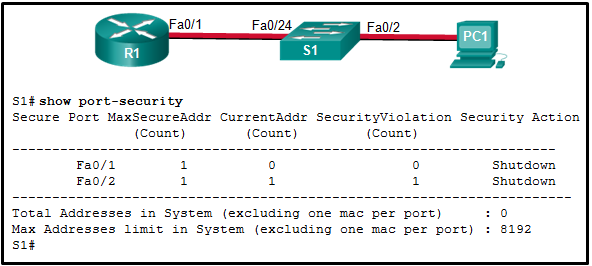
Explanation: Topic 11.1.6 – The security violation counter for Fa0/2 has been incremented (evidenced by the 1 in the SecurityViolation column). The most secure addresses allowed on port Fa0/2 is 1 and that address was manually entered. Therefore, PC1 must have a different MAC address than the one configured for port Fa0/2. Connections between end devices and the switch, as well as connections between a router and a switch, are made with a straight-through cable.
56. A network administrator enters the following commands on the switch SW1.
SW1(config)# interface range fa0/5 - 10
SW1(config-if)# ip dhcp snooping limit rate 6
What is the effect after these commands are entered?
Explanation: Topic 11.3.3 – When DHCP snooping is being configured, the number of DHCP discovery messages that untrusted ports can receive per second should be rate-limited by using the ip dhcp snooping limit rate interface configuration command. When a port receives more messages than the rate allows, the extra messages will be dropped.
57. A network administrator is configuring port security on a Cisco switch. The company security policy specifies that when a violation occurs, packets with unknown source addresses should be dropped and no notification should be sent. Which violation mode should be configured on the interfaces?
Explanation: Topic 11.1.6 – On a Cisco switch, an interface can be configured for one of three violation modes, specifying the action to be taken if a violation occurs:Protect – Packets with unknown source addresses are dropped until a sufficient number of secure MAC addresses are removed, or the number of maximum allowable addresses is increased. There is no notification that a security violation has occurred. Restrict – Packets with unknown source addresses are dropped until a sufficient number of secure MAC addresses are removed, or the number of maximum allowable addresses is increased. In this mode, there is a notification that a security violation has occurred. Shutdown – The interface immediately becomes error-disabled and the port LED is turned off.
58. A network administrator is working to improve WLAN performance on a dual-band wireless router. What is a simple way to achieve a split-the-traffic result?
Explanation: Topic 13.4.3 – By default, dual-band routers and APs use the same network name on both the 2.4 GHz band and the 5 GHz band. The simplest way to segment traffic is to rename one of the wireless networks.
59. Which access control component, implementation, or protocol controls what users can do on the network?
Explanation: Topic 10.2.4 – Authorization controls user actions.
60. Which type of wireless network is suitable for providing wireless access to a city or district?
Explanation: Topic 12.1.2 – WMAN covers a city or district.
61. On a Cisco 3504 WLC Summary page ( Advanced > Summary ), which tab allows a network administrator to access and configure a WLAN for a specific security option such as WPA2?
Explanation: Topic 13.2.6 – The WLANs tab in the Cisco 3504 WLC advanced Summary page allows a user to access the configuration of WLANs including security, QoS, and policy-mapping.
62. What type of wireless antenna is best suited for providing coverage in large open spaces, such as hallways or large conference rooms?
Explanation: Topic 12.2.6 – Omnidirectional antennas send the radio signals in a 360 degree pattern around the antenna. This provides coverage to devices situated anywhere around the access point. Dishes, directional, and Yagi antennas focus the radio signals in a single direction, making them less suitable for covering large, open areas.
64. What security benefit is gained from enabling BPDU guard on PortFast enabled interfaces?
Explanation: Topic 11.5.1 – BPDU guard immediately error-disables a port that receives a BPDU. This prevents rogue switches from being added to the network. BPDU guard should only be applied to all end-user ports.
65. Which access control component, implementation, or protocol logs EXEC and configuration commands configured by a user?
Explanation: Topic 10.2.5 – Accounting logs user commands and actions.
66. Which type of wireless network uses transmitters to provide coverage over an extensive geographic area?
Explanation: Topic 12.1.2 – WWAN covers extensive geographic areas.
67. Which access control component, implementation, or protocol controls who is permitted to access a network?
Explanation: Topic 10.2.2 – Authentication verifies identity to permit access.
68. What two IEEE 802.11 wireless standards operate only in the 5 GHz range? (Choose two.)
Explanation: Topic 12.1.4 – BPDU guard immediately error-disables a port that receives a BPDU. This prevents rogue switches from being added to the network. BPDU guard should only be applied to all end-user ports.
69. Which type of wireless network uses low powered transmitters for a short-range network, usually 20 to 30 ft. (6 to 9 meters)?
Explanation: Topic 12.1.2 – WPAN covers short ranges like Bluetooth.
70. Which wireless network topology would be used by network engineers to provide a wireless network for an entire college building?
Explanation: Topic 12.3.2 – Ad hoc mode (also known as independent basic service set or IBSS) is used in a peer-to-peer wireless network such as when Bluetooth is used. A variation of the ad hoc topology exists when a smart phone or tablet with cellular data access is enabled to create a personal wireless hotspot. Mixed mode allows older wireless NICs to attach to an access point that can use a newer wireless standard.
71. Which type of wireless network uses transmitters to provide wireless service over a large urban region?
Explanation: Topic 12.1.2 – WMAN covers a large urban region.
72. Which type of wireless network is suitable for use in a home or office?
Explanation: Topic 12.1.1 – WLANs are suitable for home/office.
73. Which access control component, implementation, or protocol indicates success or failure of a client-requested service with a PASS or FAIL message?
Explanation: Topic 10.2.4 – Authorization returns PASS/FAIL for services.
74. Which type of wireless network often makes use of devices mounted on buildings?
Explanation: Topic 12.1.2 – WMAN often uses building-mounted devices.
75. A network administrator is configuring DAI on a switch with the command ip arp inspection validate src-mac. What is the purpose of this configuration command?
Explanation: Topic 11.4.3 – DAI can be configured to check for both destination or source MAC and IP addresses:
Destination MAC – Checks the destination MAC address in the Ethernet header against the target MAC address in the ARP body.
Source MAC – Checks the source MAC address in the Ethernet header against the sender MAC address in the ARP body.
IP address – Checks the ARP body for invalid and unexpected IP addresses including addresses 0.0.0.0, 255.255.255.255, and all IP multicast addresses.
76. Which access control component, implementation, or protocol collects and reports usage data?
Explanation: Topic 10.2.5 – Accounting collects usage data.
77. Which type of wireless network uses transmitters to cover a medium-sized network, usually up to 300 feet (91.4 meters)?
Explanation: Topic 12.1.2 – Wireless local-area network (WLAN) – Uses transmitters to cover a medium-sized network, usually up to 300 feet. WLANs are suitable for use in a home, office, and even a campus environment. WLANs are based on the 802.11 standard and a 2.4-GHz or 5-GHz radio frequency.
78. Which access control component, implementation, or protocol audits what users actions are performed on the network?
Explanation: Topic 10.2.5 – The final plank in the AAA framework is accounting, which measures the resources a user consumes during access. This can include the amount of system time or the amount of data a user has sent and/or received during a session. Accounting is carried out by logging of session statistics and usage information and is used for authorization control, billing, trend analysis, resource utilization, and capacity planning activities.
79. Which type of wireless network commonly uses Bluetooth or ZigBee devices?
Explanation: Topic 12.1.2 – WPAN uses Bluetooth and ZigBee.
80. Which access control component, implementation, or protocol is implemented either locally or as a server-based solution?
Explanation: Topic 10.2.3 – Authentication can be local or server-based.
81. A technician is troubleshooting a slow WLAN and decides to use the split-the-traffic approach. Which two parameters would have to be configured to do this? (Choose two.)
Explanation: Topic 13.4.3 – Split traffic by assigning different bands for different traffic types.
82. Which access control component, implementation, or protocol restricts LAN access through publicly accessible switch ports?
Explanation: Topic 10.2.6 – 802.1X restricts LAN access on switch ports.
🚀 Ace Your CCNA Exam - Complete Study Pack!
Get 500+ exam-realistic questions, Packet Tracer labs, and detailed explanations.
Understanding L2 Security and WLANs (Modules 10-13)
Passing the CCNA 2 v7 Modules 10-13 exam requires a solid grasp of Layer 2 security threats and mitigation, AAA, and wireless LAN concepts. These modules cover port security, DHCP snooping, Dynamic ARP Inspection (DAI), VLAN security, 802.1X authentication, wireless standards, and WLAN configuration – essential knowledge for any network administrator.
Why Modules 10-13 Matter for Your Networking Career
Modules 10-13 focus on securing the network at the data link layer and implementing wireless networks. You learn how to protect against MAC flooding, DHCP starvation, VLAN hopping, and ARP spoofing. You also configure port security, implement AAA, and deploy WLANs. Employers expect CCNA-certified professionals to understand LAN security best practices, wireless encryption, and AAA frameworks. Mastering these topics prepares you for network security roles and advanced wireless design.
Key Topics Covered in the Exam
Our verified answers address common exam questions on:
- Layer 2 Attacks: MAC flooding, DHCP starvation, VLAN hopping, ARP spoofing.
- Port Security: Sticky MAC, violation modes (protect, restrict, shutdown), maximum MAC addresses.
- DHCP Snooping: Trusted/untrusted ports, rate limiting, binding database.
- Dynamic ARP Inspection (DAI): Validate source/destination MAC and IP.
- AAA: Authentication, authorization, accounting; RADIUS and TACACS+.
- 802.1X: Supplicant, authenticator, authentication server.
- Wireless Standards: 802.11a/b/g/n/ac/ad, frequency bands, data rates.
- WLAN Security: SSID cloaking, WPA/WPA2 Personal and Enterprise, encryption.
- WLC Configuration: Cisco 3504 WLC, WLAN creation, RADIUS integration.
Many questions present a network topology and ask you to identify the correct mitigation technique or configuration command. Understanding the purpose of each security feature is critical for success.
Common Pitfalls to Avoid
Students often confuse protect and restrict violation modes – protect drops packets with no notification, while restrict drops packets and sends a notification. Another common mistake is mixing up DHCP snooping trusted and untrusted ports – trusted ports connect to legitimate DHCP servers, untrusted ports connect to clients. Also, remember that 802.1X involves three roles: supplicant (client), authenticator (switch), and authentication server (RADIUS).
When practicing with our answers, avoid memorizing letter choices (A, B, C, D). Cisco often reorders options. Focus on the concept behind each correct answer. For example, instead of remembering "option B is the correct violation mode", learn the difference between protect, restrict, and shutdown.
Study Strategies That Work
To retain this material long-term, combine our exam answers with hands-on practice. Use Packet Tracer to configure port security, DHCP snooping, DAI, and AAA on switches. Set up a WLAN with a WLC and RADIUS server. Test attacks and mitigation techniques in a lab environment. This practical approach cements the theory from Modules 10-13.
We also recommend creating flashcards for key terms: MAC flooding, DHCP starvation, VLAN hopping, ARP spoofing, sticky MAC, 802.1X, RADIUS, TACACS+, BPDU guard, and the four wireless security modes (WEP, WPA, WPA2, WPA3). Quiz yourself daily until you can define each term without hesitation.
How to Use This Answer Page Effectively
Our goal at CoursMooc.com is to provide accurate, up-to-date answers for the latest CCNA v7 curriculum. For each question, we include an explanation—not just the correct choice. Read those explanations carefully. If you find a concept unclear, refer to the official Cisco NetAcad course materials or our additional tutorials linked below.
We regularly update this page to match any changes in the exam. If you notice discrepancies, please let us know through the comments. Your feedback helps other learners succeed.
What's Next After Modules 10-13?
After mastering L2 security and WLANs, Modules 14-16 cover routing concepts and configuration (static and dynamic routing). The next checkpoint exam will test your routing knowledge. Each step builds on the fundamentals you solidify here. By completing all CCNA 2 v7 exams (Modules 1-4, 5-6, 7-9, 10-13, 14-16), you earn the official "Switching, Routing, and Wireless Essentials" badge – a stepping stone to the full CCNA certification.
Final Tips for Exam Day
Before starting the real exam:
- Get a good night's sleep – fatigue leads to misreading questions.
- Read each question twice. Some ask "Which two statements are correct?" – don't just pick one answer.
- Manage your time. You typically have 50-60 minutes for 40-50 questions. Skip difficult ones and return later.
- Look for keywords like "not", "except", or "only". One word changes the entire meaning.
- Trust your first instinct unless you find clear evidence you misread.
Remember: The CCNA v7 curriculum emphasizes practical troubleshooting. If you can explain why a port goes into error-disable or why a DHCP starvation attack succeeds, you're ready. Use our answers to verify your thinking, then reinforce with simulation tools. Good luck on your exam – and on your journey to networking expertise.